The great divergence between the world's two superpowers on climate policy continues. Chinese officials passed a major new environmental protection law on the last day of their annual policy meeting in Beijing.
Today's newsletter explains what's in the new legislation and what it means for Chinese climate policy going forward. Plus, a new, potentially strong El Niño is on the horizon and how AI is helping researchers answer key questions in climate science.
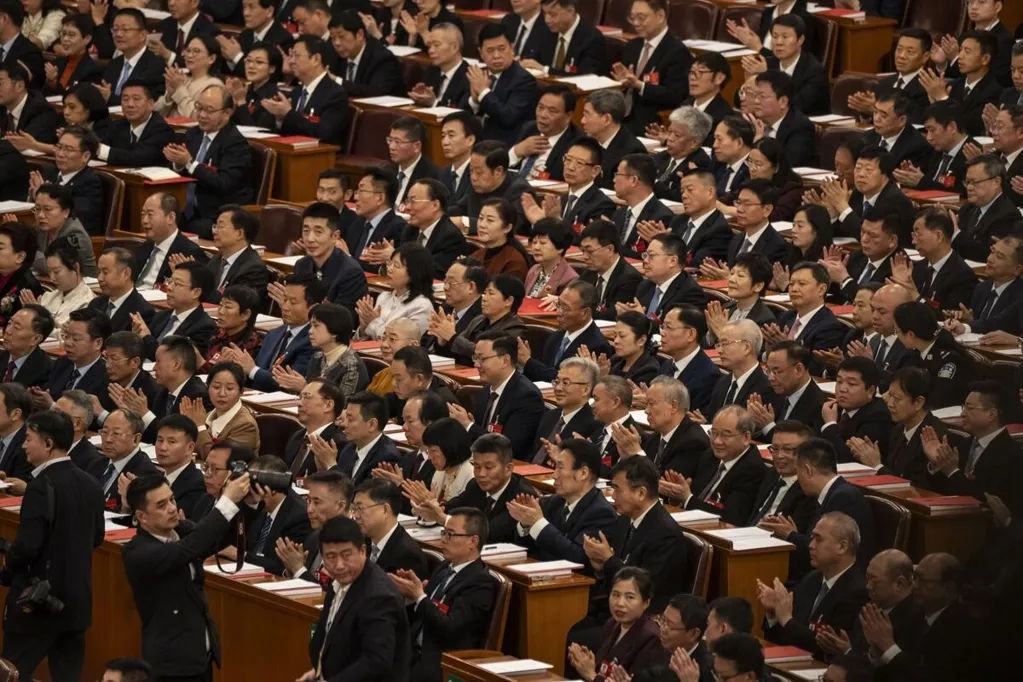
China's legislators approved a sweeping new environmental law that's seen as supporting President Xi Jinping's ambition to strengthen ecological and climate protections while also ensuring economic growth.
The Ecological and Environmental Code endorsed Thursday at the closing session of the once-a-year National People's Congress consolidates a raft of previous legislation, including on air quality, low-carbon development and penalties for corporate polluters.
Xi, a proponent of environmental protection for more than two decades, famously declared "lucid waters and lush mountains are invaluable assets," in a 2005 speech, and is continuing to demand improvements under China's latest Five-Year Plan through 2030.
The new law "demonstrates a kind of special attention and priority given to ecological and environmental protection," said Ma Jun, founder of the Institute of Public and Environmental Affairs, a Beijing-based nonprofit. "That's probably the most prominent point of it -- to demonstrate that strong support and political will."
Beyond serving as a political signal, the code was also created to address a problem: China has been prolific in writing environmental legislation in recent decades, but some of those directives overlap and conflict with each other. The revised package replaces 10 existing laws and covers everything from water and soil pollution to ecological conservation and species protection. Penalties for polluters are also largely left in place.
"You can't have one law stipulating things one way, and another law stipulating them another way -- it's difficult for a company to comply," said Wang Jin, a professor at Peking University Law School who provided suggestions to lawmakers in the drafting process. "Since 2015, China has been continuously revising its laws, and for environmental and resource laws in particular, the penalties and enforcement measures have gotten stricter."
Much-needed decline
0.3%
The amount that China's carbon emissions fell last year, according to an initial analysis by the Centre for Research on Energy and Clean Air. It would be the first dip to occur since the Covid-19 pandemic.
On to the hard stuff
"Easier gains have largely been captured. The focus increasingly shifts to more challenging areas."
Muyi Yang
Senior Asia energy analyst, Ember
At the same meeting, China set a cautious new five-year climate target, despite hopes for a tighter policy to reach peak emissions sooner.
AI 'scientists'
As temperatures in recent years broke historical records, Zeke Hausfather, a climate scientist with the research nonprofit Berkeley Earth, tried to find words to describe the heat, settling on "absolutely gobsmackingly bananas." He also sought new ways to visualize it. Hausfather created his own graphics, including a striking "tree ring plot," with the help of a brainstorming and coding assistant: ChatGPT.
"It's interesting, in part, because it's not what I would've expected AI to be good at," Hausfather said.
Like millions of other people, climate scientists are finding a role for large language models in coding, communication and other parts of their workflow. They're also pointing AI tools at central questions: How hot will it get, how rainy, how fast?
"AI is offering some pretty exciting opportunities to tackle questions we've been stuck on for a while," said Elizabeth Barnes, a Boston University professor who specializes in environmental data science. "But it is not a complete transformation of our science."
That's because traditional and AI climate research tools are likely to complement each other. Climate models are complex programs that simulate the physics of the Earth system with equations requiring more than a million lines of code. Scientists refer to them as physics-based models to distinguish them from AI and other models, which work without simulating physics. Climate models can project large-scale change that hasn't happened yet, but they have trouble resolving influential small-scale phenomena like cloud formation.
AI tools may be able to infer values for those things, but they can't yet "see" outside their training data -- for example, to extreme weather occurring on a scale outside the historical record. (There's initial evidence that they can transplant extreme weather from one part of the world to a region where it's never occurred.)
Weather watch
US forecasters say an El Niño is favored to emerge in the Pacific Ocean by September, threatening to drive global temperatures higher and disrupt crops in the months ahead.
Scientists at the US Climate Prediction Center project a 62% chance that an ocean-heating El Niño would emerge during the Northern Hemisphere's summer, with odds climbing higher into the fall. The phenomenon is poised to add extra warmth to a planet that's rapidly heating due to human-caused climate change.
El Niño's impact on global weather patterns tends to be far-reaching and can last a year or more. Wildfire risk often rises as drought develops across countries including Australia, Indonesia and South Africa, said Nat Johnson, a meteorologist for the National Oceanic and Atmospheric Administration. In the US, El Niño is associated with heavy rains in the Southeast and above-average temperatures in northern states.
Signals for an oncoming El Niño are "unusually strong," according to Johnson. But US forecasters are less certain about its intensity, noting conflicting results in underlying models.
Some scientists have predicted an unusually powerful El Niño, tied to greater warming in the pocket of the Pacific Ocean that produces the phenomenon and its cooling counterpart, La Niña. Current US government forecasts are more conservative, Johnson said, calling for a 1-in-3 chance of a strong event with starker global impacts by the end of 2026.
Cape Town and other areas of South Africa's Western Cape Province have seen record temperatures for March as a heat wave sears a region that's vulnerable to both drought and wildfires.
A landslide in Ethiopia's southern Gamo region after days of torrential rain led to the deaths of at least 65 people, according to a government agency.
This week's Zero
In the latest episode of Zero's Imagine series, Akshat Rathi is joined by Abi Daré, winner of the inaugural Climate Fiction Prize. Abi is the bestselling author of And So I Roar, which tells the story of the teenager Adunni as she confronts superstition, lack of education and the impacts of climate change on the rural communities of Nigeria. Abi joins Zero to talk about the role climate change plays in her storytelling and how she has seen Nigeria adopt climate solutions as it develops rapidly.
More from Green
The last time Los Angeles hosted the Olympic Games, in 1984, organizers came up with a plan to shuttle athletes and spectators around the sprawling metro on a special fleet of buses running express routes between venues. Improbably, this pop-up bus rapid transit system worked pretty well -- normally traffic-clogged freeways flowed freely.
For the 2028 Summer Games, a similar project is ramping up: LA Metro, the regional transit agency, plans to launch the "Games Enhanced Transit Service" -- a kind of parallel public transportation system. Organizers hope to field 1,747 extra buses, running routes connecting Olympic and Paralympic Games venues, in order to move an estimated 15 million visitors.
After a $1.45 billion makeover, East River Park promises to use massive sea walls and earthen berms to protect Lower Manhattan from flooding. But for how long?
The US Department of Homeland Security shutdown has thrust a long-awaited report on how to revamp the nation's top disaster agency into limbo, according to one of the report's authors.
Tropic Biosciences, a British gene-editing startup, has raised $105 million in new financing to expand production of bananas that don't brown.
The European Commission is considering relaxing carbon-permit supply rules and allowing more state aid as part of an emergency plan to cut spiking power prices, according to people familiar with the plans.