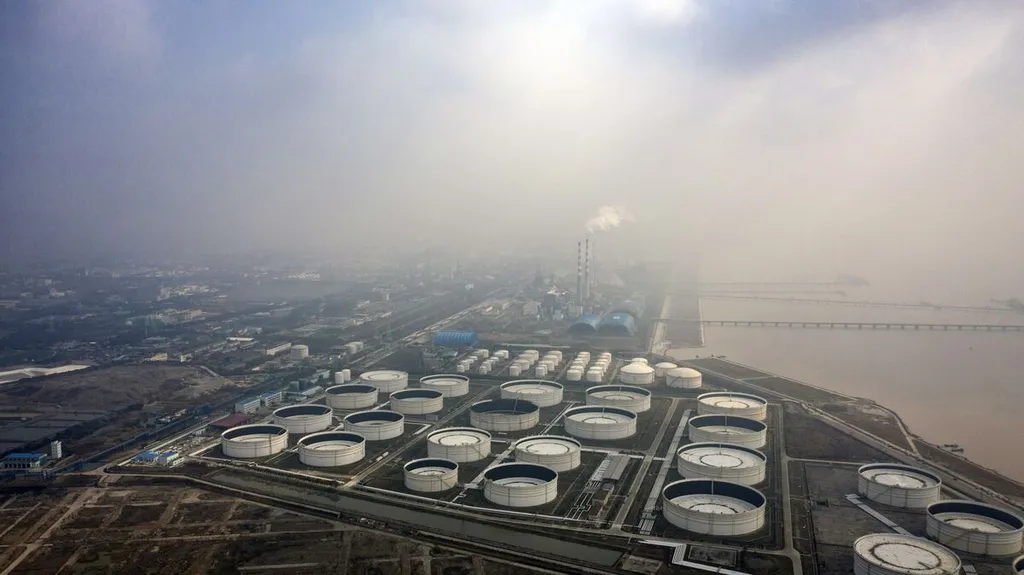
China has kept its massive crude stockpiles intact, despite a collapse in Middle Eastern flows due to the Iran war, with the much-maligned private refiners playing a pivotal role.
Overall crude inventories have dipped by less than 1 million barrels since the war began at the end of February, according to Energy Aspects, a fraction of the estimated 1 billion-barrel hoard which includes strategic stockpiles. That's even after Beijing recently gave state-run refiners approval to tap some commercial reserves to help cushion the blow from lost Persian Gulf supply.
Instead, they are cutting processing rates and selling some purchased cargoes, with the country's independent refiners -- known as teapots -- picking up the slack. Fed primarily by cheaper Iranian and Russian barrels, those smaller operators have been told by Beijing to keep fuel output high at all costs.
China's measures to suspend exports of diesel and gasoline in the early days of the war also provided a buffer to the fallout from the conflict, which has roiled global energy markets. There's been an Asia-wide scramble for alternative oil sources, and Japan and South Korea have been forced to draw on their strategic storage for tens of millions of barrels to plug the gap.
"Without the teapots, it couldn't happen," said Erica Downs, a senior research scholar at Columbia University's Center on Global Energy Policy. "Since China isn't getting all of its pre-war volumes from Gulf producers, the Iranian barrels become even more important."
This month, China's purchases of Iranian crude are set to swell to a record of nearly 1.9 million barrels a day, according to preliminary figures from Kpler. Overall crude inventories in Shandong province -- home to most of the teapots -- are also near the highest level this year, Mysteel OilChem data shows. Beijing recently granted the refiners additional import quotas.
The country's teapots have had a checkered past. They've faced criticism over their poor environmental records and resisted efforts by Beijing to consolidate the industry, but proved crucial for China's fuel security in the 2000s. They are once again playing a similar role as the war upends markets.
Teapots in Shandong have ramped up operating rates to the highest level in almost two years, according to data from OilChem. That comes as state-run refiners -- which typically don't take Iranian and Russian oil -- slash ratesBloomberg Terminal as a drop in Saudi and Iraqi supplies prompted global players to rush and bid up for alternative sources of crude, eroding margins.
The rising cost of crude has filtered through to Iranian barrels -- rising to a rare premium to benchmark Brent from a discount -- but they are still much cheaper than grades from non-sanctioned sources. About 160 million barrels of Iranian crude and condensate are currently loaded onto tankers and sailing, according to data-intelligence firm Vortexa.
China's gasoline stockpiles dipped around mid-March, but then spiked earlier this month, putting them at the highest level in more than two years, according to data from OilChem. Diesel inventories followed a similar trend and are now at the highest since July 2024, the figures show.
Still, teapots can only do so much. They account for a fifth of China's refining capacity and won't be able to cover lost fuel output from state processors if they keep cutting runs due to protracted disruptions from the war. A prolonged US blockade of the Strait of Hormuz and efforts by American forces to board vessels carrying Iranian crude could also dent flows from Tehran.
While that will cause headaches for Beijing, it still has an enviable buffer. China has amassed a mammoth inventory of commercial and strategic crude reserves over the years, with some estimating the hoard at more than 1 billion barrels.