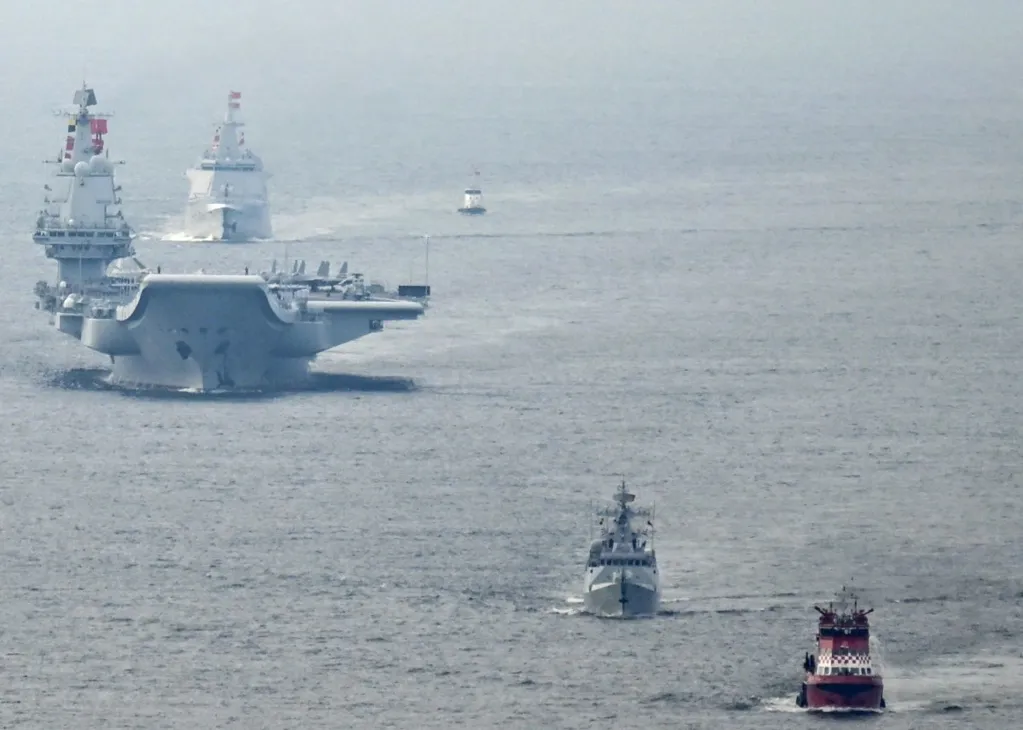
Japan's Defense Ministry told Newsweek that it continues monitoring major waterways around the archipelagic country amid reports of increased Chinese naval activities.
In an emailed statement on Friday, Japan's Defense Ministry said it monitors activities of vessels in the Osumi, Soya, Tsugaru and Tsushima straits bordering the country using naval ships and patrol aircraft for intelligence, surveillance and reconnaissance.
The Chinese Foreign Ministry did not immediately respond to a request for comment.
China, which aims to build a "world-class" military to challenge the United States, is undergoing naval modernization that has produced the world's largest maritime force by hull count, enabling Beijing to expand its military reach across the western Pacific through deployments that include dispatching aircraft carriers near Japan's islands.
Japan, a key U.S. ally in efforts to contain China's military threat under the First Island Chain strategy, often intercepts Chinese forces near its sovereign airspace and waters -- which generally extend 13.8 miles from the coast under an international treaty -- as they conduct operations east of the island chain running through Taiwan to the Philippines.
Citing data from Japan's Defense Ministry, The Asahi Shimbun reported that a total of 15 Chinese naval vessels were spotted transiting the Osumi Strait south of Kyushu -- one of Japan's four main islands and its southernmost -- in 2025, marking a record high.
The Osumi Strait is one of five specified maritime areas Japan has designated as international waterways, where the country's territorial waters are limited to between just 3.4 miles and under the standard 13.8 miles to maintain high seas corridors.
The other designated areas include the eastern and western channels of the Tsushima Strait between the Korean Peninsula and the Japanese archipelago, which connect the Sea of Japan -- also known as the East Sea in South Korea -- with the East China Sea.
The remaining two areas are located off Hokkaido, Japan's northernmost main island, including the Soya Strait -- also called the La Perouse Strait in Russia -- on the northern side, south of Russia's Sakhalin Island, and the Tsugaru Strait on the southern side.
In addition to the Osumi Strait, all three other straits have been regularly used by China, including a naval voyage between September and October 2025 that covered nearly all of Japan's territory, when three ships transited the Tsushima and Soya Straits.
Meanwhile, the Chinese coast guard has steadily extended its operating area beyond East Asia, deploying two vessels between September and October 2025 for a North Pacific fishery law enforcement patrol, during which they transited the Tsugaru Strait.
The 155-mile-wide Miyako Strait, located beyond Japan's territorial waters around Miyako and Okinawa in the southwestern islands, is arguably the gateway Chinese naval vessels and military aircraft use most frequently for western Pacific deployments.
These five straits around Japan serve as strategic chokepoints for the U.S. and China. Washington has called for a military buildup capable of denying aggression along the First Island Chain, while Beijing views the island line as its strategic center of gravity.
Japan's Defense Ministry told Newsweek: "[Japan's Defense Ministry]/[Self-Defense Forces] will vigilantly continue [intelligence, surveillance and reconnaissance] operations to resolutely defend Japan's territory, territorial waters, and airspace."
The U.S. national security strategy read: "America's diplomatic efforts should focus on pressing our First Island Chain allies and partners to allow the U.S. military greater access to their ports and other facilities, to spend more on their own defense, and most importantly to invest in capabilities aimed at deterring aggression."
Japan is expected to continue strengthening its defense posture near strategic waterways amid China's naval maneuvers, which have already included the deployment of anti-ship missiles on Okinawa Island.