Climate change is fuelling deadly disease outbreaks around the world, a new study has warned.
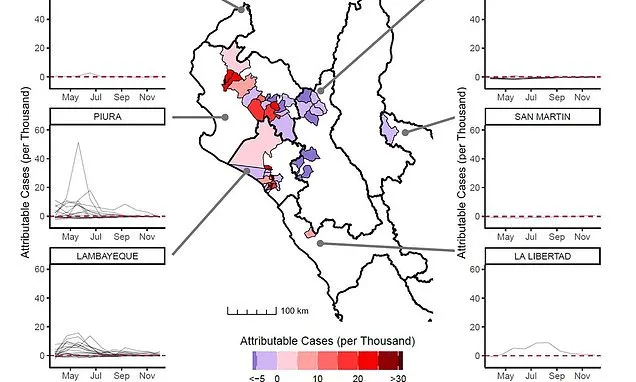
An international team of researchers traced the connection between a massive surge of dengue fever in Peru in 2023 and a cyclone which hit the region that year.
After the storm, normally dry regions were struck by an outbreak of cases 10 times larger than normal - and the experts say that climate change is to blame.
To work out how many cases were linked to the storm, the researchers simulated what would have happened without this extreme weather.
Their models revealed that 60 per cent of dengue fever cases in the hardest hit districts were caused by extreme rainfall and warm weather.
That is equivalent to an extra 22,000 people afflicted by this deadly disease.
'Health impacts of climate change aren't something we're waiting for, they're happening right now,' warned lead author Mallory Harris, a postdoctoral scholar at the University of Maryland.
Worryingly, the study comes shortly after research revealed that dengue fever is heading to Britain amid rising temperatures in the UK.
Dengue fever is a deadly disease which affects millions of people each year, according to the World Health Organisation.
This mosquito-borne disease can cause fever, rashes, and life-threatening conditions like haemorrhage and shock.
Cases have surged more than tenfold since 2000, and the disease is now beginning to show up in regions where it has been historically absent.
This includes a number of cases in the US, with a growing number of infections occurring in Texas, California, and Florida.
In their paper, published in the journal One Earth, the researchers pinpointed exactly how much a surge in extreme weather caused by climate change can spread the disease.
In March 2023, Peru was hit by a cyclone and a coastal El Niño weather pattern that brought extreme rain and heat to normally dry regions.
Heavy rain and flooding in low-lying areas knocked out water and sanitation infrastructure, creating the perfect breeding ground for Aedes aegypti and Aedes albopictus mosquitoes that spread dengue fever.
At the same time, warm weather 'turbocharged' the mosquitoes’ breeding cycles, meaning more people were being bitten and infected.
This led to massive spikes of dengue fever in warm regions, while cooler areas didn’t see outbreaks at all.
Using statistical analysis, the researchers calculated that more than half of all cases in the outbreak could be directly linked to the extreme rainfall and heat brought by the storm.
Senior author Dr Erin Mordecai, of Stamford University, says: 'While we often observe large dengue outbreaks following extreme weather events, this is the first time scientists have been able to pinpoint the role of climate change and precisely measure the impact of a particular storm on dengue.'
Critically, the researchers also show that climate change is making the weather that caused this outbreak more likely.
It has been extensively proven that the release of greenhouse gases into the atmosphere by human activity is warming the planet faster than any natural climate changes in Earth's history.
As the atmosphere becomes hotter, the air can hold more water and energy, which leads to a well-documented increase in extreme weather.
Climate change does not cause specific storms, heatwaves, or cyclones, but it does make exceptionally bad weather more likely and more extreme when it does occur.
Climate modellers analysed simulations which compared rainfall in March from 1965 to 2014 with the pre-industrial baseline.
This revealed that extreme rainfall like that which caused the 2023 dengue fever outbreak is now 31 per cent more likely in northwestern Peru than they were before industrialisation.
When combined with warming temperatures, the probability of weather conditions like those seen in 2023 has nearly tripled due to human-caused climate change.
Dr Harris adds: 'As extreme weather events become more frequent with climate change, we need to think strategically and act decisively to prevent mosquito-borne epidemics.'
This comes after scientists from the University of Montpellier warn that warming climate could mean dengue fever soon spreads to Britain.
The warming climate could turn Europe into the perfect habitat for the Asian tiger mosquito, the insect that spreads the disease.
Their models suggest that rising temperatures could spark outbreaks in cities including London, Vienna, Strasburg, and Frankfurt.
Most worryingly, the researchers say this could happen within just a few years.
Although the species is not in these cities yet, its rate or northward spread in France has been accelerating from about 6 km (3.7 miles) per year in 2006 to 20 km (12.4 miles) per year in 2024.
This suggests that the mosquito could thrive in northern France by 2035 - and could reach London shortly after.
What is dengue fever? The mosquito-borne infection being fuelled by climate change
Dengue is a viral infection spread by mosquitoes.
It is caught by people visiting or living in Asia, the Caribbean, and North, South or Central America.
Mosquitoes in the UK do not spread the virus.
In most cases, the infection is mild and passes in around a week.
Symptoms usually include:
- Fever
- Severe headache
- Pain behind the eyes
- Muscle and joint pain
- Nausea and vomiting
- Widespread rash
- Abdominal pain
- Loss of appetite
There is no cure or specific treatment.
Patients can relieve their symptoms via painkillers, staying hydrated and resting.
In rare cases, dengue symptoms can develop into severe dengue.
Elderly patients, or those with other medical conditions, are most at risk.
Severe dengue fever symptoms can include:
- Severe skin bleeding with spots of blood on and under the skin
- Blood in urine and stools
- Respiratory distress - when lungs cannot provide vital organs with enough oxygen
- Organ failure
- Changes in mental state and unconsciousness
- Dangerously low blood pressure
Severe dengue is usually treated via blood and platelet transfusion, IV fluids for rehydration and oxygen therapy if levels are low.