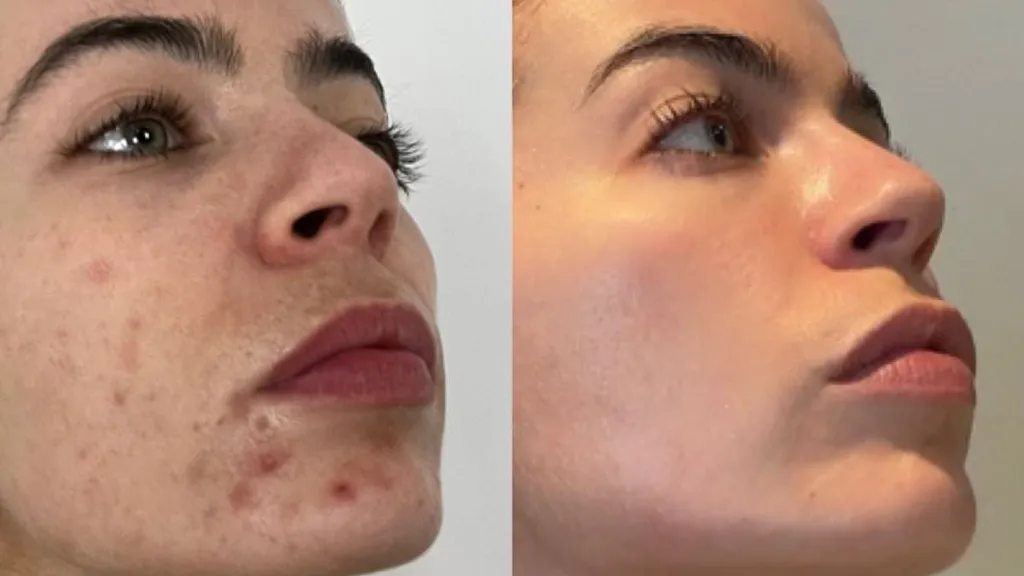
For decades, skin anxiety dominated my life - but the moment I knew that I'd had enough happened three years ago.
I was on holiday in Greece with my partner and one evening we went to dinner with another couple we'd met there. It was the most beautiful setting, but all I could think was: 'I hope this girl isn't looking at my skin.'
And that's the only thing I could focus on for the whole meal. I wasn't even listening to what people were saying. They must have thought that I was really rude as I hardly said a word.
I realised I needed help as my skin worries were starting to affect how people viewed me as a person.
My issues with spots started when I was a teenager. I was a horse-riding girl and wore a helmet a lot of the time which caused inflammation along my forehead. I tried a few cleansers for acne prone skin at the time, but nothing made a difference.
I remember a boy at school saying: 'Oh, you're so spotty.' That had a big impact on my confidence. After that, I always had a devil on my shoulder telling me I wasn't good enough.
In my late teens and 20s, hormonal acne on my chin became the problem. The worst thing for me was that it was unpredictable.
If I had a wedding or a party coming up, I'd become hyper-fixated on my skin, praying it would play ball. I'd be extremely self-conscious about it on the day which meant I couldn't live in the moment.
I'm naturally quite a bubbly, confident person but my skin troubles made me introverted. I'd avoid people if I was having a bad flare up just so that they wouldn't look at my face.
I'd have large sore spots on my cheeks and along my jawline, too. They were all gathered together and looked very red. I would cover my lower face or even sometimes my cheeks with my clothes. I'd wear a high-neck jumper or jacket and pull it up and hold it in place with my hands.
I felt so uncomfortable. I would either hide my skin or remove myself from the situation. I think it's similar to how people describe food noise as it was all I could think about. 'Skin noise' took over my life.
After my skin anxiety had ruined that holiday in Greece, I knew something had to change.
A friend had raved about the results she'd had with a skincare programme at CULTSKIN Lab. They offer long-term treatment plans with a focus on restoring skin health. I decided to give it a try (cultskin.com; subscriptions from £150/month).
I'd tried things in the past. I've seen a dermatologist before - he was a nice man and prescribed medication which helped in the short-term, but my skin issues returned and I didn't want to be on medication again. And I've used every lotion and potion out there over the years - I don't even want to know how much I've spent on them - but none of them solved the problem.
At my first consultation, Lucy, a senior medical advanced therapist, performed a skin analysis. She put my face into an Observ 520 digital skin scanner which analyses the condition of your skin and looks at any congestion or blocked pores, inflammation, hydration levels, barrier function and pigment irregularities.
She told me that my skin issues were due to a combination of congestion, inflammation and a compromised skin barrier (often caused by over-use of active skincare products) and we needed to reset the skin and rebuild barrier health, rather than stripping it back.
I signed up for the seven-month plan - I was happy to take a longer-term approach. After all, I had struggled with my skin for decades, what was a few months?
I wanted longevity and that takes time. I'm a personal trainer and it's the same thing I say to my own clients. My brand is called 'the rest of your life method' and I'm not giving a quick fix; I'm giving you something that you can take with you.
I felt CULTSKIN might actually work as you have to commit to monthly appointments, which felt sustainable but consistent.
We took things slowly and gently. Lucy started with a Hydrafacial, which uses a special device that deeply cleanses, exfoliates and hydrates the skin and offers painless extraction of clogged pores. It helps to stabilise the skin before introducing stronger treatments, Lucy explains, so it’s a great first step in an acne or skin-reset programme.
In later sessions, Lucy carried out a Hydrafacial before a gentle acid peel, which helps to decongest pores and infuse peptides and antioxidants into the skin. She'd then finish with red and infrared LED therapy to help stimulate cell regeneration.
As my course progressed, it also included Innoaesthetics Sensitive Peel to improve cell turnover and help with acne-related congestion and microneedling sessions to support collagen production, improve skin texture and address any post-acne scarring. None of this was painful and it was all designed to treat the root causes of my acne while improving overall skin quality in a gradual, safe way.
It was at around the three-month mark that I started seeing results - fewer breakouts, smoother skin texture, a brighter complexion - and began to feel more confident about my skin.
I'm not saying my skin is perfect now, but I never dreamed it could be this good. I do still get the odd spot but it doesn't concern me or consume me like it used to and these days I know it's the odd one rather than one of ten - and it goes quickly.
I've stayed on as a client as I like having the safety net there. The skin is an organ and it's going to change all the time, so for me it's important to have a professional keep track of that.
The difference in my confidence has been huge. At a friend's wedding in Italy last year, I didn't know many people but I felt so beautiful - I would have dreaded something like that in the past. Now, I'm excited to go to events.
After years of heartache, I finally feel like I've taken charge of my skin. I'm not going to let it control me anymore.