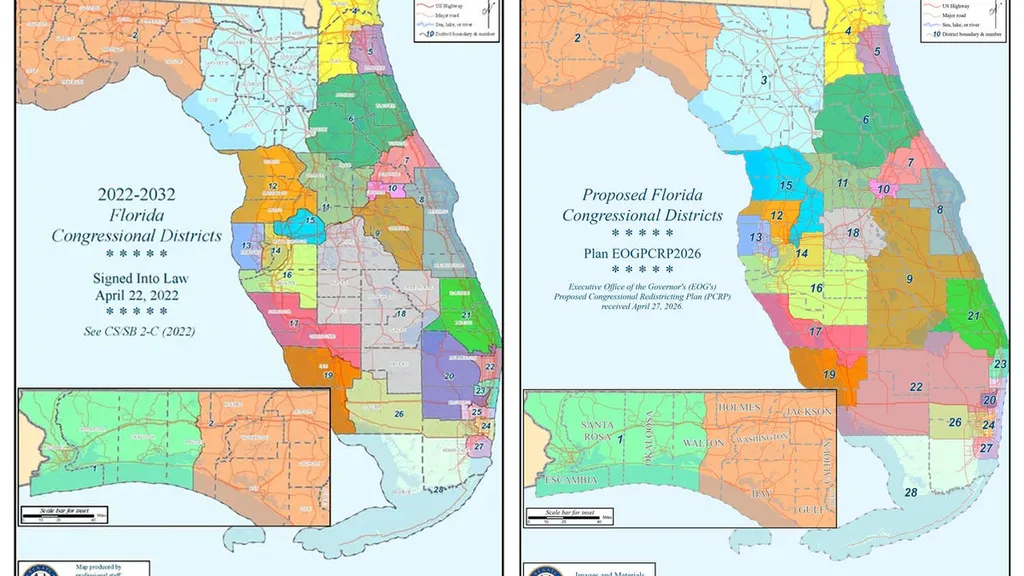
Florida new U.S. House map might put some Republicans at risk because some districts will have more Democratic voters.
The Republican redistricting push in Florida aimed at gaining U.S. House seats could backfire in some places because elimination or fracturing of Democratic districts could make as many as seven seats more competitive.
The stated goal of the new map introduced by GOP Gov. Ron DeSantis at the urging of President Donald Trump is for Republicans to pick up four House seats in the Nov. 4 election. That map, part of a national battle over the House majority, was approved last week by the GOP-controlled state Legislature and signed Monday by DeSantis.
"No more race-based gerrymandering. Florida's Congressional map is fair and represents our people," Lt. Gov. Jay Collins said on social media.
Most of the 20 House seats the Republicans currently control are overwhelmingly safe for the party, with an average advantage of plus-20 percentage points, according to an analysis by the nonprofit Civic Data and Research Institute. The new map could reduce that average overall advantage to just plus-8 percentage points.
The reason? When safe Democratic seats are eliminated, or cracked into parts, some of that party's voters and independents are corralled into GOP districts, making those more competitive.
"Aggressive redistricting creates the same number of Republican seats as doing nothing, but doubles the number of competitive seats from three to seven," said Alex Alvardo, executive director of the St. Augustine-based institute, known as CDRI.
State Republican Party chair Evan Power said DeSantis and lawmakers did the right thing by "providing for more responsive representation, reflecting Florida's growth, communities, and voter priorities."
But Power also added: "It may result in more Republicans elected to Congress. But that is ultimately decided by the people in elections."
Trump has been pushing for Republican-led states to impose new House maps in an effort to retain a narrow GOP majority despite historical evidence that the party in charge of the White House usually loses seats in midterm elections. In Trump's first term, Democrats won 40 House seats in the "blue wave" 2018 midterms to gain control of the chamber.
In addition, Democrats have rolled up multiple wins in governors' races and special elections around the country including Florida open House and Senate seats in which Republicans underperformed by up to 8%. One of those districts includes Trump's Mar-a-Lago home in Palm Beach.
Several Florida Democrats face decisions about where to run once their existing district is essentially dismantled under the new map. But U.S. Rep. Kathy Castor, the lone Democrat from Tampa Bay in the House delegation, insists she can still win her 14 District despite its new Republican edge.
Castor's seat went for Democratic Kamala Harris by 7.6% in the 2024 election but the new district would have voted for Trump that year by 10.5%, according to data analyst Matt Isbell.
Castor called the map "blatantly illegal" as a violation of Florida's Fair Districts rule voters put in the state constitution in 2010 to prohibit partisan gerrymandering. She is seeking re-election in the redrawn district.
"Governor DeSantis chose to give a political favor to Trump rather than protect Floridians' constitutional rights and their economic well-being," Castor said in a statement. She was first elected to the House in 2006.
U.S. Rep. Hakeem Jeffries of New York, the Democratic leader in the House, used the term "dummymander" to describe GOP efforts in Florida and elsewhere to gain seats even though their strength is diluted.
"The Republicans are dummymandering their way into the minority before a single vote is cast," Jeffries said at a recent news conference in Washington.
There are also legal challenges to the Florida map that could reverse it to the old one or require other changes. It will take weeks if not longer for the court action to play out.
Another factor in the national battle is the recent U.S. Supreme Court ruling on the Voting Rights Act that weakened protections for the creation of districts in which minorities can elect candidates of their choice.
Curt Anderson is the Policy and Politics Reporter for The USA TODAY NETWORK-FLORIDA.