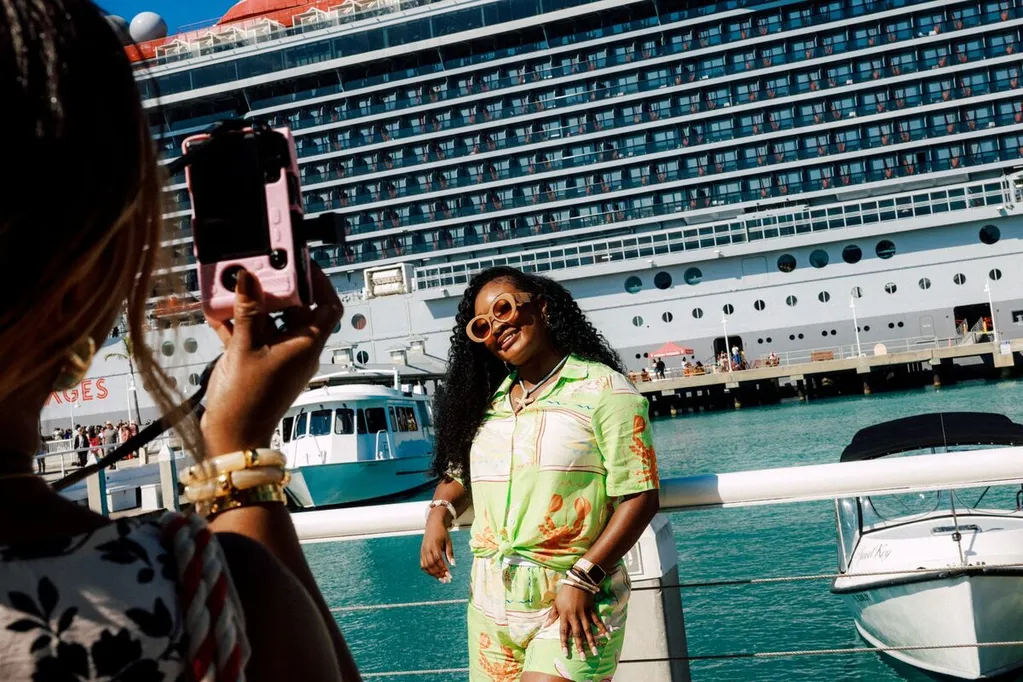
Business professor Melissa Newman once shied away from the term "influencer." It has become more palatable after social media posts sharing her love of travelling on cruise ships earned her $350,000 last year, quadrupling her regular salary.
Newman, 46, calls herself "Professor Newman" across her YouTube, Instagram, Facebook and TikTok accounts, where she has amassed almost half a million subscribers guiding fellow cruisers on everything from the five worst ports to how to avoid overpacking. The money comes in via affiliate links and advertising across her videos, blog and podcast, as well as services she offers as a travel agent.
"You can have 10 million followers, but if you're not monetizing it, you're just yapping on social media," said Newman, who takes 12 to 14 cruises a year and uses special offers and casino perks to travel rather than taking freebies from cruise companies.
She's one of a growing number of social media users -- call them influencers, call them content creators -- who are helping the industry shake off the image that its vacations are best suited to older travelers and those most interested in the all-inclusive drinks packages.
As cruise companies have bounced back after the devastating effects of the Covid-19 pandemic, when ships were quarantined for weeks at a time and most companies suspended operations, influencers have become a core part of their strategy to appeal to new customers. The equation is simple: Influencers can earn money while traveling, and the companies gain access to a demographic of followers who might never have considered cruising.
"What they're trying to do is break the mold of people's view of cruises in the past," said Melius Research analyst Conor Cunningham, who has a buy rating on the four cruise companies that he covers.
"I've been on a bunch of these ship launches and you can see that there are influencers all over the place," Cunningham said.
At Virgin Voyages, the adults-only cruise line backed by Bain Capital and Richard Branson's Virgin Group, the distinction between influencers and content creators is an important one. The company tried partnering with the former -- in its terms, celebrities who already have large followings -- but found that while a lot of people were seeing the posts, very few were acting on them and actually booking travel.
Targeting more niche creators who already had a following in the cruise world has been much more effective.
"No one is going to believe Kim Kardashian sails on Virgin Voyages given her lifestyle," Virgin Voyages' chief brand and marketing officer Nathan Rosenberg said in an interview.
Instead, content creators "tell the story in a way that's authentic to their audiences, which means it generally tends to make behavioral changes," he said. "The view count is irrelevant. The action and engagement count and the conversations -- that's where you see actual change."
Alex Ojeda, 24, started posting videos in 2018 when he was still a teenager, but it wasn't until after the pandemic that he found his niche in adventurous travel -- specifically waterslides.
His popularity led to a contract with Royal Caribbean Cruises Ltd. to produce videos showcasing the latest thrill rides across its fleet of cruise ships. He has also made posts advertising new cruise destinations for the company. In one video, Ojeda rides multiple waterslides on the massive Star of the Seas ship alongside Michael Bayley, the chief executive officer of the Royal Caribbean International brand, who Ojeda refers to as his "best friend."
Ojeda said Royal Caribbean has also consulted him on water attractions it's developing -- including at a new private cruise stop in Mexico -- to make sure they were exciting enough.
"We went through and dissected like every single slide and we just made tweaks," Ojeda said. When companies market new attractions as the "longest, tallest, biggest, that's all great," he said, "but actually making it a great experience is kind of where I come in."
That also means considering how the rides appear on social media. In his conversations with brands, Ojeda said he always uses the same example -- a surf machine called the FlowRider. "You'll never see a kid at a water park riding the FlowRider with a boogie board without a mom at the bottom smiling and recording," he said. "She's going to record this and she’s going to post it on her Facebook."
Ojeda declined to share details of how much he earns for videos, but his follower count of 14 million across multiple platforms got him included on Forbes 30 Under 30 list for social media this year.
Royal Caribbean sees influencers as an effective way to connect with younger travelers, a spokesperson for the company said. While it partners with some content creators with big followings, it also looks for more mid-level creators in niche areas with good engagement.
On TikTok, videos tagged #cruise have been viewed 38.9 billion times, according to Exolyt, which tracks trends on the social media platform. Views increased 14% in the month through March 23 -- toward the end of the typical cruise discounting season -- from the prior month.
Caribbean Market
Since the start of 2023, Royal Caribbean and Carnival Corp. have each more than doubled their market value, though rising oil prices stoked by the US-Israel war against Iran have weighed on the shares in recent weeks. Norwegian Cruise Line Holdings Ltd. has lagged slightly, but still climbed about 70% over the same period. More than 40 million passengers are forecast to sail in 2027, up from 29.7 million in 2019, according to the Cruise Lines International Association, an industry trade organization.
Much of that success has come in the Caribbean market, where customers are drawn to three- and four-day trips that leave from major US ports like Miami and Fort Lauderdale, Florida. In 2024, nearly 15 million people cruised in the Caribbean, more than the next five markets combined and up 17.1% from the previous year, CLIA data show. It's an easy, low-commitment option for people wanting to try out cruising.
Jason Liberty, the CEO of the Royal Caribbean parent company, has said that its Caribbean trips are "an important entry point for new-to-cruise" travelers and those who haven't booked with the company before, with the offerings particularly popular among younger customers. About half of Royal Caribbean's customers are either millennial or younger.
From 2019 to 2025, the price of a night in a Caribbean hotel jumped by more than three times that of an average cruise ticket, according to analysts at Truist Securities. The daily costs covered by a cruise package usually include the room, all-inclusive meals and some activities.
"Millennials and Gen Zs are definitely looking for affordable options," said Adrie Smith, a full-time content creator and travel agent with more than 600,000 followers across Instagram and TikTok. "They're looking for a quick time to get away."
Influencers are also a useful commodity for cruise liners entering new markets. Later this year, Virgin Voyages will run its first cruises to Alaska, a popular bucket-list destination that's often a much longer, more expensive trip to make. The company plans to allocate 50 to 60 cabins on the first two voyages for content creators. The aim is, essentially, to flood the zone.
"You have a bank of content because in the world of media you have to keep rolling through," said Rosenberg. "Its not a static thing any more because the algorithms can literally make you disappear."
And however many free rides a company gives to influencers, it still works out to be significantly less expensive than traditional media spending. Virgin Voyages said that during the cruise industry's main marketing season this year, its total spend on video production fell by 95% compared to previous years.
"It's a much cheaper way of actually creating content, versus doing a multi-million dollar Super Bowl spot," said Nirmal Saverimuttu,Virgin Voyages' CEO.
Cruise companies can also avoid discounting unsold rooms by upping marketing closer to departure dates, according to analyst Cunningham. The tactic appeals to younger people, who tend to book more last-minute trips. "They used to discount to fill," Melius' Cunningham said. "Now it's marketing to fill."