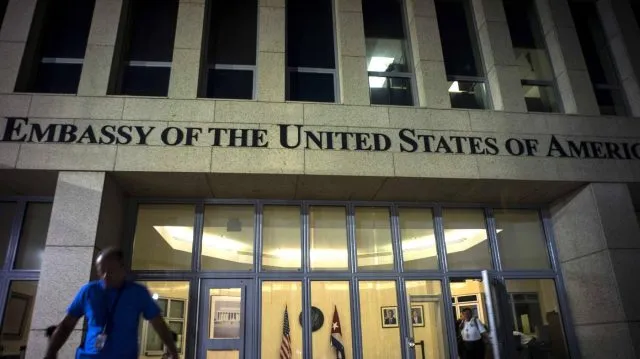
The Cuban government rejected a request from the U.S. Embassy in Havana to import diesel for its generators, as the island grapples with a fuel shortage due to a blockade imposed by the Trump administration earlier this year.
Citing diplomatic cables, The Washington Post reported the embassy warned the State Department on Wednesday that the denial could force nonessential staff to leave the Caribbean island in May or "possibly earlier."
The embassy sought permission to import two containers of fuel from the U.S., per the Post.
"The Ministry interprets as shameless the claim by the diplomatic mission to access a good as a privilege that it denies to the Cuban people," the Cuban Foreign Ministry reportedly said in its refusal, according to a State Department translation.
Cuba, which is heavily dependent on Venezuelan oil, has not received any shipments in the past three months as a result of a sustained U.S. embargo put in place in January following the military operation that ousted Venezuelan leader Nicolás Maduro. President Trump also threatened tariffs on countries that do business with Cuba.
The burgeoning crisis reached a tipping point when the island's electrical grid collapsed earlier this week, leaving nearly 11 million people in the dark for more than a day before power was partially restored.
Amid the island-wide blackout, Trump told reporters Monday that he believed he would have the "honor of taking Cuba."
"Whether I free it, take it, I think I can do anything I want with it," he said. "You want to know the truth? They're a very weakened nation now."
Gen. Francis Donovan, head of the U.S. Southern Command, testified during a Senate hearing later in the week that his command was not currently preparing for a military incursion, according to Reuters.
The Trump administration's economic pressure campaign has been centered around a push from U.S. officials, including Secretary of State Marco Rubio, for political reform inside Cuba.
U.S. officials are reportedly pushing for Cuban President Miguel Díaz-Canel to be removed from power during ongoing bilateral discussions regarding the island's future. Rubio has seemingly not ruled out relaxing the U.S. embargo in exchange for leadership change.
The Trump administration-imposed sanctions could be tested over the next several weeks, as two tankers carrying Russian oil are reportedly sailing for Cuba's shores.
The issue also comes as fuel prices rise globally following joint strikes on Iran launched by the U.S. and Israel late last month. In response, Tehran has largely closed off the Strait of Hormuz, a key passageway for vessels carrying oil in the Middle East.