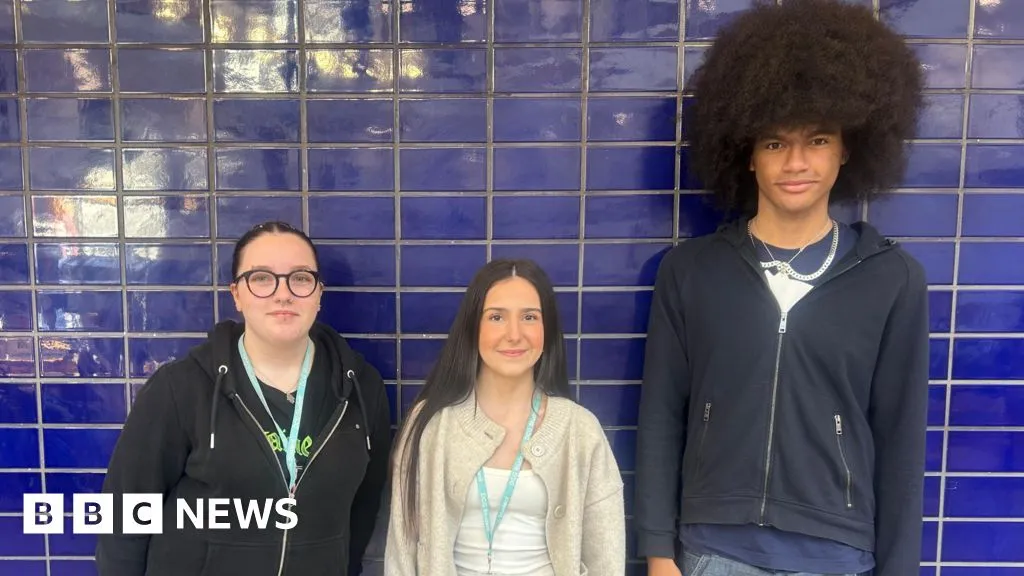
"People assume it is just helping around the house, but it's actually so much more emotionally challenging than that," says young carer Gabby Congui.
Gabby and fellow Derby College students Esme Neal and Dre Frazer, all 18 years old, are among an estimated 600,000 young adult carers aged 18 to 25 in the UK who support someone they know with illness, disability, mental health conditions or addiction.
The Carers Trust has said there is also about one million young carers who were 17 or under in the UK.
While their friends plan nights out and think about university and career choices, the young carers are now weighing those decisions against the worry of what happens if they leave home.
Esme said she was the primary carer for her mum, as her sister was at university.
She supports her mum with daily tasks, including housework, administering medication, and assisting with personal hygiene.
"It just kind of felt like the norm," said Esme.
"I didn't really think anything of it when I was younger because I just thought like I should be doing it, like you are meant to look after your parents."
Alongside support from her mum and sister, Gabby cares for her dad, who is blind, suffers with seizures, and has Functional Neurological Disorder, known as FND.
"He only became disabled about three years ago, so that was that massive adjustment in our lives," she said.
"I've not grown up with it, so I've kind of just had to like adapt and take on adult responsibilities.
"I've learned so much since I started doing it, that now I'm a lot more comfortable and confident."
After his parents split up, Dre said he was now the sole carer for his mum, who suffers with Fibromyalgia, which is a long-term condition that causes pain all over the body.
"I've had to step in mainly in the last two years because my parents split up. I'll just do whatever I can do," he said.
"I help her in and out the bath, and just day-to-day things, and just make sure she's all right and has someone to talk to.
"It's been a lot to go from having my dad there to be able to help do things. It's just me. I do the best I can to look after her."
All three young carers said they felt a sense of "guilt" when deciding whether to go out with friends or think about what life might look like if they go to university.
"If I was to move away right now, who would be there when my mum gets unwell", said Dre.
Gabby said she felt the same and often worried that if anything went wrong at home, she would be "responsible for all of it".
"When I was deciding about what uni to go to, I would have to go to one that's near home because I can't move away," she said.
"I think that's just part of me, the guilt and also knowing that the load would be a lot for my mum and my sisters."
Esme and Gabby believe many people still misunderstand what being a young carer actually involves.
"I feel like there's just one standard representation of being a carer," she said.
Esme believes the focus is often on personal hygiene, but she said it also involved "cleaning, food shopping, picking up prescriptions, going to doctor and hospital appointments."
Gabby is encouraging young carers to speak openly about their responsibilities.
"Make sure the people around you are aware of what's going on. This may be a part of your life, but it's not your whole life. You're more than just a carer."