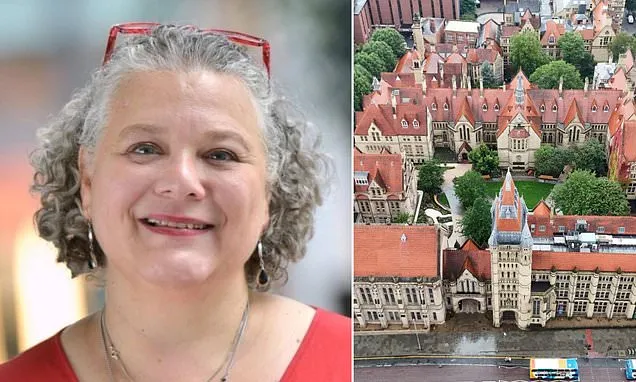
A university worker who had her career 'sabotaged' after misgendering a trans colleague has won a disability discrimination case.
Karenne Sylvester, 56, was found to have 'harassed' her transgender colleague following an investigation by the University of Manchester - because her short term memory issues meant she forgot the right pronouns, a tribunal heard.
Ms Sylvester 'persistently' used the wrong pronouns for a colleague who transitioned from a woman to a man and made them cry, it was said.
Ms Sylvester told how her dyspraxia gave 'short term memory problems', making it hard for her to use the approved terms following her colleague's transition.
She fought against the university's finding of harassment but was transferred to a different team, a move which she said 'sabotaged' her career.
Ms Sylvester has now successfully sued the university for disability discrimination.
An employment tribunal ruled managers investigating the harassment claim against her 'ignored' that her disability was likely why she misgendered her workmate.
The tribunal, held in Manchester, heard Ms Sylvester had been employed as a Learning Technologist for the university since December 2018.
Karenne Sylvester, 56, was found to have 'harassed' a transgender colleague following an investigation by the University of Manchester - but has now been cleared by a tribunal
On her disability, it was told: 'Dyspraxia is usually associated with problems with physical coordination but has much broader and complex characteristics.
'It is a condition that affects the way that the brain processes and transmits information and it is a lifelong condition.
'[Ms Sylvester] received a diagnosis of dyspraxia when she was aged 42 in November 2011, at a point when she was a student at the University.'
Ms Sylvester's transgender colleague was referred to by the tribunal only as CD, someone who transitioned from a woman to a man at some point in 2021 or 2022.
Ms Sylvester met CD in the summer of 2022 and by the autumn of that year she knew the colleague had transitioned.
On the misgendering incident which took place in February 2023, the tribunal was told: '[Ms Sylvester] used the incorrect pronoun for CD. CD corrected [Ms Sylvester].
'[Ms Sylvester] apologised to CD, making a comment suggesting she would probably misgender CD in the future and was apologising for future occasions as well.
'[Colleague] Rebecca Oldfield made it clear that [Ms Sylvester] should not misgender CD at all in the future. Everyone went back to working. CD was later found crying.
The tribunal, held in Manchester, heard Ms Sylvester had been employed as a Learning Technologist for the university (pictured) since December 2018
'[Ms Sylvester] tried to speak to CD later, but he did not want to speak to her.'
Following the incident, Ms Sylvester was told that she could not have any 'physical interaction with the rest of her team, who all worked in the shared open plan workspace along with 40 or so other staff'.
She had to book a back room on the same floor when she worked on the university's campus, to make sure that she 'did not risk coming into contact with CD'.
In a meeting about the incident in March, Ms Sylvester told investigators from the Faculty of Humanities, Stuart Phillipson and Martin Banks, that 'her dyspraxia made it more difficult for her to gender CD correctly'.
E-learning manager Mr Phillipson and lead people partner Mr Banks found she had 'persistently used the incorrect pronoun over a period of time' and had 'unlawfully harassed CD'.
Ms Sylvester appealed against this finding and the appeal hearing was held in September 2023 - before ruling again that she had harassed CD.
She was transferred to a different team in September 2024 - a move she described as having 'sabotaged' her 'career and academic intentions'.
Ms Sylvester had intended to do a PhD by Publication, but now 'no longer has access to the relevant academics who could support this activity'.
She was told in October 2024 that she would not face disciplinary proceedings for the harassment of CD.
The tribunal found the appeal panel carried out some 'sloppy work' and failed to do some 'basic due diligence'.
Employment Judge Zoe Thompson said: 'Having weighed all the evidence, we find that on balance the reason why [Ms Sylvester] had used the incorrect pronoun on this and previous occasions was because of her dyspraxia.
'Her dyspraxia affected her short-term memory, meaning it took longer for her to consistently adopt the correct pronouns compared to a neurotypical person.'
The judge said that investigators found Ms Sylvester had harassed her colleague because of a situation arising from her disability, and they were 'personally liable' for her discrimination claims.
Judge Thompson added: 'We find that [Mr Phillipson and Mr Banks] were aware that [MsSylvester] was raising her dyspraxia as the likely reason why she misgendered CD and they chose to ignore that.
'We find that they did not conduct a fair or impartial investigation and then provided incorrect information to the appeal panel.'
Ms Sylvester's other claims were unsuccessful.
The amount of compensation she receives will be decided at a later date.