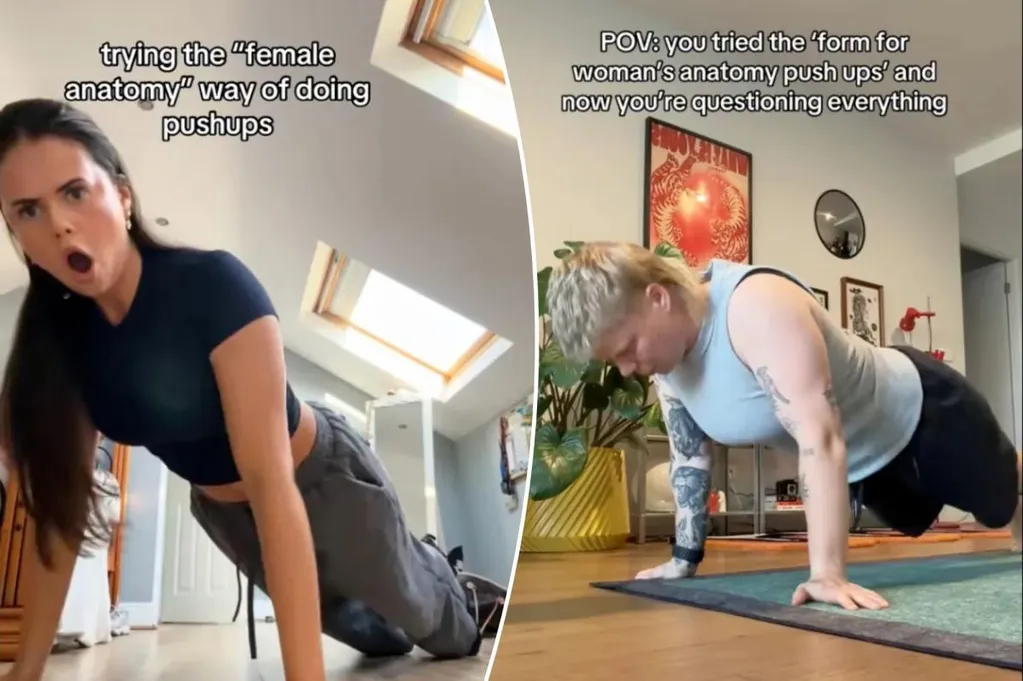
The latest viral fitness trend gives a whole new meaning to "girl push-ups."
Across TikTok, ladies are dropping down for a set and popping back up stunned, finding that a small tweak to their form suddenly makes the move easier, more comfortable -- and, for some, possible for the first time.
"POV: You tried the 'form for women's anatomy push-ups' and suddenly now you're questioning everything," wrote another.
But not everyone is sold on the so-called breakthrough.
So is this a game-changing hack for women -- or just another overhyped internet fitness fad? The Post asked two longtime coaches to weigh in.
"Traditional push-up form generally includes hands placed slightly wider than shoulder-width, wrists stacked under the shoulders, a straight line from head to heels and elbows tracking about 30 to 45 degrees from the torso, with the arms forming a slight arrow shape," Haley Wall, senior manager of fitness at Orangetheory Fitness, told The Post.
"This setup typically creates a slight chest or pectoral emphasis."
Influencers hyping the new approach argue that this standard form was developed with men in mind -- but Hayley Akradi, a certified personal trainer at Life Time Fitness, said it's not that straightforward.
"I wouldn't say it was intentionally designed for men, but most traditional strength standards have historically been demonstrated on male bodies," she explained. "So naturally, that's influenced how things have been taught."
To tailor push-ups for female anatomy, fitness influencers suggest placing the hands slightly wider than shoulder-width and rotating them outward about 45 degrees, instead of pointing them straight ahead.
They say this adjustment accommodates women's naturally greater "carrying angle," which can reduce wrist strain, improve stability and make the exercise feel easier.
"What's happening here is people on the internet are finally calling out something we see in real life all the time," Akradi said.
"Some people, especially women, don't feel great in a super tucked push-up position," she continued. "The mistake is turning that into a blanket rule instead of understanding why."
"The carrying angle refers to the natural angle formed at the elbow when the arms are extended at the sides with the palms facing forward," Wall said.
Because of how the upper arm and forearm meet at the elbow joint, most people's forearms angle slightly outward rather than hanging perfectly straight.
"This is a normal anatomical feature that allows the arms to swing freely without contacting the hips while walking," Wall said.
"On average, women do tend to have a slightly greater carrying angle than men," Akradi said. "That's tied to overall skeletal structure."
Still, both experts stressed that individual differences matter more than sex.
"There is significant overlap from person to person," Wall said. "Carrying angle exists on a spectrum, and an individual's skeletal structure ultimately plays a much larger role in how they naturally perform movements like pushing or pressing."
Not necessarily.
"Individual anatomy naturally creates variation in how people perform exercises like push-ups, so there isn't a single cue or form adjustment that works for everyone," Wall said.
Akradi, for one, prefers keeping her arms and elbows closer to her body, rather than letting them flare out like the trend online.
"It's not wrong, it's just not one-size-fits-all," she said.
Rather than saying all women should rotate their hands outward, Akradi and Wall both said that the effect varies by person -- and some men with greater carrying angles might find the tweak helpful, too.
"For some individuals, a slight outward rotation of the hands or allowing the elbows to open a bit can help the arms move in a way that better matches their natural joint alignment," Wall said.
"Small tweaks can help the joints track more naturally," she noted. "Extreme rotations, such as turning the fingertips fully sideways, can place unnecessary stress on the wrists."
Before chasing viral tweaks, experts say it's best to nail the basics.
"The first priority should always be alignment before volume, starting with a strong plank position," Wall said.
"A stable plank helps protect the lower back, engages the core and allows the shoulders, elbows and wrists to stack and move properly, which makes the push-up itself more efficient."
If you feel strain or discomfort, she recommended starting with a modification to build strength while maintaining proper mechanics. Options include wall push-ups, elevated push-ups on a bench, knee-supported push-ups, and eventually full push-ups.
"As your body moves closer to horizontal, the load increases across the shoulders, arms, core and wrists—which is why building core engagement and proper joint alignment from the start is so important," Wall explained.
If your wrists don't love the floor, Akradi suggests holding dumbbell handles to keep them straight and in a more natural position which reduces pressure and strain on the joint.
Her other advice? "Don't force your elbows into a position that doesn't feel natural."
"At the end of the day, the goal is to get stronger and move well, not just check a box on what a push-up is supposed to look like," Akradi said.