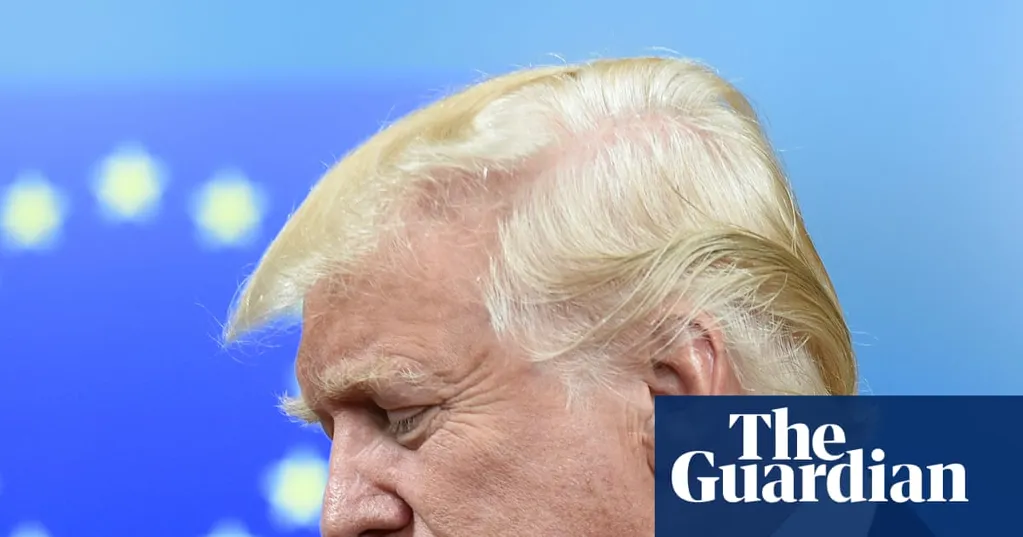
Next few weeks will show if Trump overplayed his hand with EU over Greenland levies, as calls grow for bloc to trigger untested anti-coercion tool.
As the sun set over the port of Limassol in Cyprus, the head of the European Commission, Ursula von der Leyen, last Thursday used a tried and tested formula to describe the United States - calling it one of "our allies, our partners". Only 24 hours earlier, Denmark, an EU and Nato member state, had warned that Donald Trump was intent on "conquering" Greenland, but the reflex at the top of the EU executive to describe the US as a friend runs deep.
Trump's weekend announcement that eight countries that have supported Greenland would face tariffs unless there was a deal to sell the territory to the US was another hammer to the transatlantic alliance, mocking the notion that the US is Europe's ally. The eight countries include six EU member states, as well as Norway and the UK, the latter unprotected by the much vaunted "special relationship". It suggests that Europe's strategy of flatter and appease the US president has failed.
For critics, exhibit A is von der Leyen's decision to sign a trade deal with Trump that was deeply skewed in favour of the US. While the EU agreed to eliminate tariffs on many US goods, it accepted 15% duties on many products and 50% on steel. After years of the EU extolling its heft as a trade player, the terms of the EU-US trade deal signed at Trump's Turnberry golf course last July were seen as a humiliation.
Von der Leyen defended that deal by saying it provided "crucial stability in our relations with the US" at a time of acute instability in an "unforgiving" world.
Now that argument is left in ruins. While the 0% tariffs for the US may never be implemented. The Trump administration has succeeded in uniting the European parliament from radical left to far right - via mainstream groups - against the agreement. The leader of France's far-right National Rally party, Jordan Bardella, described Trump's threats as "commercial blackmail" and said the EU should suspend last summer's agreement. Meanwhile, the centre-right European People's Party leader, Manfred Weber, aligned itself with other mainstream parties in calling for ratification of the deal to be paused.
The unspoken reason for accepting the unequal trade bargain was the hope it would keep the US backing Ukraine to defend itself in its war with Russia, providing capabilities, such as intelligence, which Europe is unable to match after decades of low defence spending. The former prime minister of Latvia Krišjānis Kariņš has described this as Europe's diplomatic disadvantage. "Europe still needs the US," he told the Guardian this week, before the latest Trump announcement. "So that's what makes the entire process [on Greenland] very, very difficult. And national leaders are generally speaking quite hesitant to criticise President Trump. But they're also hesitant in explaining to their societies why that's the case, this security dependence."
But Trump may have pushed the EU too far. Although Greenland left the EU's predecessor organisation, the European Community, in 1985, acquiescing in the forced sale of the territory of an EU member state would send a disastrous signal about the EU as a geopolitical actor and its commitment to Ukraine.
As European leaders lined up to declare their determination to uphold Danish and Greenlandic sovereignty, there are growing calls to use the EU's powerful but untested anti-coercion instrument against the US.
The regulation, invariably described as the EU's "big bazooka", was originally conceived as a response to Chinese economic pressure. It would allow the EU to impose sweeping restrictions on US goods and services, suspend investment or intellectual property protections.
France, which has long championed a muscular response to US pressure, called on the EU to trigger the instrument if Trump goes ahead with tariffs on countries supporting Greenland. But using the anti-coercion instrument is neither quick nor simple. While the commission promises "a certain expeditiousness" agreeing on sanctions could take around one year. Punitive measures require agreement of at least 55% of EU member states representing 65% of the population.
When Trump introduced his so-called liberation day tariffs in 2025, European leaders denounced them as "wrong", harmful", mutually destructive and pledged a "robust response". In the end divisions among the 27 member states and determination to shelter national industries from Trump's countermeasures put the EU on the path of appeasement rather than confrontation. As the 80-year-old transatlantic relationship goes through epoch-defining changes, the next few weeks will reveal whether this time is different.