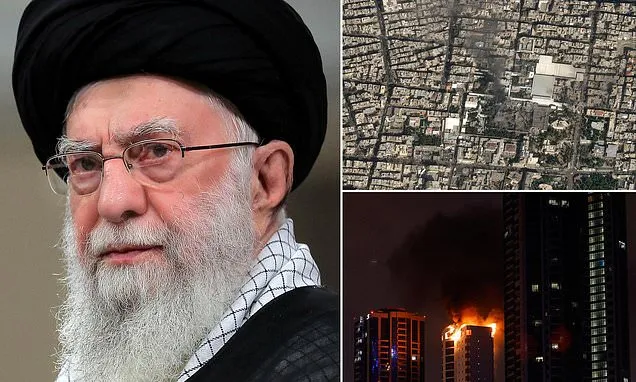
Former Israeli military intelligence chief Yossi Kuperwasser has warned the conflict with Iran would continue 'for as long as it takes to topple the regime', as he revealed what could unfold in the coming days.
US President Donald Trump announced Ayatollah Ali Khamenei's death on Saturday evening, saying he had been killed in joint US-Israeli strikes on Saturday morning alongside other senior figures.
'Khamenei, one of the most evil people in History, is dead,' Trump said, adding: 'This is not only Justice for the people of Iran, but for all Great Americans, and those people from many Countries throughout the World, that have been killed or mutilated by Khamenei and his gang of bloodthirsty THUGS.'
Speaking to the Daily Mail from a bomb shelter in Tel Aviv, Kuperwasser described the reported killing as a turning point.
'This is a major development,' he said. 'Khamenei was the most important decision maker in Iran for many years.'
'He represented the stubbornness and the commitment of Iran to pursue its policy of supporting terror and spreading extreme radical Islam.'
The Ayatollah's removal, he suggested, could be seen by some Iranians as 'a step toward freedom', adding: 'It is no wonder that people in Iran are celebrating today.'
Discussing the current power vacuum at the top of the regime, Kuperwasser said: 'There is no clear heir.'
Speaking to the Daily Mail from a bomb shelter in Tel Aviv, former Israeli military intelligence chief Yossi Kuperwasser described the reported killing of Ayatollah Ali Khamenei (pictured in 2024) as a turning point
'This is a major development,' he said. 'Khamenei was the most important decision maker in Iran for many years.'
Following the joint US-Israeli strikes, explosions were heard across Bahrain, Qatar, Kuwait and Abu Dhabi after Iran vowed a 'crushing' response.
'They will have to decide who is going to lead, especially since other top figures were also killed.'
Following the joint US-Israeli strikes, explosions were heard across Bahrain, Qatar, Kuwait and Abu Dhabi after Iran vowed a 'crushing' response.
Several US bases were targeted, including Al Dhafra air base in the UAE, Ali Al Salem in Kuwait, Muwaffaq al Salti in Jordan and Al Udeid air base in Doha.
The Israeli military said around 200 fighter jets had taken part in what it described as the largest ever flyover in its history, striking Iranian missile and defence systems in western and central Iran.
The operation, planned for months with Washington, took place near Khamenei's offices.
Kuperwasser cautioned against expectations of a swift resolution, saying: 'This is only the first day. The Iranian regime is not going to fall in one day.'
'There is a feeling this could be over in maybe three days, but there is no guarantee. I believe it will take more time.
'We need to be patient and understand it will go on as long as it takes to create the conditions for the people of Iran to remove this regime from power.'
He said the US and Israel had come together to dismantle threats posed by Iran, such as terrorism, ballistic missiles and the nuclear programme.
'The goal is a more stable Middle East without terrorism and without Iran interfering across the region,' he said, adding that the hope is for Iran to ultimately play a positive role.
The military expert pointed to a range of groups that could compete for influence in coming days, including regime insiders, students, opposition movements, supporters of exiled Crown Prince Reza Pahlavi and ethnic minorities like the Kurds and Balochs, warning that any transition could be complex.
'We all hope for a revolution,' he said. 'But nobody knows how it will unfold.'
Kuperwasser cautioned against expectations of a swift resolution, saying: 'This is only the first day. The Iranian regime is not going to fall in one day'.
The escalation follows the collapse of nuclear negotiations between Washington and Tehran last week.
The risk of further escalation now hinges on whether Iran's proxies in the region join the fight.
'The key question is whether Hezbollah and the Houthis will intervene,' he said, suggesting the threat is particularly high from Yemen.
'The chances of the Houthis joining are quite high,' he said,'But with Hezbollah, it's more complicated because they have to see how this affects their Lebanese identity. They don't want to bring disaster to Lebanon.'
At the same time, Kuperwasser dismissed the likelihood of direct military intervention by global powers such as Russia or China.
'They will try to promote a diplomatic solution that allows the regime to stay in power,' he said,'They may provide weapons but not troops.'
As the conflict escalates, the West is on high alert, with FBI Director Kash Patel revealing that the bureau's joint terrorism task forces are working round the clock to disrupt potential plots.
Kuperwasser said: 'There is a possibility of terrorist attacks in the West by Iran or Hezbollah. This is something the West must prepare to prevent.'
He warned that 'Iranian dissidents abroad may be particularly at risk'.
The escalation follows the collapse of nuclear negotiations between Washington and Tehran last week, with Kuperwasser saying that 'Iran's maximum flexibility was still far from meeting the minimum American demands'. He added that there was no way to 'bridge the gap.'
Inside Israel, he said public support for the operation remains strong, despite the ongoing threat of missile attacks.
'The atmosphere is completely positive,' he said. 'People are in shelters, but they understand this is the price they have to pay.'