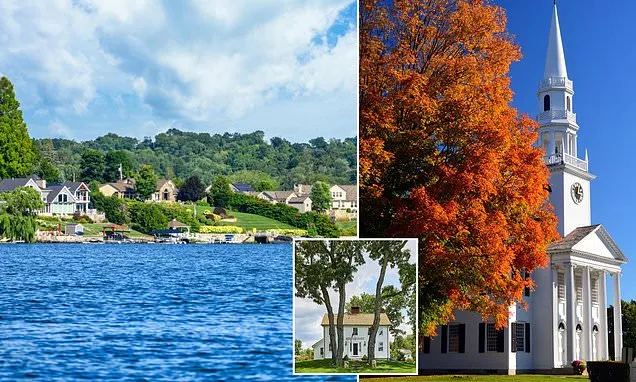
For decades, the Hamptons reigned as the ultimate summer sanctuary - a glittering seaside enclave close enough to Manhattan for a spontaneous Friday escape, yet far enough to feel worlds away from the city's sweltering heat.
It was the place to see and be seen, where sprawling estates, pristine beaches, and exclusive soirées defined the season. But the shine has started to fade.
What was once effortlessly chic now feels overcrowded, overpriced and overexposed. For young professionals, the Hamptons have become overly scene-driven - even 'cheugy,' in Gen Z parlance - more about posturing than pleasure.
Families, too, are reconsidering. Endless gridlock along Montauk Highway, jam-packed beaches and soaring rental prices have turned what was once a relaxing retreat into a logistical headache.
Even retirees who settled there seeking serenity have watched their quiet coastal haven transform each summer into a frenzy.
Among the country's wealthiest, a new consensus is emerging: The scene Out East has simply become too intense.
Increasingly, those in the know are trading flash for privacy and understated refinement, and a growing number of well-heeled New Yorkers are quietly redirecting their weekend escapes elsewhere.
Two hours north of Manhattan, in the rolling hills of Litchfield County, Connecticut, a different kind of luxury has taken hold - one defined less by scene and spectacle, and more by space, history and discretion.
Just a couple of hours north of Manhattan, in the rolling hills of Litchfield County, Connecticut, a different kind of luxury has taken hold.
Litchfield is defined less by scene and spectacle, and more by space, history and discretion.
Mike Fabbri, a New York City real estate agent who purchased a second home in Litchfield in 2022, said he and his partner initially assumed they would buy in the Hamptons. After years of renting there, however, they began to reconsider.
'What we really wanted was an escape from the hustle of the city,' he told the Daily Mail. 'Somewhere quiet and relaxing, but still beautiful and aligned with our lifestyle.'
They found it in a restored 1735 farmhouse set among mature gardens and rolling hills. For Fabbri, the appeal began with proximity.
He said their country home is about a two-hour drive from where they live in New York City. 'You're not sitting in traffic for five hours just to start your weekend,' he said. 'You already arrive feeling relaxed.'
Litchfield also offers a four-season rhythm that some say feels more stable than the one Out East.
Fall foliage draws leaf-peepers; winter brings skiing at nearby mountains; spring ushers in garden tours and outdoor dining; summer revolves around lakes, hiking trails and understated village life.
Even Marilyn Monroe was a fan and once lived in the scenic town of Roxbury with her husband Arthur Miller.
'Each season feels like a different experience,' Fabbri said. 'We use it year-round.'
The county is composed of several small towns—including Litchfield, New Preston, Washington Depot, Kent and Sharon—each with its own postcard-ready green, antique shops and locally owned restaurants.
Residents can drift from one village to another within 20 minutes, spending an afternoon browsing independent bookstores or dining in converted inns that nod to the region's colonial past.
That sense of preservation is deliberate. Large swaths of land are protected by local trusts, limiting overdevelopment and maintaining the area's pastoral character.
In Litchfield, historic farmhouses are more coveted than new construction. Strict zoning has helped preserve what local expert Victor Zhang described as a feeling of 'old-world grandiosity'—expansive estates framed by rolling hills and unspoiled farmland rather than dense subdivisions.
'People want something that feels like it's been part of the landscape,' Fabbri said. 'It's not about building a flashy McMansion. The history has value.'
Price is another powerful motivator. In Litchfield, buyers can typically secure substantial homes on acreage for between $1 million and $3 million. In the Hamptons, comparable properties can command three times that amount—often with smaller lots and far denser surroundings.
'The largest markets in the Hamptons are Southampton and East Hampton, where median prices reach $3.7 million and $2.8 million respectively in January,' said Hannah Jones, senior economic research analyst at Realtor.com.
'Litchfield and the larger region are far more affordable than the Hamptons and perhaps as a result more competitive.'
The median listing price in the town of Litchfield was $599,000 in January and homes spent just 53 days on the market.
'That's more than three weeks less than the national norm,' Jones said. 'Inventory levels in the area remain just a fraction of pre-pandemic levels contributing to strong competition in the market.'
In January, the median listing price in Litchfield County was $650,000 and properties remained on the market for about 85 days—an increase of roughly 18 percent compared with the same time last year.
In contrast, homes in Southampton and East Hampton took even longer to sell, with median market times of 135 and 129 days in January respectively—a sign analysts say of softer momentum at the ultra-high end.
Taxes also play a pivotal role. Property taxes in Litchfield County can be dramatically lower than in neighboring New York enclaves—in some cases as much as 75 percent less than homes just across the state line—further enhancing its appeal for high-net-worth buyers seeking long-term value.
Historic farmhouses such as Fabbri's are more coveted than new construction.
In Litchfield, buyers can typically secure substantial homes on acreage for between $1 million and $3 million (pictured: Fabbri's farmhouse).
'People want something that feels like it's been part of the landscape,' Fabbri said. 'It's not about building a flashy McMansion. The history has value.' (pictured: Fabbri's farmhouse)
'There's been a huge uptick in interest over the past five years,' Fabbri said. Friends and clients who once focused their searches on the South Fork are now looking north instead—drawn by that promise of privacy and relative value.
'The Hamptons is still great to visit,' he said. 'But building a community somewhere you can actually use year-round—that feels more sustainable.'
Litchfield's appeal also lies in what it lacks: a constant churn of short-term visitors.
While accessible by train, the area largely requires a car to navigate, which residents say naturally tempers day-trip crowds and fosters a more rooted community. 'When you're there, you feel like you're really there,' Fabbri said. 'It encourages people to put down roots.'
For many transplants, the move is as much philosophical as financial. In place of velvet-rope restaurants and influencer-packed beaches, Litchfield offers a slower social calendar and what some brokers call a ‘quiet luxury’ market that prioritizes discretion over display.
Litchfield (pictured) has even been dubbed the 'anti-Hamptons'
Luxury exists in Litchfield - in the form of meticulously restored inns, elevated farm-to-table dining and carefully designed country homes - but it is quieter, less performative
Luxury exists - in the form of meticulously restored inns, elevated farm-to-table dining and carefully designed country homes - but it is less performative.
'It still feels like a hidden gem,' Fabbri said. 'Everyone seems to have their own personal story of how they found it. That creates a certain kind of community - people are happy to be there.'
As the Hamptons continue to grapple with congestion and eye-watering price tags, Litchfield County is emerging as an alternative for affluent buyers seeking breathing room - and perhaps a different vision of what exclusivity looks like.
The area has even been dubbed the 'anti-Hamptons' by local realtor William Melnick of Elyse Harney Real Estate, a boutique brokerage long associated with high-end country properties in the region.
'When people go to the Hamptons, they think they are going to the country and not going to see the people they've seen all week. But now it's New York City on steroids, and New York City by the sea,' Melnick told Realtor.com. 'It can take three to four hours to get there, and it's super crowded and super commercial.'
He contrasted that with peak-season scenes in places like East Hampton. In Litchfield, he said, even the busiest summer weekends retain a sense of calm.
'It's more chill and laid back here,' he said. 'Every single town has a town beach. It's idyllic, like you're in a Fun With Dick and Jane book.'
Litchfield and the larger region are far more affordable than the Hamptons and perhaps as a result more competitive.
Property taxes in Litchfield County can be dramatically lower than in neighboring New York enclaves—in some cases as much as 75 percent less than homes just across the state line—further enhancing its appeal for high-net-worth buyers seeking long-term value.
Climate considerations are entering the equation as well. Agents report increased interest from buyers relocating from California and Texas, where extreme heat and wildfire risks have intensified.
For some, inland New England represents not just a lifestyle upgrade but a climate hedge—a place perceived as more stable and resilient over the long term.
Taken together—space and privacy; elite schools; relative affordability; lighter taxes; a more stable four-season community—Litchfield's rise reflects a broader recalibration among affluent buyers.
The appetite for spectacle has not vanished; but for a growing cohort, understated luxury in the Connecticut hills now feels far more compelling than another summer in the glare of the Hamptons.