There's no safe amount of alcohol you can drink before driving. That's long been the message from the Government and road safety charities. As one famous ad campaign from the early 1980s succinctly put it: 'Fancy a jar? Forget the car.'
But, until now, that's not what the law has said. And the UK's drink-driving limit is far more lenient than most other European nations. In fact, our current limit - 80mg of alcohol per 100ml of blood - is 60 per cent higher than that of France, Ireland and Spain.
As it's long been popularly understood, this means most people can get away with two drinks before getting behind the wheel.
Now that's set to change. Earlier this month, ministers announced that the limit will be cut to 50mg, in line with most of Europe.
Experts say that the effects of alcohol vary wildly depending on age, size, gender and even how much that person has eaten. This means that, under the new guidelines, many people could have a drink - even two - and still be legally allowed to drive, while others could be risking arrest after one glass of wine.
It begs the question: Is there a way to accurately predict who can safely get away with a drink before driving?
To answer this, The Mail on Sunday recruited ten colleagues, of varying sizes and ages, to see how two drinks - either a medium 175ml glass of standard strength white wine or two pints of medium strength lager - would affect their blood-alcohol level.
Our experiment - while light-hearted - also has a serious purpose.
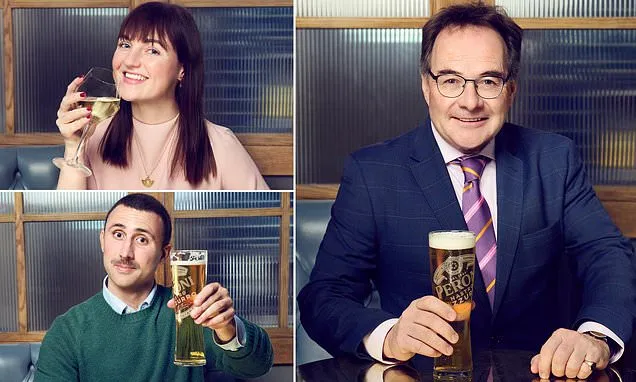
The results of our experiment were startling, writes Ethan Ennals (pictured). While some participants would be legally allowed to drive after two drinks under the new limits, some were over the current, more liberal, limits, after just one.
The Government argues the change to the drink-driving limit will save lives, citing figures that show 16 per cent of road deaths - about 260 people - every year involve drink-driving. However, critics point out that, in Scotland, where the limit has been 50mg since 2014, there has been no noticeable reduction in road accidents and deaths.
Others argue that the new law could put hundreds of village pubs - which rely on customers who drive - out of business.
Our results were startling. While some participants would be legally allowed to drive after two drinks under the new limits, some were over the current, more liberal, limits, after just one.
We also found a clear pattern. The older the participants were - particularly women - the more likely they were to fail the breathalyser test after just one glass of wine or one pint of beer. Women of all ages were also significantly at an increased risk of being over the limit after one drink than men.
'The older you are, the more susceptible you are to the effects of alcohol,' says Professor Adam Taylor, an anatomy expert at Lancaster University. 'As you reach your 60s, your body's ability to handle booze gets worse.'
'Under these new limits, there's going to be a lot of older people who could find themselves above the legal limit after just one drink.'
So how at-risk of drink-driving are you? And is there anything you can do to boost your tolerance?
First, it's important to explain how alcohol affects the body.
When it is consumed, it quickly enters the bloodstream via the stomach lining. As it circulates through the body, a proportion of it reaches the brain, where it blocks certain chemical signals, eventually leading to intoxication.
At the same time, alcohol filters through the liver - the organ that removes toxins and waste. How long it takes the liver to filter out booze plays a big part in influencing how drunk people will get.
Research shows that, for most people, it takes the body about an hour to rid itself of one unit of alcohol - roughly half a pint of lager or a small glass of wine. For others, often those with underlying medical issues or on certain medicines, this can take longer, so they might feel more intoxicated.
Consuming food before drinking, studies show, can also impact levels of intoxication because a full stomach can slow the rate at which alcohol enters the blood.
However, experts say that, perhaps surprisingly, the most important factor in predicting drunkenness is how much water someone contains in their body.
This is because, according to Prof Taylor, the more water there is in the body, the more diluted the alcohol in the bloodstream becomes, meaning less makes it to the brain.
'Alcohol doesn't just go to the brain and liver; it goes everywhere in the body, like limbs,' says Prof Taylor. 'If you have high water levels in these areas, alcohol will be more evenly distributed and less concentrated in the brain.'
Crucially, Prof Taylor says water levels in the body are not primarily defined by how much of the liquid we consume but by the amount of muscle in the body.
'Muscles are really effective at holding water; much more so than fat,' says Prof Taylor. 'So the less muscle tissue you have; the higher your blood-alcohol score will be.'
'Older people are more susceptible to alcohol because; in later life; we lose muscle mass.'
'And women have; on average; less muscle mass than men; meaning they aren't able to consume as much alcohol.'
For this reason; boosting muscle mass; through strength-training; like weights or resistance bands; could increase alcohol tolerance and potentially lower a blood-alcohol score on a breathalyser.
Ian Rondeau score 30 on his second drink - meaning he would be allowed to drive under the new law. He was surprised by his results,saying:'I've always believedthe unofficialadvice that drivingafter twopintsisdecidedlyrisky'
Rhodri Morganreceived a scoreofonly10afterhisfirstpint.Afterhissecond,hisblood-alcohollevelwas30,meaninghewouldlegallybeallowedtodriveunderincominglimits.However,hebelievedthatafterhisseconddrink,hewastoo intoxicatedtodrive
All of this science was reflected in our experiment, held over several days last week.
Our ten participants - an equal split of men and women - ranged in age from 25 to 62, heights 4ft 11in to 6ft 2in, and weights 7st 5lb to 16st 5lb. Keen to contribute to science, I volunteered myself.
Subjects were asked to choose between two pints of lager or two glasses of white wine, which contain roughly the same amount of alcohol - four units.
They were asked to consume one drink, wait half an hour, and then blow into a breathalyser, which calculates blood-alcohol scores based on the amount of booze in the breath.
Once their score was recorded, they consumed their second drink, waited another half hour and then had another breathalyser test.
Daily Mail health reporter Zoe Hardy, 25, is 4ft 11in and weighs 7st 5lb. After just one medium glass of white wine, Zoe was over the new drink-driving limit with a score of 60.
After her second, she scored 100—twice the new limit and well over the current ceiling of 80.
Zoe said: ‘I definitely felt tipsy after the first glass and wouldn’t have felt confident getting behind the wheel.’
Meanwhile, freelance journalist Jane Druker, 59, 5ft 3in and 8st 3lb, fared even worse. After her first glass of white wine, Jane blew a score of 80—meaning she would have risked arrest under the current drink-driving laws.
Her second glass raised this score to an astonishing 130—way over the new limit.
Jane said: ‘I was shocked by my readings. I didn’t feel even slightly drunk after the first, though by the second I was noticeably under the influence and wouldn’t have driven at that point.’
Tall men performed better on the breathalyser test.
Data journalist Rhodri Morgan, 32, 6ft 1in and 13st 3lb, received a score of only 10 after his first pint. After his second, Rhodri’s blood-alcohol level was 30—meaning he would legally be allowed to drive under the incoming limits.
Similarly, The Mail on Sunday’s production editor Ian Rondeau, 57, 6ft 2in and 12st 7lb, scored 20 on his first blow of the breathalyser and 30 on his second—meaning he would also be allowed to drive under the new law.
Both Rhodri and Ian believed, after their second drink, that they were too intoxicated to drive.
Ian, in particular, was surprised by his results. He said: ‘I’ve always believedthe unofficialadvice that drivingafter twopintsisdecidedlyrisky.’
One participant who did believe he could drive after two pints was Daily Mail sketch writer Quentin Letts, 62, 5ft 10in and 13st 3lb. He blew a score of 90 after his second drink—above both the current and incoming limit.
'Afterthe second pintI feltaslightrelaxationofthemind,'saidQuentin.'IthinkIwouldhavebeenOKbehindthewheel.InormallyreckonIcandriveontwopints;thoughIusuallydrinkbitter;whichisgenerallyweakerthanlager.'
Perhaps themostinterestingreading,howerver,wastheof freelancejournalistKarenConstable,aaged64,5ft7in&11st5lb.
Her scores—10afterthefirstdrinkand30aftertheseconddrink—initiallyconfusedexperts.Thisisbecause;asawomaninher60s;Karen’stolerancetoalcoholshould;accordingtoresearch;belowerthananyoneelseinvolvedintheexperiment.
However,thereasonquicklybecameclear—unliketheotherparticipants;whohadconsumedtheirdrinksonemptystomachs;Karenhadhersstraightafterdinner.
When sherepeatedtheexperimentadaylater;thistimeonanemptystomach;herscorewasmarkedlyhigher—90aftertheseconddrinkandwellabovethenewlimit.
'Foodsoaksupalcoholandslowstherateatwhichitentersthebloodstream,'saysProfTaylor.'Soeatingrightbeforedrinkingmightmeanyoufeellessdrunkgetalowerbreathalyserscore.'
'However,Iwouldn'trelyonfoodtogetroundthetest.Thealcoholwilleventuallygetintotheblood,itwilljusthappenatslowerrate.Yourscoremightbelowerbutyoumightremaindrunkerforlonger.'
This easy mistake I made with my contact lenses landed me in hospital: SCARLETT DARGAN
As for myself,I was pleased to find that;after two drinks;my score was 30—meaning I would still legally be allowed to drive.
However,this is hardly surprising.As a 29-year-old man of average height and weight—5ft9in and11st8lb—I shouldbe ableto respondto alcoholbetterthanmostothersinvolvedintheexperiment.
So I decidedto see justhowmanydrinkscouldconsumebeforeIwasabovelegal limit.Iwenttopubnearestofficeandruntheexperimentagain—butthistimewithintentionof stoppingonlyonceI reachedscoreof50.
The answer,Iquicklyfound,wasthepints;afterwhichmyscorewas60.Bythispoint,Ifeltnoticeablydrunk.Yet,significantly,underexistinglaw,Iwouldstillhavebeenallowedtodrive.
AndasIleftpub,IhadtomakeadecisionabouthowIwasgoingtogettodinnerwithfriendscentralLondon.
UsuallymytransportchoicewouldoneofmanyrentalLimeelectricbikesthatclutterstreetscapital.However,inmysomewhatinebriatedstate,Idecidedthatwouldbeanirresponsibledecisioncouldendangermyselfandothers;soIjumpedTubeinstead.
To me,itseemsmadthatIwouldstilllegallyhavebeengivenpermissiongetbehindwheelcarthisstate.
Perhaps thesimplestsolution,insteadofrelyingontestestimatesminusculechangesalcoholblood,is touseyourownjudgment.