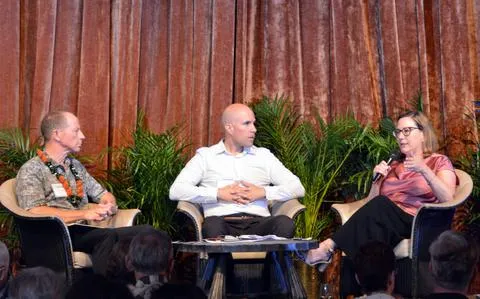
WAIKIKI BEACH, Hawaii -- The area of responsibility embraced by U.S. Indo-Pacific Command should include the entire border of China to better exploit its tensions with India, Pakistan and Russia, a retired Air Force general and former State Department official said Tuesday.
"We need to redraw that map so there is no [Central Command] on China's western border," David Stilwell, who was assistant secretary of state for the Bureau of East Asian and Pacific Affairs from 2019 to 2021, said during a panel discussion at Pacific Forum's annual banquet on Waikiki Beach.
He was joined by Kelly Magsamen, former chief of staff to Defense Secretary Lloyd Austin from 2021 to 2024.
Pacific Forum is a Honolulu-based foreign policy think tank that focuses on security, political and economic issues in the Indo-Pacific and began holding annual defense conferences in 2024.
"We redesign it so the commander of INDOPACOM has ways of affecting Chinese interest on its western border, where it's weak," said Stilwell, a China hawk who was a central figure in moving U.S. policy away from engagement with China and toward "strategic competition."
China has a robust military and economic presence to its east, where it tries to dominate neighboring Southeast Asian countries in its disputed claims of sovereignty over most of the South China Sea. America and allies Japan and Philippines, however, push back on China's agenda, with the U.S. Navy maintaining a steady presence in the sea.
INDOPACOM is already the largest of six in the Unified Command Plan, and covers more than half the Earth's surface, half its population and several other large militaries, according to its websites.
Stilwell argues that the Unified Command Plan that divides combatant commands by geographical region, such as Africa Command and European Command, was designed to counteract the threat posed by the Soviet Union, which dissolved in 1991.
"It is no longer relevant," he said. "The fact that CENTCOM sits on China's western border and is thinking about ways they can cooperate with China on counterterror is just shocking. I mean, are they not reading the headlines today?"
Stilwell was referring to the Chinese Communist Party's treatment of the Muslim Uyghur people who live in Xinjian province in western China.
President Donald Trump's first administration designated the party's actions, which have included forced sterilizations, forced labor and mass detentions, as genocide.
"I've been to Xinjiang," said Stilwell, who served as defense attaché in Beijing from 2011 to 2013. "I can tell you it's happening."
In an essay published in 2024 in the journal Space and Defense, Stilwell wrote that a counterterrorism-focused combatant command cannot meaningfully exploit frictions in the Chinese Communist Party's Shanghai Cooperation Organization, whose members include Russia, India, Pakistan and Iran among others on China's western border.
China established the organization as a collective security mechanism on its "weak western flank," Stilwell wrote.
The collective, however, is "doomed" given the realities of the open and ongoing conflict between Pakistan and India and China and India, he wrote.
It will, however, take more than the American military to exploit such fissures, Stilwell told the audience Tuesday.
"If we were as serious about economic and information warfare as we are about military security, this problem would be solved tomorrow," he said.