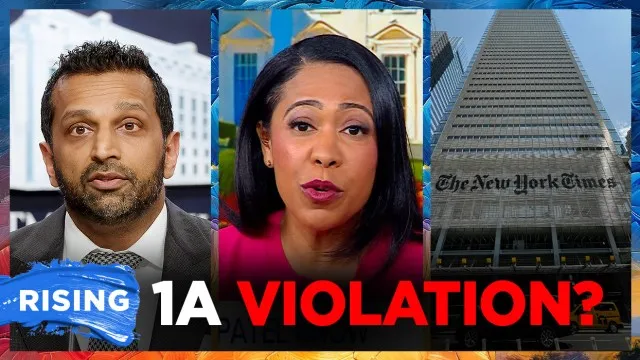
In today's edition of "What exactly is going on at the FBI?", we're back talking about Kash Patel. And look -- at a certain point, when headlines start stacking like this, it's not about one bad story. It's about a pattern.
The latest development is raising real constitutional questions.
According to new reporting, the FBI looked into a New York Times reporter after she wrote a story about Patel's girlfriend and the use of FBI resources to provide her with security and transportation. Agents reportedly interviewed the girlfriend, searched databases for information on the reporter, and even explored whether her reporting crossed into criminal behavior like stalking.
Let's just pause there. Because if you're a journalist, or even just someone who believes in a free press, that should set off alarms. Reporting on public officials, asking questions, reaching out to sources, that's not harassment. That's the actual job.
And even inside the government, there were concerns. Justice Department officials ultimately determined there was no legal basis to move forward, and the FBI says it is not even pursuing a case.
But the can of worms has already been opened -- and the bigger issue is the fact that it even went that far.
We're already in a moment where trust in institutions is shaky. And now the head of the FBI is tied, directly or indirectly, to a situation where a reporter is scrutinized after publishing a story about him. It feeds into a very real fear: Are we starting to blur the line between national security and personal sensitivity?
Now, to be fair, the FBI says its initial questions came after a threat was sent referencing the article. That matters. Threats should always be taken seriously.
But investigating a threat is one thing. Exploring whether a journalist's reporting itself could be criminal? That's something else entirely.
And critics are calling it exactly what it looks like: an attempt, or at least a willingness, to treat aggressive reporting as suspicious behavior. The New York Times's executive editor didn't mince words, calling it "a blatant violation" of First Amendment protections.
So zooming out, here's why this matters beyond just one story.
We're talking about the FBI -- the agency tasked with upholding the law -- being linked to a situation that brushes up against press freedom, government power and potential retaliation. Once journalists start wondering if doing their job could land them under investigation, it doesn't just affect one reporter; it chills the entire system.
And at the end of the day, whether you're a Democrat, a Republican, or somewhere in-between, that should concern you.
A functioning democracy depends on accountability. And in turn, accountability depends on a press that can ask uncomfortable questions without looking over its shoulder.
Lindsey Granger is a NewsNation contributor and co-host of The Hill's commentary show "Rising." This column is an edited transcription of her on-air commentary.