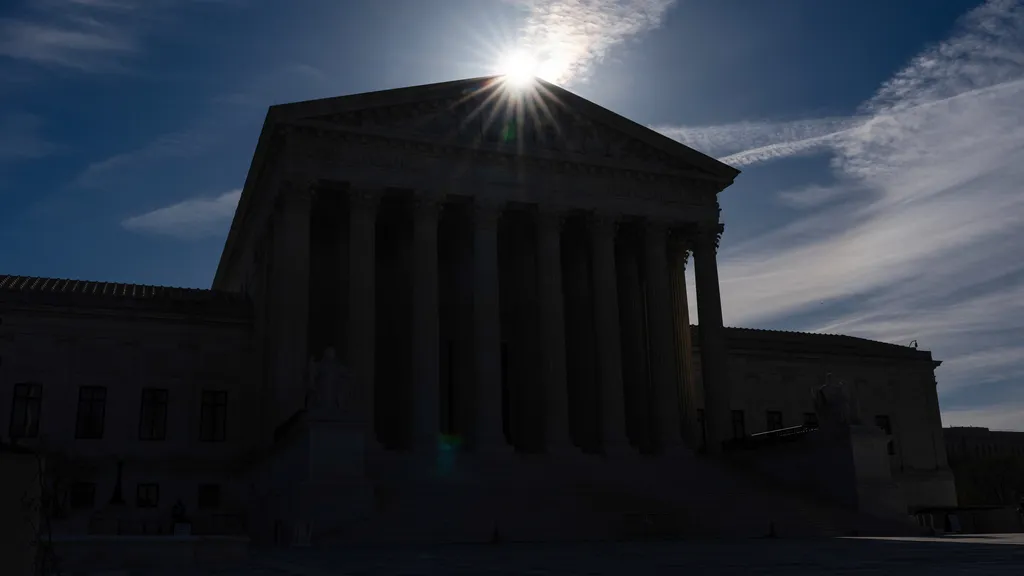
The Times unearthed memos that signaled a major shift in the court's operations, in a decision that critics say was rushed and flawed.
In 2016, a surprise decision from the Supreme Court "sent both climate policy and the court itself spinning in new directions," Jodi Kantor and Adam Liptak wrote in an investigation published last week.
The one-paragraph ruling halted the Clean Power Plan, President Barack Obama's signature environmental policy, which was aimed at reducing emissions from power plants. The decision signaled the birth of the court's modern "shadow docket," which the court uses to issue short opinions and bypass the time-tested procedures of hearing oral arguments and publishing detailed explanation of the justices' thinking.
The court has since used this emergency docket to grant President Trump more than 20 victories on issues like immigration and employee firings. Decisions made with it are typically temporary but can be enormously consequential.
At the heart of the case were the Obama administration's attempts to address climate change. And, yet, even as Chief Justice John G. Roberts fretted about the costs to industry of allowing the rule to go into effect, not a single justice mentioned climate change throughout any of the memos The Times unearthed.
Since the investigation was published, environmental lawyers and former E.P.A. officials have criticized the court's use of the shadow docket and called its decision rushed and flawed.
Claims of unbalanced evidence
The flurry of internal Supreme Court memos published by The Times began with a 2016 message from Chief Justice Roberts arguing that the court should move quickly to block Obama's environmental policy.
But the evidence he cited in that memo to his fellow justices was incomplete and biased, according to the former head of the E.P.A. under President Obama and environmental law experts.
Roberts argued that the Supreme Court was likely to eventually overturn the Clean Power Plan and that waiting for the case to move through the lower courts would cause irreparable harm to energy companies because they would have to make big investments in emissions reductions.
In 2015, the Supreme Court had ruled against the Obama administration in a case involving mercury emissions. But by the time of the decision, the case had been in court for three years and many power plants had already taken steps to comply with the emissions rules. By acting earlier this time around, Roberts wanted to prevent what he viewed as a potentially unlawful regulation from having its intended effect before the courts had their say.
In making this final point, Roberts referred to a recent comment the E.P.A. administrator at the time, Gina McCarthy, had made to the BBC, in which she said, "We are baking" the Clean Power Plan "into the system."
McCarthy, in an emailed statement to The Times said, "It seems clear that in making their decision to stay the Clean Power Plan, the majority of the Supreme Court were more focused on the fossil fuel industry's wants and needs than on people's health and well-being."
The court's notes "show that the majority had personal biases against the Obama administration that factored into the legal merits of the rule," she wrote. "Their actions were more than a failure of due diligence or communication; they were taking away the ability of people across the country to tackle climate change and breathe cleaner air."
In a memo, Chief Justice Roberts cited an estimate that the cost of implementing the plan could be as high as $480 billion, averaging $32 billion per year over 15 years.
That number was far higher than the E.P.A.'s own cost estimate, which was less than $10 billion per year.
"The majority was taken in by the one-sided cost estimate from the appellants, which turned out to be completely false," said David Doniger, a senior attorney with the Natural Resources Defense Council who worked on the case. (State governments and companies challenged the E.P.A.'s plan in court.)
"If they'd gone through a normal briefing and so on, these facts would have come out," he added. The Supreme Court did not respond to a request for comment.
What's happened since
The court halted the Clean Power Plan in February 2016. Still, energy companies met its emissions targets by 2019, well ahead of the 2030 deadline. This happened, experts say, in large part because the fracking boom and other developments shifted the economics of energy production away from coal toward other less-polluting sources.
The emergency docket has not been used extensively to halt environmental policies without explanation in recent years, Doniger said. The court's makeup has also changed. Six of the nine current justices were appointed by Republican presidents. But in 2016, five justices had been appointed by Republicans, and Justice Anthony M. Kennedy, appointed by President Reagan, was often a swing vote.
But the memos may shed some light on how the Supreme Court could treat the Trump administration's recent efforts to rescind the scientific finding that underpins the federal government's legal authority to combat climate change.
Richard Lazarus, an environmental law professor at Harvard Law School, said the documents suggest the new court could be willing to entertain the administration's argument.