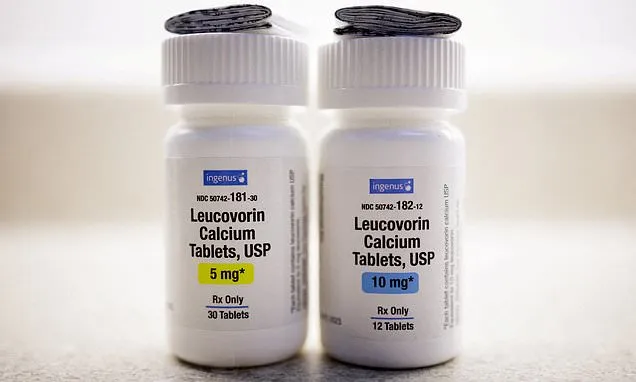
The FDA has declined to approve a $2.50 'miracle pill' for autism, despite previously hailing it as a potential treatment for thousands of children.
On Tuesday, the FDA approved leucovorin - a high-dose B vitamin derived from folic acid - for cerebral folate deficiency, (CFD), which occurs when the brain can't absorb folate, a naturally occurring form of folic acid found in foods like leafy greens.
Recent research shows about three in four autistic people have CFD, which could be the culprit behind speech and behavioral issues seen in many cases of autism.
However, the agency did not approve the drug for autism itself, despite FDA commissioner Dr Marty Makary, Department of Health and Human Services Secretary Robert F Kennedy Jr and President Donald Trump in September indicating that leucovorin could help children with autism.
Kennedy said at the time they had 'identified an exciting therapy that may benefit large numbers of children who suffer from autism.'
At that same briefing, Trump made widely unsupported claims that Tylenol may be a cause of autism and cautioned parents about getting too many vaccines for their children.
Instead, he said changing the label on leucovorin, traditionally given to cancer patients to lessen the effects of chemotherapy, for autism 'gives hope to the many parents with autistic children that it may be possible to improve their lives.'
The FDA's move comes after the American Academy of Pediatrics (AAP), America's leading pediatrician group, said in October that it did not recommend routine use of leucovorin for autistic children due to 'very limited evidence' that the benefits of outweigh potential risks, as well as unclear data on dosages for children.
The FDA on Tuesday approved leucovorin (pictured in the above file image) for cerebral folate deficiency but not for autism
The FDA said about its leucovorin approval for CFD: 'This action reflects the agency's commitment to accelerating cures and expanding treatment options including for patients with serious and unmet needs.'
'Leucovorin is the first treatment for the rare genetic condition of cerebral folate deficiency.'
Leucovorin is derived from folic acid (also known as Vitamin B9), a vital nutrient that helps synthesize DNA and replicates and repairs cells throughout the body.
Its naturally occurring form, folate, is found in foods such as leafy green vegetables, beans and lentils.
Folic acid is a precursor to DNA and RNA, which are needed to help replicate a cell's genome - a set of instructions that help cells function properly. This is why most prenatal vitamins contain folic acid.
Research on leucovorin dates back to the early 2000s, during which scientists Dr Vincent Ramaekers of the University of Liege in Belgium and Dr Edward Quadros of SUNY Downstate University of New York took blood and spinal fluid samples from autistic children and found that while they had normal folic acid levels in their blood, there was much less in their cerebrospinal fluid, which protects the brain and spinal cord.
This suggested that something was blocking folate's absorption by the brain.
The researchers also found 75 percent of autistic children had autoantibodies in their blood, a type that mistakenly targets and attacks the body's tissues and organs.
These autoantibodies are known to block a protein called folate receptor alpha, a protein that transports folic acid from the blood into the brain and placenta.
Research suggests that leucovorin may clear chemical blockages in the brains of autistic children, and this contributes to improving their language skills
But unlike other forms of folate, such as those in vitamin supplements, leucovorin is able to cross the blood-brain barrier - a semi-permeable layer lining the inner surface of blood vessels in the brain that protects it from potentially damaging substances in the blood.
This means it can penetrate the brain and have a direct effect.
The FDA's move to approve leucovorin for CFD was based on an analysis of data from about 40 cases, showing improvements in behaviors such as speech in autistic children taking leucovorin.
'Today's approval represents a significant milestone for patients living with cerebral folate transport deficiency due to the FOLR1 variant, a rare genetic condition that has had no FDA-approved treatment options until today,' Makary said.
He added: 'This action may benefit some individuals with FOLR1- related cerebral folate transport deficiency who have developmental delays with autistic features.'