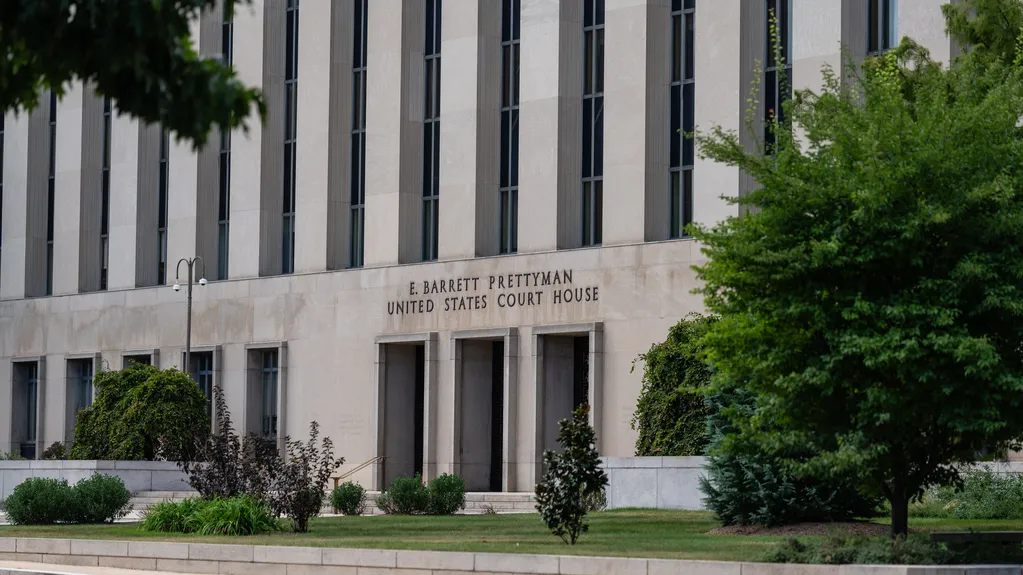
A three-judge panel gave a group of 17 transgender women a few weeks to seek further recourse in court before their transfer to men's facilities could take effect.
The Bureau of Prisons could soon move forward with the transfer of 17 incarcerated transgender women to men's facilities, after a federal appeals court on Friday vacated rulings by a district court judge that had been blocking the transfers for more than a year.
In a 27-page ruling, a three-judge panel for the U.S. Court of Appeals for the District of Columbia found there was insufficient evidence to support the claim that the transfers would constitute "cruel and unusual punishment," in violation of the Eighth Amendment. Such a claim, two of the judges found, would need to be supported by a specific finding about the prisoners' individual vulnerabilities "to violence, abuse, and psychiatric harm in men's prisons."
The ruling left open the possibility that the transfers could be blocked again in the future if those facts were presented to the court, or potentially for other legal reasons. It noted that the court record already contained "ample, uncontested evidence" that, according to the prisoners, made them "distinctively vulnerable to harm in men's facilities" and left it to the lower court to decide whether, for each prisoner, that evidence amounted to a constitutional violation.
The appeals judges also delayed the implementation of their ruling, leaving in place a legal barrier to any immediate transfers. Lawyers for the transgender women who brought the case will have a few weeks to either ask for a rehearing by a larger appeals panel or persuade the district court judge to block their transfers once again.
At one point 18 transgender women, identified by pseudonyms, were bringing the lawsuit against the government. One recently died, according to their legal team, leaving 17 plaintiffs.
Shannon Minter, the legal director of the National Center for L.G.B.T.Q. Rights and one of the lawyers representing the prisoners, said he was "very encouraged" by the ruling's legal findings despite the more immediate defeat. "We're going to do exactly what the court directed us to do," he said. "Go back to the district court judge and ask him to put these individualized findings on the record in a ruling."
A spokeswoman for the Justice Department did not immediately respond to a request for comment.
The transfers are a consequence of one of the first executive orders that President Trump signed after taking office. It mandates that imprisoned transgender women be housed in men's facilities and be barred from receiving medical treatment for gender dysphoria. The order has been the subject of a number of lawsuits before Judge Royce C. Lamberth of the Federal District Court for the District of Columbia. He had previously issued the preliminary rulings blocking the transfers that were vacated on Friday by the appeals court.
Friday's ruling was split, with Chief Judge Sri Srinivasan and Judge Cornelia Pillard, both appointees of President Barack Obama, in the majority. Judge Raymond Randolph, an appointee of President George H.W. Bush, filed a dissent, arguing that the plaintiffs' claims in the lawsuit should be thrown out because, in his view, a federal law requires that they first exhaust their administrative remedies within the Bureau of Prisons. He also questioned whether Judge Lamberth had the authority to issue a series of rulings that although temporary in nature, have effectively blocked the transfers since February of last year.
In a separate but related case, Judge Lamberth has ruled that more than 1,000 transgender inmates must continue to receive hormone therapy while their lawsuit moves forward. That block remains in effect and the government has not yet appealed.