An estimated 8,000 soldiers, 130 chariots and 520 horses make up the life-size terra-cotta army, most of which remains in situ near the mausoleum of the Chinese emperor Qin Shi Huang in Xi'an. Shechet, 77, considers the army part of a long history connecting the medium of ceramics to memorialization. "The first emperor of China wanted to live forever and couldn't believe he wasn't allowed to," Shechet says; he built the army to fortify himself in the afterlife.
Origin: Japan
Date: sixth century A.D.
Collection: Tokyo National Museum
Chosen by: Shio Kusaka
The haniwa are clay sculptures that were placed on funerary mounds during the Kofun period (300-700). Ranging from about a foot to several feet tall, haniwa, in the form of animals, people and houses, were thought to have "taken care of or entertained the person who passed," Kusaka, 54, says. The artist is particularly fascinated by this figure's long skirt: "It's hard to make two legs standing. I love the way they came up with this as a solution."
Origin: present-day United States
Date: 1000-1150
Collection: Western New Mexico University Museum, Silver City
Chosen by: Ron Nagle
Nagle, 87, says he is "drawn to the graphic quality" of Mimbres pottery, a prized form of black-and-white ceramics from the Southwestern United States. But what interests him even more are the holes in the middle, like the one next to the tadpole in this bowl [not pictured]. The hole was "placed over the head of the deceased as a conduit to the spiritual world," he says. After some Mimbres pieces were stolen from burial sites, Nagle notes, "the holes were mistakenly repaired."
Origin: present-day Mali
Date: 13th century
Collection: Metropolitan Museum of Art, New York
Chosen by: Woody De Othello
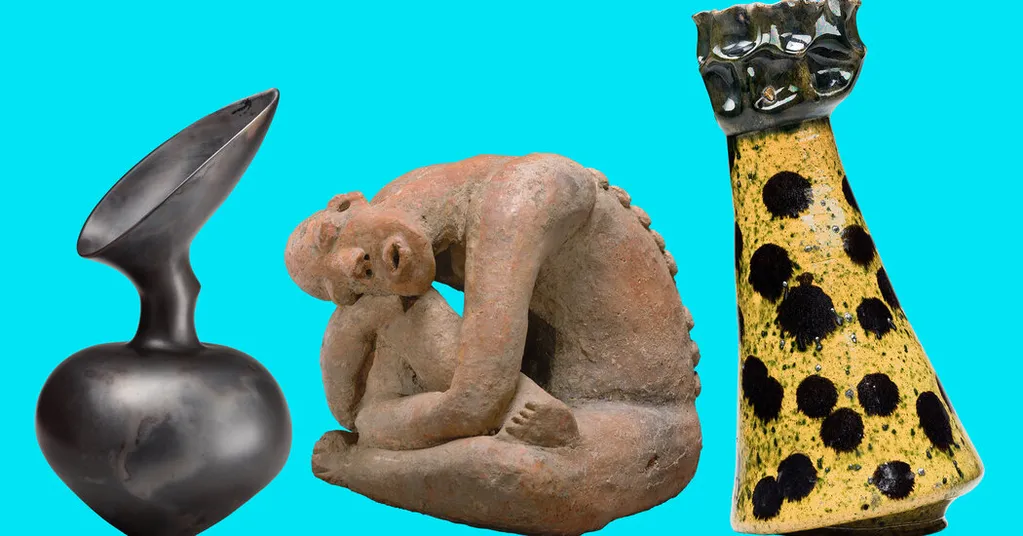
This crouched figure -- who looks either tortured or lost in prayer -- comes from the oldest known city in sub-Saharan Africa, Djenné-Djeno, in what is now Mali. "I've seen it come up in a lot of different African statuary books," Othello, 34, says. "It's a mystery why the figure is contorted in this way; from the back, you see these weird scales." Othello marvels at the fact that even 800 years ago, "people were using ceramics to tell a psychological, emotive story."
Origin: Korea
Date: 16th century
Collection: Mitsui Memorial Museum, Tokyo
Chosen by: Ron Nagle
"The solitariness of that one section with the brown dagger shape knocks me out," Nagle says of this Korean tea bowl. "It’s wabi-sabi to the max." That term, he adds, has been attributed to Japanese ceramics for centuries and can be applied to any object that manages to achieve "soulful simplicity, not trying too hard. It’s something I aspire to."
Origin: Japan
Date: 17th century
Collection: Sunritz Hattori Museum of Arts, Suwa, Japan
Chosen by: Ron Nagle
"This is what I call the 'Mona Lisa' of Japanese ceramics," Nagle says. The tea bowl [not pictured] was in all the books on 16th- and 17th-century Japanese pottery. The name is a reference to Mount Fuji looming from a distance. It looks like a painting. It's got simplicity, restraint, spiritual richness -- it's about the intangible."
Origin: France
Date: 1774
Collection: Frick Collection, New York
Chosen by: Arlene Shechet
In the 18th century, Europe's ruling class "was insanely desirous of porcelain," Shechet says. Prized objects like this one were reinterpretations of pieces from China, where porcelain was developed over hundreds of years. Despite its name, this vessel’s shape is based on a Chinese bronze vase from the Han dynasty (206 B.C.-A.D. 220), while its patterning is borrowed from 18th-century Chinese woodblock prints. As a finishing touch, Shechet notes, "Marie Antoinette’s jeweler made the chain, which references ancient Chinese wine carriers."
Origin: United States
Date: 1859
Collection: National Gallery of Art, Washington
Chosen by: Arlene Shechet
This object is an example of "ceramics as an act of defiance," says Shechet. David Drake was an enslaved artisan who made stoneware storage vessels in South Carolina in the 1800s. Although it was illegal for him to read or write, he signed his pots and carved poems and dedications into their surfaces. "He knew he was speaking to the future. The fact that clay is a plebeian material -- so many more people had access to it. It has a rich history because of that."
Origin: United States
Date: 1897-1900
Collection: Metropolitan Museum of Art
Chosen by: Arlene Shechet
Known as the Mad Potter of Biloxi, Miss., Ohr didn’t have much success selling his eccentric vessels during his lifetime. But “he believed in it so much that he said ‘I’m going to sock it away in this garage.’ And 50 years later, people found it,” Shechet says. The artist “used a Victorian vocabulary and pushed it to the edge—the frills, the glazes. He’s had a huge influence on contemporary ceramics. But his stuff could never be matched.”
Origin: United Kingdom
Date: 1995
Collection: Newark Museum of Art, New Jersey
Chosen by: Woody De Othello
"She's the GOAT," Othello says of the 75-year-old British Kenyan potter. "Her forms are just beautiful and elegant, but they point back to so many different African forms, like Mangbetu ceramic figures, headwear and headdresses. Magdalene is burnishing her surfaces to get this iridescent look."