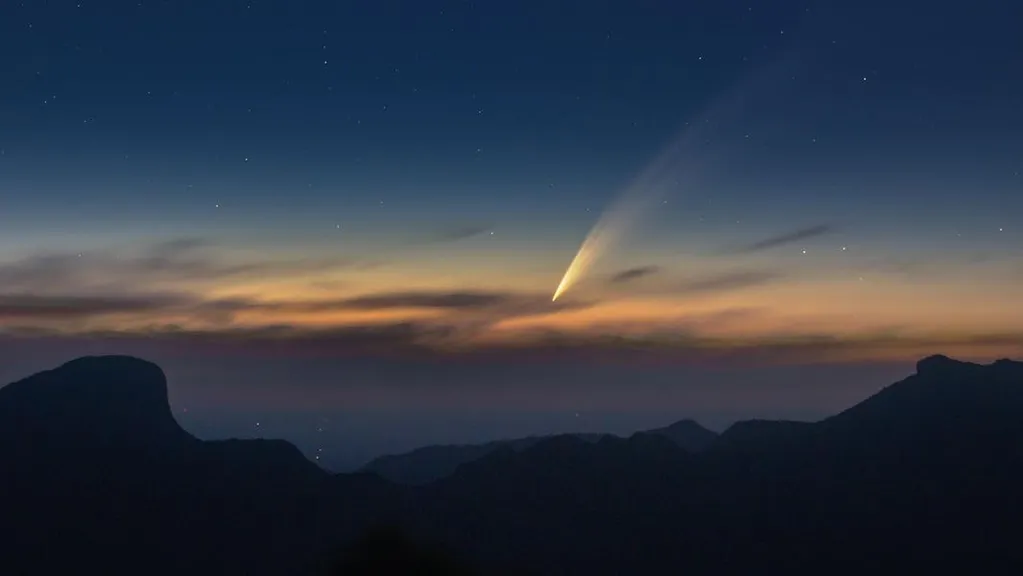
A brightening comet reaches a key moment on Sunday morning when it reaches its brightest. Comet C/2025 R3 (Pan-STARRS) will be at perihelion, its closest point to the sun, a stage when comets often become more active and begin to brighten more rapidly. At the same time, Mercury and Mars are gathering low in the eastern sky for early risers who keep looking after the comet is swallowed up by the gathering dawn. However, this is one of your final chances to see the comet -- so act fast. Remember to check my feed for the latest on comet Pan-STARRS.
Key Facts
Comet Tracker For Sunday, April 19
On April 19, Comet C/2025 R3 (Pan-STARRS) reaches perihelion at about 0.50 AU (75 million kilometers) from the sun while closing to roughly 0.59 AU (88 million kilometers) from Earth -- a key moment that may accelerate its brightening. Here's how to find it:
How To Find Comet Pan-Starrs
- The comet will appear as a faint, diffuse glow, but steadily brightening as it approaches the sun.
- Go outside about 90 minutes before sunrise where you are and look low in the eastern sky.
- The key is to first locate the Great Square of Pegasus rising due east—a large, diamond-shaped pattern of four stars.
- Now look for the lowest of the square's four corner stars, closest to the horizon. That's Algenib. The comet will be just to the left of this star.
- Look for a small misty patch of light—and hopefully a tail—using a pair of 10x50 binoculars to make it easier.
- If you have binoculars, scan close to the eastern horizon for Mercury, and possibly Mars.
Why Perihelion Matters
Perihelion is when a comet is closest to the sun—and when the action often begins. As a comet approaches the sun, increasing heat causes frozen gases inside the comet to vaporize more rapidly. That releases dust and gas into space, building up the coma and tail and often leading to a noticeable increase in brightness. Not all comets respond dramatically, but this is the point when changes can begin to accelerate. Sadly for the Northern Hemisphere, it's also where the action for Comet Pan-STARRS ends because it now drops out of view, lost in the sun's glare.
How To Photograph A Comet
If you can't see the comet easily, photograph it. Even a basic smartphone on a tripod using night mode can reveal a faint comet as a soft green glow, often with hints of a tail. With a manual camera, try 5-30 second exposures at ISO 800-3200 and a wide aperture (around f/2.8). Focus on a bright star first, then compose your shot. In many cases, your camera will "see" the comet before your eyes do -- though binoculars will hugely help.