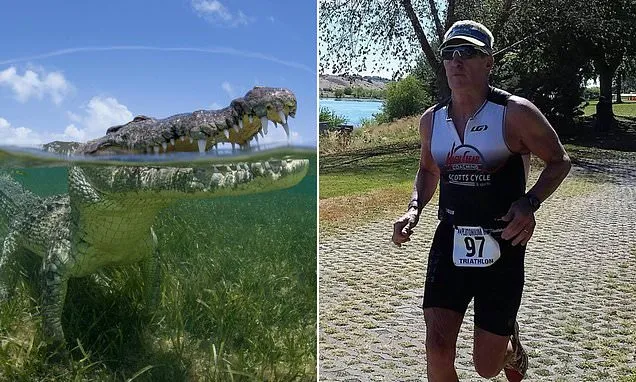
A 72-year-old fitness trainer has revealed how he escaped the jaws of death after a crocodile tried to drag him to the bottom of the Caribbean Sea.
Eric Greager, of Richland, Washington, was attacked by the 10-foot apex predator last week during what was supposed to be a dream vacation to Mexico.
The seasoned personal trainer said he broke free from the crocodile's death roll - a technique used to pull prey to the ocean floor - by repeatedly punching it in the head.
Greager, who is also a spin bike instructor, told the Tri-City Herald he was on a scuba diving trip with his wife Elaine in Cozumel when he came face-to-face with the creature.
'The day before our first dive I went out for a swim,' Greager said. 'I was 30 yards from shore, almost done with the swim, when something hit me from behind.
'As I turned around to see what was going on, two feet away from me was the face of a crocodile. Most surprising thing of my life.
'He lunged at me, and as I tried to block him, my right arm wound up in his mouth, which he immediately clamped down on and started thrashing back and forth like a dog with a rag toy,' Greager added.
'Meanwhile, with my other hand I was beating him in the head and kicking him in the stomach and yelling and screaming, and he went into a death roll and started to take me down to the bottom.'
Greager recalled the moment he narrowly avoided the jaws of death during what was supposed to be a dream vacation.
A 'death roll' is a technique crocodiles use to subdue prey in which they violently twist onto their backs before attempting to pull their victims towards the bottom of the ocean.
However, Greager managed to avert the crocodile's deadly mission.
'Somehow, with all the kicking, hitting and screaming I was doing, he let go,' he said.
'I came to the surface, looked back, he came at me again, I blocked him off, got a few more nicks, and then he left, for whatever reason, thank goodness.'
Greager said he pulled himself towards the shore using a buoy line while 'sheets of blood' spilled from his right arm, turning the water crimson.
The personal trainer said he began 'yelling for help' until beachgoers noticed and ran to his aid.
'About a half a dozen or more people, great people, came off the beach, helped me to the shore, put a tourniquet on my arm, which at a minimum, saved my arm, and probably saved my life,' Greager recalled.
'They got the ambulance there, I had a 30-minute ambulance ride to the hospital and an hour wait before the surgery.
'I grabbed several of the doctors' hands and asked them to please save my arm, and they said they were going to try.'
'As it turned out, I was in surgery for six hours, had a severed artery, which the surgeon put back together.'
Greager, of Richland, Washington, is a seasoned personal trainer and spin bike instructor.
Greager, who is also a spin bike instructor, told the Tri-City Herald he was on a scuba diving trip with his wife Elaine in Cozumel last week when horror struck.
'All the tendons in my arm were severed. An orthopedic surgeon took care of all of that.'
'The lucky part was the two main nerves that were exposed that were not severed, and no bones were broken.'
Greager stayed in hospital for three days before returning twice daily for IV treatments.
The best way to fight off a crocodile is to punch it in the head while aiming for vulnerable areas like the eyes, according to outdoor expert Bear Grylls.
Grylls also recommends aiming for the palatal valve at the rear of the crocodile's mouth.
'If you can punch that, water will flood into its lungs. It'll have to release you, or it will drown,' he told Outdoors.com.
Only one person is believed to have died after an encounter with one of the scaly creatures in Mexico through 2025.
Crocodiles are significantly more aggressive than alligators. They have narrower snouts than alligators and are light olive or tan in color rather than gray.
They lurk in freshwater and saltwater bodies unlike alligators which are almost always found in freshwater.
Crocodiles live in Africa, Asia, the Americas, and Australia while alligators can be found mainly in southeastern United States and China.