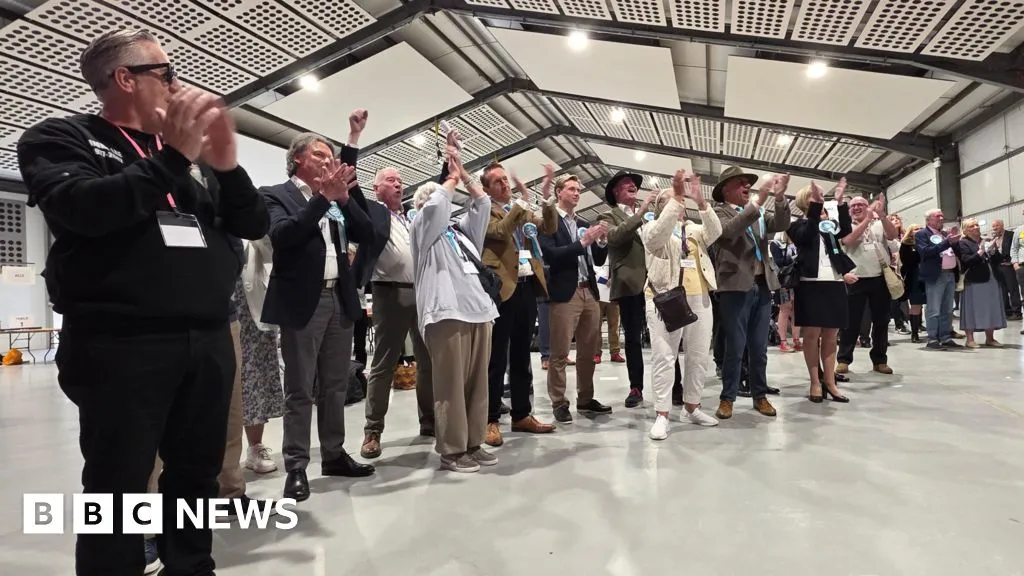
It was a historic day in the local elections in Norfolk.
In the county council vote, a party that had dominated for decades was nearly wiped out by one that was founded just a few years ago.
And in Norwich, another party that typically controls the area was turfed out of power.
So what are the main takeaways from the results?
Norfolk County Council was a target for Reform and it was fairly confident it could take majority control.
The first results suggested it might happen.
43 seats are needed to run the authority outright and, early on, it looked like that number could be achieved.
However, while the party swept most opponents aside in areas like Breckland, Broadland and west Norfolk, it only reached a total of 40.
Reform's progress was particularly slowed in north Norfolk, where the Liberal Democrats made gains, and in Great Yarmouth.
The party can run Norfolk as a minority administration but will it seek support from other councillors to get its policies through in votes?
While Reform is less than a decade old, an even newer party spoiled its attempt to seize a majority.
Great Yarmouth First was formed at the end of last year by the Great Yarmouth MP Rupert Lowe following his acrimonious split with Reform.
Promising to put the interests of people in the borough of Great Yarmouth first, it comfortably won all nine seats it contested, with Reform notably coming second in eight of those divisions.
Its candidates won almost 5% of all votes in the county council elections, compared with Labour's 10%.
Bear in mind that Labour accrued those votes while standing 75 more candidates.
Some polls had suggested the Conservatives could be left with just one or two seats after the votes were counted.
In the end, it was not quite that bad for the Tories, who finished the day with eight, and their leader, Kay Mason Billig, retained her seat.
But it will go down as a shocking result as the party has been the predominant power in Norfolk for decades, winning 58 seats in 2021.
It was perhaps even worse for Labour, whose performance reflected the national picture.
It won just one council seat and even then, only by three votes.
The Greens have long been the second largest party in the city and are now finally in power.
Labour have run Norwich for two decades but in recent years the Greens have gradually added to their number of seats.
On Thursday they took five from Labour and won a vacant seat, giving them a majority of 21.
Reform also gained a foothold in Norwich, taking two wards from Labour.
Interest in voting for local councils is usually lower than it is for general elections.
While that trend was not bucked here, there clearly was more appetite for voting than usual.
For context, the general election turnout in Norfolk's constituencies was about 60% or higher in 2024.
In this year's county council vote, 325,335 votes were cast, which is 45.44% of the electorate.
At the 2021 county council elections, the turnout was about 237,000 people.