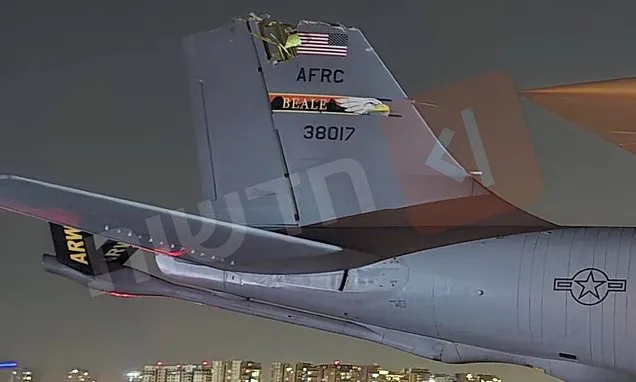
Four crew members have been confirmed dead after an American refuelling aircraft crashed in Iraq, the US military has said. In a post on X on Friday morning, the US Central Command (Centcom) said that 'four of the six crew members on board the aircraft have been confirmed deceased.' It comes after Centcom announced on Thursday that a KC-135 refuelling plane had gone down in 'friendly airspace' and a second aircraft involved in the incident landed safely. The second aircraft was also a KC-135, The Washington Post reports. The identities of those killed will be withheld for 24 hours until next of kin can be notified, Centcom said, adding that rescue efforts are ongoing as two crew members remain missing. It comes after a major blaze appears to have broken out at a French air base in Erbil, Iraq, following a drone attack.
A helicopter was apparently hit and at least six French soldiers were injured. President Emmanuel Macron confirmed early this morning that one had died. 'Their presence in Iraq is part of the strict framework of the fight against terrorism. The war in Iran cannot justify such attacks,' he said. 'The French soldiers there have no connection to war or conflict. They are simply military advisers legally present in Iraq'. An explosion was also reported near the U.S. Consulate and the Erbil International Airport area, where there is a US military base. Iraq became the main theatre of war in the Middle East on Wednesday as another drone attack hit British special forces. Events in Iraq also threatened to pull Britain and France into the conflict after days of practising a defensive strategy. A French soldier was killed in an attack on a joint base in Iraqi Kurdistan, President Emmanuel Macron announced on Friday.
The strike on the headquarters - which France shares with Kurdistan's Peshmerga forces - involved two drones and injured five more troops. Meanwhile, Iranian drone attacks targeted a British Special Forces base in Iraq earlier in the day. The 'hidden hand' of Vladimir Putin was blamed for directing strikes against military headquarters and helping co-ordinate Iran's military operations. John Healey condemned the Kremlin's secret mission to support the regime that has fired at UK troops at least three times. The assault on the camp at Erbil in northern Iraq was repelled by soldiers using the UK's Martlet missile system. Wednesday night's engagement followed attacks on RAF Akrotiri on Cyprus and challenged the wisdom of Keir Starmer's strategy.
On the Prime Minister's orders, British troops are permitted only to intercept enemy rockets. They cannot engage rocket systems. Meanwhile, RAF pilots flew operational sorties over the United Arab Emirates, Jordan and Qatar as Britain was dragged deeper into the conflict. Mr Healey said: 'No one will be surprised to believe that Putin's hidden hand is behind some of the Iranian tactics and potentially behind some of their capabilities as well. We have seen this axis of aggression with Russia firing 60,000 drones into Ukraine. We have seen the same tactics by Iran. These countries like to menace their neighbours. Nobody wants a situation where the Strait of Hormuz is closed, where international oil prices are at more than $100 a barrel. Nobody except Putin. Everyone else is concerned about it.'
The Kremlin was struggling to find money to support its illegal occupation of Ukraine before the spike in oil prices. The increase from $60 to more than $100 a barrel has delivered a windfall for Putin, as has the US waiver on sanctions applying to countries buying Russian natural resources. Overstretched British forces have been withdrawn from patrolling the High North and the North Sea to contribute to Middle East operations. HMS Dragon, which sailed from Portsmouth on Monday, had been earmarked for Nato operations there before she was redeployed. There were no British casualties in the Iranian attack on the Erbil base, but some US service personnel were wounded. Targets in Baghdad were also struck.
The UK's Chief of Joint Operations Lieutenant General Nick Perry said the Iranian drones were 'problematic' and 'proving effective' due to their flight patterns. In tactics borrowed from the Russians in Ukraine, the Iranians are ensuring their Shaheed suicide drones approach targets on a lower trajectory. The shallowness of their flight makes detection and interception more challenging. But the Martlet missile system proved up to the task. With the Hormuz strait blockaded due to threats to cargo ships and oil tankers, Mr Healey was asked why the Navy removed its minesweeper HMS Middleton. He said: 'Any ship, like a car, needs maintenance. It was brought back for that.'