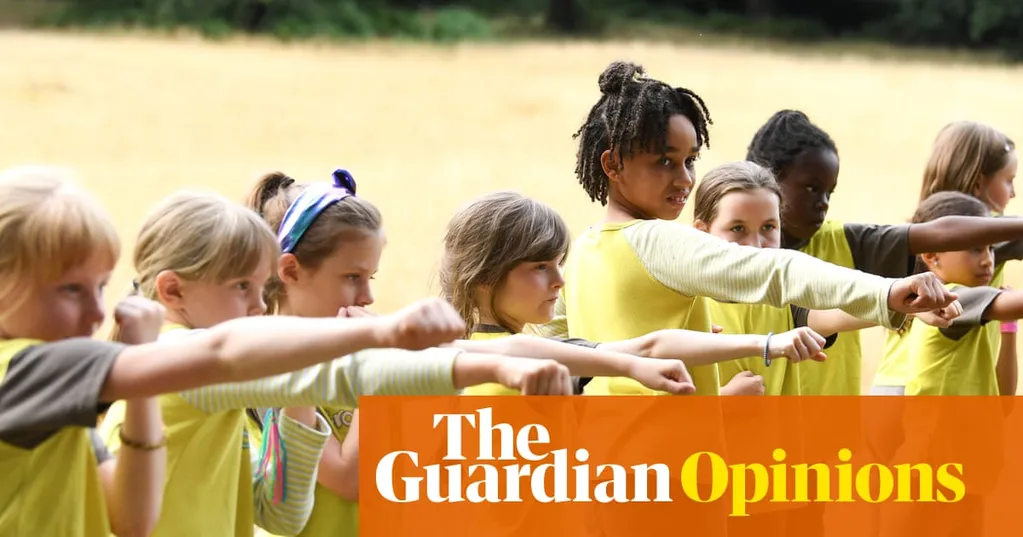
Girlguiding's response to last year's supreme court ruling is not the humane option - and changes the organisation's identity.
Great work, Guides; you've taken some members you had no idea even existed, and expelled them from your organisation with effect from September. This gives trans girls a humane half-year to extricate, because that's definitely what kids want: to participate for six months in a uniformed, voluntary, social organisation that has explicitly kicked them out, while they look for somewhere more welcoming.
"Like every charity, we have to follow the law," Girlguiding says in an online info pack whose FAQs are almost comically Stasi-lite. "Will volunteers be expected to carry out additional checks or ask for proof?" (The good news, folks, is that they won't; the mind boggles at what those additional checks might be that didn't breach at least some safeguarding protocols.) "How should volunteers check that trans girls have left?" (Some sort of dunking stool? In actuality, again, they won't check.)
The supreme court ruled unanimously last April that "sex" and "woman" referred to biological sex assigned at birth. It permitted services to be single-sex, but did not require it. Let's give the charity the benefit of the doubt and say that its board really did fear legal action if it continued to badge itself single-sex but remained inclusive. An obvious solution would have been to change its name away from something so clearly single-sex to KidGuiding or RangersRainbow, which reference two existing categories of Guide and sound about as gender-neutral as it gets.
Indeed, all the age-grouped sections of Guides are already essentially gender-neutral - four- to seven-year-olds are called Rainbows, harking back to a time (it was named in 1987) when it was considered fun for children to be able to identify bugs and sew things without constantly being reminded how female they were. Brownies, seven to 10, were so named in 1915, after the kids complained that "Rosebuds" was saccharine and they would prefer to dress in the colour of what they intended to get covered in: mud. I'm guessing; I don't actually have the minutes of that meeting. Guides and Rangers (10-14 and 14-18) are so gender-neutral, they could be, and most probably are, also the names of cars.
It was always understood that the more questionable elements of Guiding, the background hum of Christianity, the promises to "love my God" (which held until 2013), the oaths of allegiance to the monarch, the uniforms themselves, were all fine regardless of your worldview because the ultimate aim was sound. What was it? Now we'd say "community-building"; in the 1980s we'd have said "socialising"; doubtless in the 1920s it was "character-building". This was a way for girls to socialise without endlessly encountering the rules and strictures and expectations they found everywhere else. It was radical precisely because at no time in history did it insist on the femaleness of its members; it wasn’t where you went to dress like a fairy princess. It was supposed to be fun. It was still too trad for some, and they went to the Woodcraft Folk, where you got to smoke weed in the teenage division. But it never had a trace of nastiness.
Renaming the organisation would not have killed it, while the choice it has made could well do. It is impossible to quantify how much immediate impact this will have, since Girlguiding does not collect data on gender identity. Trans volunteers have also been asked to see themselves out, but the organisation doesn't even know how many of those there are. Will it deter new joiners? It's hard to see kids the age for entry into Rainbows or Brownies having made a final call on their gender identity, but it's very easy to see parents who are trans allies giving Girlguiding a wide berth. Deterrence and alienation are much more likely impacts of this decision than a wave of new members, and that's just the parents.
The Rangers, who are 14 to 18, play a huge part in the lives of younger Guides. Gen Z are famously inclusive, more likely than any other generation to identify as LGBT+. In the UK, women are more trans-inclusive than men. If you scoured the country to find some late teenagers who were in favour of this new rule, they would be more likely to be male, and so wouldn't have been allowed in the first place.
Girlguiding didn't have to address the supreme court judgment this way; it has centred notions of femaleness as an exclusive and fragile quality in a way that seems counter to the spirit of its founders; it has been hurtful to its trans members. A name change might have been dicey for the brand. What it has done instead has capsized its identity.