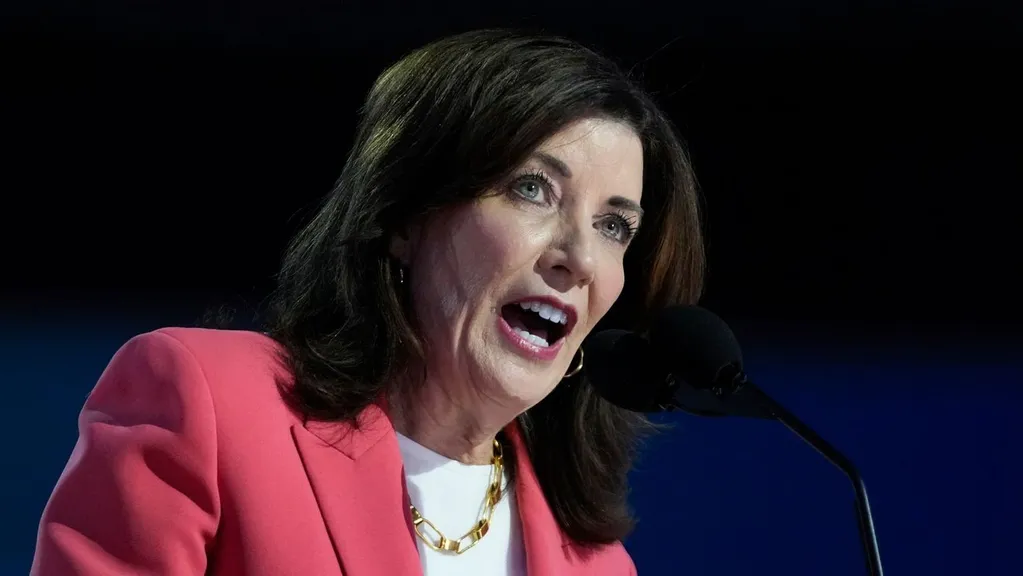
Albany, NY (WRGB) -- Gov. Hochul is calling for changes to New York's landmark climate law, arguing that shifting economic conditions, federal policy headwinds and rising energy costs have made the state's near-term emissions targets increasingly difficult to meet without driving up household and business expenses.
In an op-ed published March, 20th by Empire Report, Hochul said New York has become "a national leader for clean energy and climate action," and pointed to major investments and projects her administration has supported since she took office. Hochul wrote that more than $88.7 billion has been invested in clean energy through state programs during her tenure.
Hochul cited New York's "first-ever utility-scale offshore wind farm in the United States," and said two more offshore wind projects are under construction and have been "protected from Trump administration efforts to stop these fully-permitted projects dead in their tracks." She wrote that one of those projects "will power half a million homes in Brooklyn later this year."
She also pointed to congestion pricing, writing that her efforts to reduce emissions included "stopping the White House from killing congestion pricing," which she said is "already delivering results," while facing "fierce opposition from the President."
Hochul said the state met its 2025 solar goals a year early, approved 31 large-scale solar and wind projects, and "just last year allocated the largest investment to address climate change in state history." She also wrote that New York has remained a key participant in the Regional Greenhouse Gas Initiative.
Hochul said the Champlain Hudson Power Express, which she said she championed, "will become operational" in "just a few months," delivering hydroelectric power to New York City and helping offset emissions increases tied to the shutdown of the Indian Point nuclear plant.
While reaffirming support for the Climate Leadership & Community Protection Act passed in 2019, Hochul said "so much has radically changed since the Climate Act was enacted," and she is seeking "common-sense adjustments" that keep the state on a clean-energy path "in a way that is affordable for New Yorkers."
In the op-ed, Hochul cited post-COVID inflation, supply chain disruptions and "federally imposed illegal tariffs" as factors that have increased project costs. She also described a shift in Washington, writing that the federal government has moved from being "eager to partner on the clean energy transition" to a White House under President Donald Trump and a Republican-controlled Congress that she said has launched "a full-on assault on renewables and the tax incentives that encouraged companies to build and residents to convert."
Hochul wrote that "just this week" Trump "again vowed to block all new offshore wind projects" and is "actively attempting to dismantle those already under construction." She also said the federal government is canceling grants and tax credits for clean-energy technologies and "rolling back key scientific findings and regulations."
Hochul argued that state efforts are also being hindered by local opposition and restrictions, including "NIMBYism, moratoriums and outright bans" that she said have made siting on-land wind, utility-scale solar and battery storage "impossible in too many parts of our state."
She also linked energy affordability pressures to international events, writing that "the war in Iran is driving up gas prices at the pump to the breaking point for too many New Yorkers." Hochul said that with energy demand growing and the state having retired more fossil fuel plants than it has replaced with renewable sources, the state's electric system operator is projecting potential energy shortages, "particularly downstate," that could lead to brownouts and blackouts.
Hochul said she is pushing a "Ratepayer Protection Plan" aimed at holding utilities accountable, reforming how regulators consider rate hike requests, and making it easier for families to learn about and access the state's Energy Affordability Programs. She also said she has adopted an "all-of-the-above approach to energy" that includes renewables, "emission-free, reliable round-the-clock nuclear," and other power sources.
As part of budget discussions with the Legislature, Hochul said she is pushing changes to the climate law "solely out of necessity" to protect affordability and the economy. She pointed to a lawsuit by advocates seeking to force the state to issue regulations to meet the law's 2030 emissions reduction targets, and wrote that a judge ruled the state must swiftly issue regulations to achieve targets that she described as "costly and unattainable," unless the law is changed.
Hochul wrote that while the climate law "is not the driver of the high energy prices we are experiencing," she said the state cannot meet the 2030 targets "without imposing new and additional crushing costs on New York businesses and residents."
She cited findings from the New York State Energy Research and Development Authority, writing that meeting the 2030 targets would cost "more than $4,000 a year for upstate oil and natural gas households," and "$2,300 more for New York City natural gas households." She also wrote that gas prices would rise "an additional $2.23 per gallon above where it would otherwise be."
Hochul said she is proposing an amendment that would require regulations to reduce statewide greenhouse gas emissions to be issued "at the end of 2030." She said the state is seeking to change which emission limits the regulations are tied to, including "a new 2040 target" and the existing 2050 statewide emission limits, while keeping the law's statewide emission limit targets intact.
She also called for changing the state's emissions accounting methodology to align with international standards used by "nearly every other U.S. state," arguing that otherwise "these impossible emission reduction targetsonly used by NY and one other state will ensure our failure despite all of our efforts and billions of dollars spent."
Hochul said the proposed changes would preserve the intent of the law while recognizing economic and political challenges, and she urged lawmakers to approve what she called "needed and practical revisions." She said she looks forward to working with the Legislature on an outcome that makes New York "both more sustainable and more affordable."