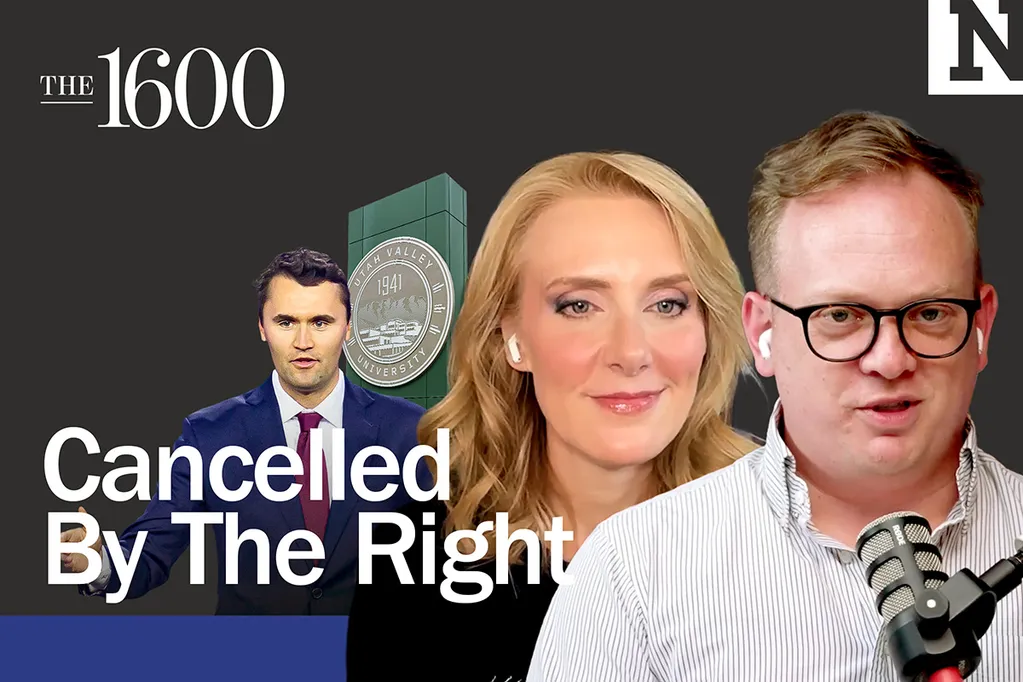
Sharon McMahon, a bestselling author and civics educator dubbed "America's government teacher," was scheduled to deliver the commencement address at Utah Valley University on Wednesday. UVU had endured a traumatic school year that began when Charlie Kirk, the conservative activist and Turning Point USA founder, was assassinated on campus last September. The administration wanted her to help close out a devastating year.
McMahon had built an organic social media following by refusing the binary thinking that dominates American public discourse. She runs a popular Substack newsletter called "The Preamble," hosts a podcast, and has written books on civics. She had spoken at UVU twice before to packed arenas. When the school announced her as commencement speaker, she did not expect the backlash.
"There began an organized, coercive pressure campaign on the part of government officials, both congressional officials and state level officials, along with Turning Point USA, to try and pressure the school into removing me as the speaker," McMahon told Carlo Versano on Newsweek's The 1600 podcast, explaining why the invitation fell apart.
The invitation was rescinded days before the ceremony. An organized pressure campaign, involving government officials at both congressional and state levels as well as Turning Point USA itself, forced the university's hand. With it came security threats -- not just against McMahon, but against the school president, the board of trustees, and the institution itself. "Let her get up on the stage and we'll just take her out that way," some wrote, according to McMahon.
Senator Mike Lee of Utah, a Republican, led the cancellation campaign over several days on X, urging followers to pressure the university to revoke the invitation. The immediate trigger was an Instagram post McMahon shared two days after Charlie Kirk's assassination.
On the day of the shooting, she said in a post on Facebook: "This isn't the kind of America I want to live in. I'm sure Charlie Kirk and I would not agree on many things. And my heart is still broken for his family."
Her second post took a different tone. On Instagram, McMahon included a series of slides explaining who Kirk was, outlining his organization, his podcast, and his influence. She was trying to reach two audiences at once. Some people had never heard of him. Others supported him and could not understand why he drew so much opposition.
"I thought he was much more of a household name than perhaps he actually was," McMahon said. "So there were thousands of people reaching out to me saying, I just don't understand what is going on here. Why would somebody want to assassinate somebody that they had never heard of?"
The post was meant to close that gap. For Kirk's admirers, she explained why his rhetoric had sparked backlash. For those unfamiliar with him, she said she wanted to offer context about his reach and role.
"The idea that I'm platforming Amy Coney Barrett," McMahon said, referring to her book club, which has featured figures from across the political spectrum, "she has a far bigger platform than I do. I'm just asking you some questions."
At its core, McMahon said her frustration over being disinvited to speak to UVU grads was not about her ego. She believes Americans are losing the ability to engage with opposing views. In her telling, social media algorithms reward outrage over understanding, feeding users content that provokes rather than informs.
"The idea that we are somehow entitled to only be surrounded by information that we agree with, I think that's actually a huge problem in the United States right now," she said. "I agree with it. So it's true, right. And if I disagree, it's a lie."
The system, she argues, is designed to learn what holds attention. It tracks what angers you and what you like, then serves up more of it. Sometimes it confirms your beliefs. Sometimes it provokes you. Either way, it keeps you engaged, and the space for genuine learning shrinks.
Yet McMahon says her newsletter and podcast have built a "cult following" because they push against that pattern. People often tell her they disagree with her on many points but still find themselves thinking more deeply after listening.
"You cannot develop critical thinking skills or intellectual maturity without wrestling with information you might disagree with," she said.
The commencement speech McMahon was planning to give would have centered on America's 250th anniversary. She wanted to talk about what it means to love a country while also demanding it be better.
"Celebrating something does not mean you agree with every aspect of it," she said. "It doesn't mean you ignore the realities of history. It doesn't mean that you pretend we have not made mistakes."
She offered a simple metaphor: You can love your spouse and also be frustrated by them. You can be proud of your accomplishments while recognizing your laziness. These contradictions are not strange in the human mind. Why should they be strange when we think about the concept of America?
What is worth celebrating, in her view, is the long arc of American expansion of rights and freedoms. Over 250 years, the country has gradually extended political inclusion to more people. It has welcomed immigrants from around the world. It has, despite profound challenges, held together as a multiracial democracy.
"Most other enduring democracies don't have nearly as challenging a hand," she said."The fact that we have made it this far,I think that's worth celebrating."
But celebration is not complacency. “When you love something,you want it to be the best you can be.And that’s how I feel about America.I want America to keep being better.”
That message -- that two things can be true at once, that nuance is not weakness, that engaging with opposing ideas is a prerequisite for citizenship -- was supposed to be her parting words to the UVU graduating class. Instead, it remains undelivered.