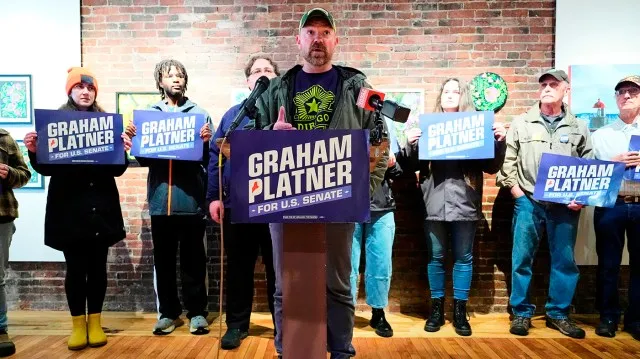
Populist Democratic candidate Graham Platner shook up his party's establishment when his primary competitor, Maine Gov. Janet Mills, suspended her Senate campaign last week amid polls that showed she was badly trailing her rival, an oyster farmer who had come out of nowhere to win a national following in the party.
Platner's rise is just the latest example of the outsiders era in the Democratic Party, a period coinciding with President Trump's tenure that has also seen Zohran Mamdani, a self-proclaimed democratic socialist, defeat former Gov. Andrew Cuomo in the race for New York City mayor last year.
Platner, Mamdani and Trump all seemed to win political support with attacks on their respective parties' political establishments; each has a brand signaling a desire to shake up the state quo.
It's left some Democrats wondering whether that means there is a wide-open lane for an outsider to become the party's presidential nominee in 2028.
"There's always only a few tickets out of the early primary states, and in the 2028 primary cycle, one of those tickets will very likely be from an outsider who comes from outside of the traditional political system," said Democratic strategist Joel Payne.
"The public at large is in the midst of a very antiestablishment moment, and I think that is particularly true for base Democratic voters," Payne explained. "There is a hunger for voices from outside the system, and those who have experience within the system are carrying baggage with them politically."
There's no question there is a lot of anger and frustration within the Democratic base.
This anger has been sparked in part by the disappointment in losing to Trump in 2016 and 2024, when candidates backed by party leaders lost in November to the GOP's lead outsider candidate.
In 2024, Democrats didn't even really get to choose their nominee from the primary process, since former President Biden dropped out of the race after a poor debate performance and was replaced by former Vice President Kamala Harris. While the Biden ticket won the Democratic primary that cycle and Harris was the natural heir apparent when he made his exit, it left some Democrats feeling like higher powers were picking their nominee.
That's likely sparked more interest in nonestablishment voices.
At the same time, however, the best-known contenders for the Democratic presidential nomination in 2028 are establishment figures who are dominating the early conversation.
It all suggests that while voters may be flirting with outsiders, the party's donor class and infrastructure remain firmly aligned behind more traditional candidates.
California Gov. Gavin Newsom has made waves for attacking President Trump on a regular basis, sometimes mimicking his would-be rival on social media. He has also built a massive email list from his successful Proposition 50 fight on redistricting and has remained the early front-runner, according to Beltway insiders.
Harris has also remained at the top of polls, even as some in the party question why she would run again.
Other potential candidates including Pennsylvania Gov. Josh Shapiro, Illinois Gov. JB Pritzker and Rahm Emanuel, the congressman-turned White House chief of staff.
None of them would be considered outsiders.
An Echelon Insights poll released last month found an already tightly packed field, with Harris at 22 percent support, Newsom at 21 percent, former Transportation Secretary Pete Buttigieg at 12 percent and Rep. Alexandria Ocasio-Cortez (D-N.Y.) at 10 percent. The survey said another 10 percent of respondents were undecided.
While Ocasio-Cortez would argue her candidacy would be about changing the status quo, she'd fit in the progressive lane of the primary process occupied by Sen. Bernie Sanders (I-Vt.) over the last several cycles.
The field is lacking a true outsider voice, according to some Democrats, who worry that without one, the party could fall to the GOP in the battle for the White House.
"We need new energy," said one Democratic donor for Harris. "I don't care if she lost by one vote. She still lost. And we need to look forward, not back."
"That's part of the problem, we never really learn our lessons," the donor added. "We keep making the same mistakes, with the same people. I think the recent elections have shown that people want change."
In 2008, Barack Obama, then a first-term senator, ran on a message of change and defeated Hillary Clinton, overcoming a well-oiled Democratic machine that had long been seen as the dominant force in the party.
In 2016, Sanders came out of nowhere to challenge Clinton as an ideological outsider, extending her primary campaign far longer than she hoped.
Obama and Sanders are not in the mold of Trump or Platner, but they were seen as challengers to an existing Democratic status quo.
In 2020, Buttigieg, then a small-town mayor from Indiana, surged in the polls; building a sizable following in a short time was unusual for such figures in presidential contests. Buttigieg’s status as a gay man and mayor of South Bend gave him some degree of outsider status.
Trump ran on being an outsider in the 2016, 2020 and 2024 presidential elections with calls to "drain the swamp." He's also a widely known critic of the establishment, and his policies didn't always fall along neat ideological lines of the past.
Susan Del Percio, a veteran Republican strategist who does not support Trump, has long predicted that Democrats will look past an establishment figure in favor of an outsider in the 2028 race.
"People are fed up and they don't see solutions," Del Percio said. "In either party, no one wants someone who's tinkering around the edges. They want bold."
"They don't expect someone within the system to change the system," she added.
That said, no true political insiders have emerged as potential 2028 Democratic candidates so far. Names banded about include billionaire Mark Cuban—who has all but ruled out a run—Stephen A. Smith (television host/sports analyst); comedian Jon Stewart.
If Platner does beat Sen. Susan Collins (R) in Maine, strategists say he could instantly be seen as someone who would be the future of the party -- and it could stoke a run for higher office.
"It isn't hard to imagine anymore," one Democratic strategist said.