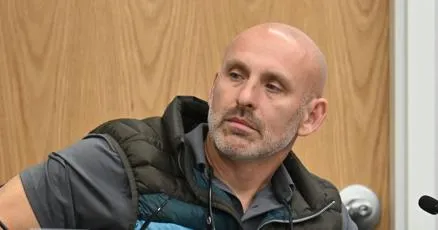
GREENVILLE -- In the lead-up to a 2024 referendum for a Greenville County penny sales tax for roadwork, then council candidate Curt McGahhey joined a chorus of voices opposing the measure.
The process was rushed, lacked transparency and if successful would unnecessarily grow county government, he said during an appearance on a local radio program a month before the vote.
Ultimately, that tax was defeated for the second time in a decade, sending county officials back to the drawing board in their effort to address the area's multibillion-dollar infrastructure crisis.
Now, with a little more than a year as a sitting council member, McGahhey has announced he will champion a penny tax to pay for roadwork.
And it appears others are on board -- including Council Chair Benton Blount, who also opposed the 2024 referendum.
The decision, McGahhey said, is not an about-face from his previous stance. For one, he said he would support eliminating the existing county roads fee, which accounts for about $14 million in revenue a year, if the local option sales tax is approved.
More broadly, McGahhey said there are significant differences between the sales tax he is now advocating for and the one rejected by voters almost two years ago, including that it would be under direct council control versus the previous ballot measure that was governed by an appointed committee.
McGahhey said his proposed tax would last roughly the same time as the defeated levy would have -- eight years -- and raise the same amount of revenue during that time -- more than $1 billion.
The defeated ballot measure, however, was a capital projects sales tax while the one McGahhey is now pushing for is a transportation sales tax.
Both add another 1 percent to purchases in the county, but they differ in a few key ways.
One of the most consequential, McGahhey said, is the way the county crafts the ballot measure before it goes to the voters and how they administer it once it's in place.
For a capital sales tax, the county under state law must form a CPST committee, a group that in turn formulates a list of projects that would be funded by the new revenue. The council could choose to approve or deny that list but not change it, and the tax revenue can only be spent on the listed projects and only those projects.
The capital sales tax can be spent on a wide range of expenditures, though the 2024 list that appeared before voters included only road work, comprising more than 1,500 projects across the county.
That process lacked transparency, McGahhey said, because council members ceded their authority to a group of unelected committee members.
By contrast, the council has direct control over what transportation tax revenue is spent on. That, and a narrower list of approved uses, creates more accountability, he said. The council would decide what to prioritize based on the county's existing road conditions index.
"We're accountable to the citizens and bureaucrats aren't," he said.
Councilmember Liz Seman, one of the most senior members of the council, supported the penny tax in 2024 and argued in a recent interview with The Post and Courier that the transportation penny is in fact less transparent than the capital sales tax.
While County Council would have been constrained to the list of projects put forward in 2024 and decided on by voters, she said the council has less stringent guardrails on revenue from the transportation tax, making it more susceptible to shifts in political winds.
Still, Seman said she would support a transportation tax as outlined by McGahhey.
"I think it was pretty obvious as we were going through our year's worth of activities that the road issue was pretty insurmountable without a dedicated funding source," she said. "I definitely got the sense he (McGahhey) got a much clearer sense of what we were facing, so I'm not surprised he's championing it."
McGahhey said the proposal he is putting forward would not be used to pay for work on any state roads, another key difference from the 2024 ballot measure.
In the lead-up to the 2024 vote, opponents regularly criticized the capital tax for including roads they said should be the sole responsibility of the state Department of Transportation. McGahhey said his proposal would do away with that concern.
"We're not going to pave state roads with it," McGahhey said. "We already pay the (state) gas tax."
However, proponents of that defeated measure noted that close to half of the more than 4,000 lane miles in the county are owned by SCDOT, and residents are more interested in seeing roads fixed than who owns them. Despite the recently matured state gas tax, advocates for the local solution argued that waiting on state funding could be perilous as SCDOT works to address a decadeslong backlog across the state.
Seman said she believes it's misguided to neglect such a significant portion of the county's road inventory on principle.
"I think the conversation should be more about what are our worst roads," she said. "In some instances, the state roads are connected to local roads. To me, you can't just fix part of the problem."
McGahhey said he would be open down the line to consider some projects on state-owned roads, specifically where they intersect with county roads, but not in the near future.
A previous Greenville County transportation penny tax failed by a wide margin in 2014; a defeat officials at the time attributed to the fact it would have taxed groceries and pharmaceuticals.
But a recent change in state law allows for those essential purchases to be excluded.
"We'll exempt groceries," McGahhey said. "I'm not trying to tax people on every little thing."
The penny sales tax vote in 2024 came on the heels of a controversial property tax increase the year before -- the county's first in three decades -- that led to upheaval on the council, with three incumbents who supported it losing their seats to primary challengers.
All of those primary victors -- including McGahhey -- as well as several sitting council members campaigned against the capital sales tax in the lead up to the vote.
Despite those headwinds, the penny tax only failed by a 3-point margin. McGahhey said District 21, which he represents, actually voted in its favor by roughly 700 votes.
"When people say you're just trying to tax us, I'm not," he said. "I'm representing my district. My district passed the capital project sales tax in 2024. I have the numbers."
Now, other members of council who opposed the penny increase two years ago are voicing support for McGahhey's proposal, including Blount.
McGahhey's proposal to use a transportation tax, focus on county-owned roads and eliminate the roads fee have all made the proposal more palatable for Blount.
"It gives the public a better chance to really address the specific road concerns in their districts with their own council person," he said.
Blount has repeatedly said county leaders need to prove to voters they are exhausting every option before sending them another penny sales tax referendum. Since 2024, County Council has squeezed more money out of business incentive deals to significantly expand road spending; but those funds still fall woefully short of meeting growing area needs.
The 12-member body has also studied implementing impact fees in an effort to make development pay for its own effect on surrounding roads. But the consultant county hired to examine fees was clear that, as structured under state law, it could not afford them without separate funding source such as penny tax.
"I think most of the main mechanisms that people use to address decades-old road needs have been exhausted," Blount said. "The only other option would be some sort of revenue increase, which would come through a tax increase. The only way I would support a tax increase would be for the citizens themselves to vote on it."
Still, it is unclear how the historically tax-averse county will respond to a penny tax on the ballot so soon after rejecting a similar measure in 2024.
McGahhey said he plans to get the sales tax in front of voters in this November's election just six months away and as of yet no independent group has stepped forward to advocate for it as economic development promoter OneSpartanburg did for a successful capital sales tax initiative in 2017.
Blount said he isn't concerned that a local group has yet to take on that role.
"Citizens are smart enough to digest real, factual information for themselves," he said. "I don't know if they need a sales pitch."