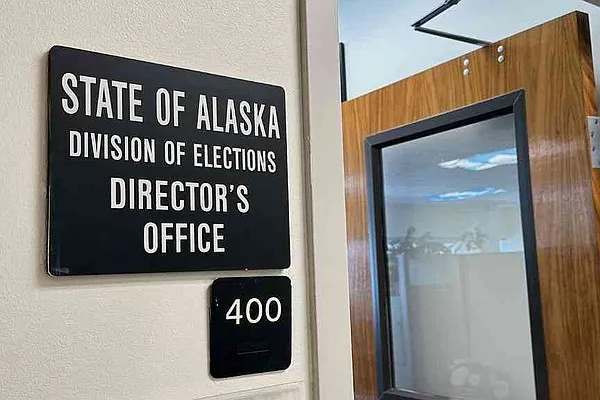
JUNEAU, Alaska -- Voting and civil-rights groups sued Alaska elections officials Wednesday, claiming that their sharing of the state's full voter registration list with the U.S. Department of Justice violates the state constitution.
Alaska is one of at least 12 states that has provided or said it would provide detailed information about its voters -- including date of birth, driver's license number or partial Social Security number -- to the Trump administration, according to the Brennan Center. Alaska and Texas also signed agreements when they shared data in which the department outlined plans for its own analysis of voter files, its plans to flag voter list issues and directions for removing voters deemed ineligible.
Several other states provided the data, but refused those agreements, as part of a wide-ranging effort by the Justice Department to obtain detailed voter data from every state. Some elections officials have expressed concern the information being sought could be used by the Trump administration to search for possible noncitizens.
The Alaska lawsuit was filed in state court against state Division of Elections officials by the League of Women Voters of Alaska and Alaska Black Caucus. It claims the handing over of personal data on the voter list violates the right to privacy under the state constitution. It also says the memorandum of understanding violates due process by allowing the Justice Department to flag voters for removal "without any apparent notice or process for impacted voters to challenge those decisions."
The lawsuit names as defendants Republican Lt. Gov. Nancy Dahlstrom, who oversees the division, and division Director Carol Beecher.
Sam Curtis, a spokesperson with the state Department of Law, said by email that it would be premature to comment on specific claims raised in the lawsuit. But Curtis said the department has previously explained in public hearings that state law "expressly permits the sharing of this information for authorized governmental purposes. That statute is on the books, and we will defend it."
The plaintiffs are represented by the American Civil Liberties Union of Alaska, ACLU Voting Rights Project and the Electronic Privacy Information Center.
The Justice Department has sued at least 30 states and the District of Columbia to try to force the release of the data, according to a tally by the Brennan Center. Judges have rejected those efforts in California, Massachusetts, Michigan, Oregon and most recently Rhode Island. A judge in Georgia dismissed a Justice Department lawsuit after ruling it had been filed in the wrong city. It was subsequently refiled.
In addition to the state court lawsuit in Alaska, at least four federal lawsuits have been filed around the U.S. seeking to stop the Justice Department from collecting information from unredacted voter registration files or to prevent states from taking steps to cancel or suspend people's voter registrations based on the federal project.
During a legislative hearing in Alaska last month, Rachel Witty, an attorney with the state Department of Law, told lawmakers the state had a "compelling interest" to comply with the federal request.
"To ensure the integrity of elections, there was a mutual interest in maintaining voters rolls that were accurate and current," she said.
The Alaska lawsuit describes the process under state law for maintaining voter rolls and states that there are only limited circumstances under which a voter's registration can be promptly canceled -- "upon death or conviction of a felony involving moral turpitude." It says that while elections officials have said they will only remove voters "to the extent allowed by state and federal law," that interpretation is "irreconcilable with the plain language" of the agreement signed with the Justice Department.
Information for this article was contributed by John Hanna of The Associated Press.