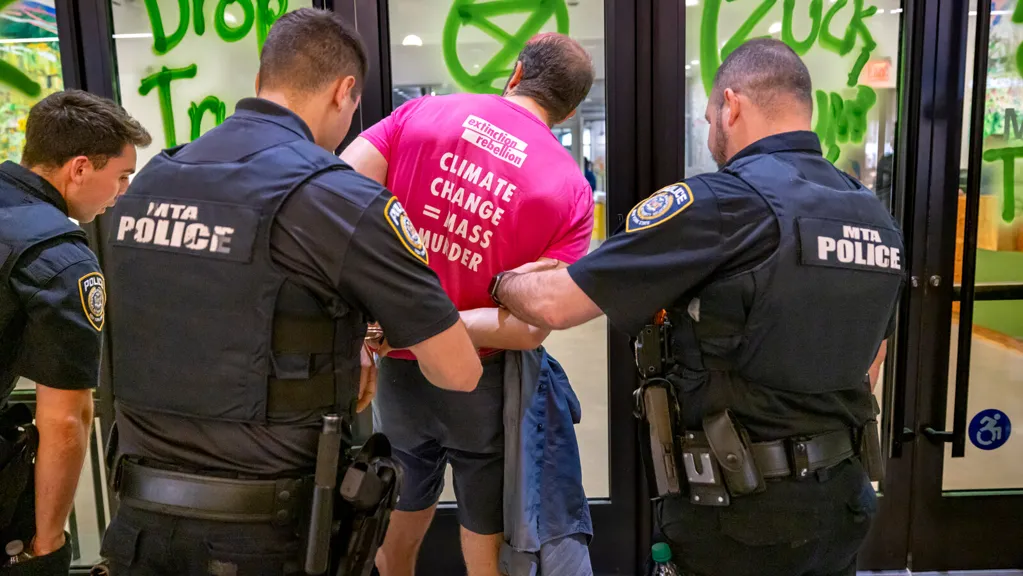
As the Trump administration cracks down on climate change activism, members of environmental groups like Extinction Rebellion fear they are being targeted.
On a recent frosty February morning, 200 miles north of New York City, a middle-aged man had just had his tea and toast and opened his laptop. He heard a knock on his door. When he answered it, a woman, accompanied by a man, identified herself as a counterterrorism agent with the Federal Bureau of Investigation. She said that she wanted to talk with him about Extinction Rebellion, a global environmental group. He was not in trouble, she told him.
The man's heart started racing. He told them he had nothing to say. The F.B.I. agent asked if there was someone who could speak on the man's behalf. He said no. The two agents thanked him and left.
The man closed the door and called his lawyer.
For several years, the man, who spoke on the condition of anonymity because of safety concerns, had been active in Extinction Rebellion, which specializes in splashy, nonviolent actions that call attention to global warming. Members have disrupted a Coco Gauff tennis match at the U.S. Open and interrupted a Broadway play. Now, Extinction Rebellion and other environmental groups are concerned that the Trump administration, as it continues to clamp down on protesters, is casting its net wider to include climate activists.
In January, the man, who is no longer active in the group, received a call from the F.B.I. He figured it was a scam and hung up. Two minutes later, an agent texted him, saying that she was standing outside his home. But it was his old address, hundreds of miles away. A few weeks later, the same agent and a colleague were standing outside the mud room of his current home.
"This door knock marks a significant escalation," said Ronald L. Kuby, the man's lawyer, who represents several climate activists. "The fact that they went to the wrong address of a member who has not been active suggests that they are starting an investigation. They are digging."
Mr. Kuby called the agent, but did not hear back from her. When The New York Times called the agent, she referred a reporter to the public affairs officials in the F.B.I.'s New York office. A spokeswoman there said that the agency could not "confirm or deny the existence or nonexistence of any investigation."
Climate activists, with their disruptive and creative tactics, get both media attention and public criticism, but they are not violent, said Dana R. Fisher, the director of the Center for Environment, Community and Equity at American University.
The Biden administration was open to differing public opinions -- some of them voiced loudly and in large numbers -- on global warming, Dr. Fisher said. But President Trump has called climate change a hoax, removing mentions of it on government websites. And last week, his administration ended the federal government's legal authority to control the pollution that is heating the planet.
Climate activists can prove to be especially vulnerable, Dr. Fisher said, because they often equate environmental justice with economic and racial justice, joining protests against other Trump-era actions, such as mass deportations. The Trump administration, in turn, will "try to pick off what they see as the lowest hanging fruit of activists," she said.
The Department of Justice said in a statement that it would "continue to hold accountable any individual that crosses the red line between peaceful First Amendment activity and obstructing, impeding or attacking federal law enforcement agents. No matter the cause, no one is above the law."
Marianne Engelman-Lado, the director of the Environmental and Climate Justice Initiative at the New York University School of Law, said that over the past year she had noticed an uptick in efforts within the legal community to help nonprofits working in the realm of climate justice. Several of those groups have received threatening letters from members of Congress.
"They are now very aware that they need to have their ducks in a row," she said.
In late January, a different climate group disrupted an event at a synagogue in Roslyn, N.Y., to protest a Long Island congressman's support of a bill that would provide billions of dollars for deportations. Afterward, Harmeet Dhillon, an assistant attorney general, posted on social media that the Department of Justice would investigate the incident to see if federal law had been broken.
Mr. Trump has doubled down on what he calls "domestic terrorism." Last fall, after the assassination of conservative activist Charlie Kirk, the president issued a memorandum that called for a new strategy to "disband and uproot networks, entities and organizations that promote organized violence, violent intimidation, conspiracies against rights and other efforts to disrupt the functioning of a democratic society."
Climate groups were not mentioned in the document, but Nate Smith, a member of Extinction Rebellion, highlighted the memo's sweeping language, which calls out those who it says oppose capitalism and Christianity and those who it says hold extreme views on migration, race and gender. "It is a very dangerous wish list," he said.
In May, six activists in Boston—several of whom belong to Extinction Rebellion—were visited by people who said they were F.B.I. agents. In October, Peter Thiel, the tech billionaire and a Trump ally, called critics of artificial intelligence—including Greta Thunberg, the Swedish climate activist—"legionnaires of the Antichrist."
Three years ago, Marco Rubio, who was then a U.S. senator, asked the F.B.I. and the Department of Homeland Security to stop foreign members of Extinction Rebellion from entering the country. He was concerned, he said in a letter to the agencies, about activists plotting to block important transit routes and disrupting federal sites. (In 2019, members of the group delayed train service at a London station, resulting in violent outbreaks among commuters. Afterward, group leaders said that the protest had been a mistake.)
The middle-aged man who said that he had received a knock on the door from an F.B.I. agent once witnessed tidal flooding submerge a neighborhood. It alarmed him. Soon, he was observing state-sponsored public planning meetings about reducing greenhouse gas emissions, but he found them wonky and uninspired.
He started to believe that public awareness was the solution, so he joined Extinction Rebellion. He participated in about half a dozen actions between 2022 and 2024 and was arrested multiple times, facing a misdemeanor charge in Connecticut. He and other activists were fined more than $6,000 in total. But a year ago, he left New York City, as well as his activism, behind.
Extinction Rebellion is reminding members about measures they can take to deal with federal agents and the importance of knowing their legal risks each time they engage in activism. And the group's leaders say they emphasize practicing nonviolence.
"We are not dissolving and not retreating," Mr. Smith said. When asked if any new actions were planned, his response echoed the F.B.I. statement: "We can neither confirm nor deny that."