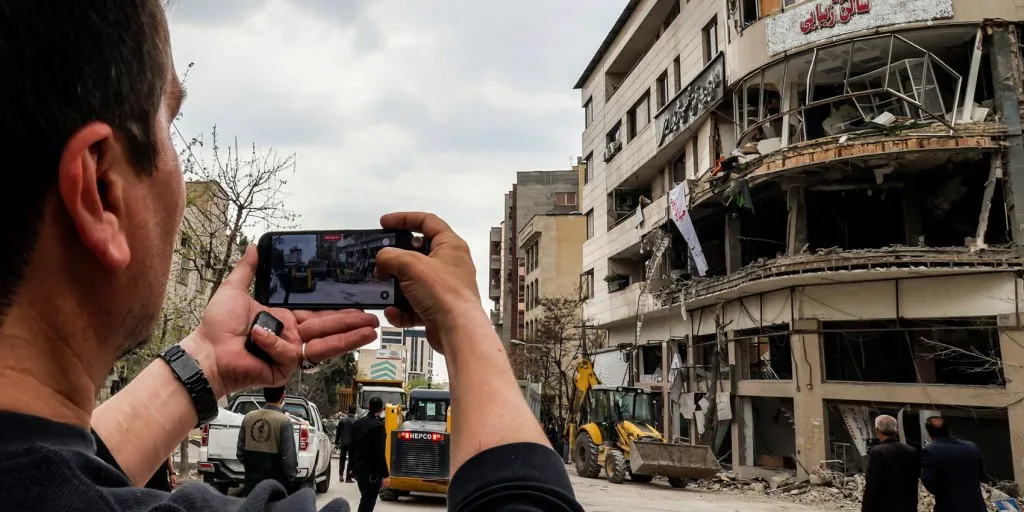
Crackdowns in Persian Gulf countries have chilled speech and limited the open-source evidence available to investigators tracking the conflict.
Sayed Mohammed Al-Mousawi disappeared in Bahrain after leaving a shisha cafe where he broke his Ramadan fast with his cousin and a friend. It was past midnight, in the early hours of March 19. Eight days later, his family received a call to collect his corpse.
Images of Al-Mousawi's body covered in bruises and lesions on his face, feet and torso filled social media feeds.
"The entire body, sir, cannot be described as intact," a family member said in a statement to human rights investigators shared with NBC News. "It was severely disfigured."
The images ignited a torrent of confusion and outrage at Bahraini authorities and calls for an investigation. The exact circumstances around Al-Mousawi's detention remain unclear, but his killing has become a flash point in a wider crackdown across the Persian Gulf in the shadow of the U.S. war on Iran, human rights groups say, in which authorities have made arrests under uncertain circumstances and targeted individuals over social media posts.
Hundreds have been arrested in countries across the Gulf region, according to the United Nations' high commissioner for human rights, some on allegations of expressing sympathies for Iran's attacks and for posting images of Iranian bombardments to social media. Often, those arrested are accused of espionage and are sent for expedited trial -- an action the U.N. says could lack due process. In Bahrain, it is estimated that over 200 people have been arrested in similar circumstances. An unknown number have disappeared. Some of those accused of espionage are facing the death penalty. Governments in the region have long kept a tight grip on power. Since the war began, they've sought to preserve an image of stability and openness to investors.
NBC News reviewed Al-Mousawi's death certificate, examined photos and videos of his body, consulted with medical professionals and interviewed human rights investigators to scrutinize the circumstances of his death amid what those investigators say is a broader pattern of repression in the country.
Al-Mousawi's case is the first known death in detention seemingly tied to such arrests. It illustrates the brutality of the crackdowns and the limits on governments' powers to control information about the conflict. News of his death became pervasive on Telegram, Instagram, X and other platforms, with the same four images shared over and over. Confusion about the circumstances around his detention sparked false theories, drawing further ire.
In an initial statement in response to the images circulating online, Bahrain's Interior Ministry said Al-Mousawi had been charged with espionage "with the intent of facilitating attacks against the Kingdom," adding that the case is under investigation. The ministry called the photos "inaccurate and misleading." His family has denied the charges.
The Special Investigation Unit released the results of the investigation on Apr. 16, announcing that it has charged one individual with "assault resulting in death." Al-Mousawi and others were detained "pursuant to a lawfully issued arrest warrant," authorities said, but did not clarify the initial cause for the arrest.
"The Special Investigation Unit affirmed its full commitment to carrying out its mandate by exercising all its judicial powers to uphold the rule of law, ensure its enforcement, and respect human rights, particularly the rights of accused persons and detainees," the statement said.
The detentions have made residents hesitant to speak about the war, throttled the availability of crucial online evidence of the unfolding conflict and contributed to a climate of fear in the face of authoritarian governments.
"You have the war, bombardment and rockets are flying at you, and you're not allowed to talk," said Khalid Ibrahim, the executive director of the Gulf Center for Human Rights, a nonprofit organization that has been tracking the arrests.
The repression has extended to members of the press, according to the Committee to Protect Journalists, a nonprofit that tracks media repression globally. In one prominent case, American Kuwaiti journalist Ahmed Shihab-Eldin is being held on what are understood to be charges of "spreading false information, harming national security and misusing his mobile phone," said a statement from CPJ, which called the accusations "vague and overly broad." Shihab-Eldin, a prolific social media user, previously posted a video of an F-15 fighter plane crashing in Kuwait.
The crackdown has been acute in Bahrain, human rights organizations say. Since the war began, authorities have set up checkpoints where residents' phones may be searched, and the country has monitored online activity.
The importance of digital media from the region goes beyond free expression. In conflict, online images and videos have become essential to countering misinformation and propaganda. From Ukraine to Sudan, it has helped investigators compile evidence of apparent war crimes and mass killings. In the war against Iran, it has been instrumental for dissecting the consequences of the conflict.
The arrests in Bahrain are focused in part on what authorities say is "misusing social media platforms," including posting images of Iran's attacks and support for Iranian aggression. Authorities have not pointed to specific posts made by the detained individuals. Others have been detained without clear charges, leaving their families wondering about their location, human rights organizations say.
"The war has given them a good opportunity to further silence their own citizens," Ibrahim said.
Such was the case with Al-Mousawi's family, who did not know what prompted his detention or where he was held. Al-Mousawi disappeared just after 3:00 a.m., having abruptly ended a phone call with a family member, said Sayed Ahmed Alwadaei, the director of the Bahrain Institute for Rights and Democracy (BIRD), who has been investigating the case.
Al-Mousawi's family tried unsuccessfully to reach him. But they had access to his smartwatch and tracked his phone to a police station. When they called to inquire whether Al-Mousawi was held there, they were told he was not. As state institutions closed for holidays to mark the end of Ramadan, there was nothing they could do but wait.
Al-Mousawi, of the historically oppressed Shia Muslim faith, was previously detained and had served about 11 years as a political prisoner following arrests across the region in the wake of the Arab Spring, said Alwadaei of BIRD. He was released in a mass pardon in 2024. Since his release, he had been catching up on lost time; his family told human rights investigators he married and opened his own barber shop.
Al-Mousawi's family was only told he was dead after they arrived at the military hospital where his body was held.
A death certificate obtained by NBC News shows the official cause of death as cardiopulmonary arrest and acute coronary syndrome. Images and videos of the body viewed by medical professionals at the Independent Forensic Expert Group, led by the International Rehabilitation Council for Torture Victims (IRCT), point to mistreatment in detention.
IRCT experts could not ascertain when and how each wound had been established without a careful examination of the body, but determined "the observed pattern is highly consistent with physical ill-treatment and is compatible with abuse in a police or detention setting."
Bahrain's Interior Ministry did not respond to a request for comment.
Those he was arrested with remain in detention in an unknown location, human rights groups say. The U.N. has called for an investigation.
"We urge an end to serious civic space restrictions more generally, including all forms of surveillance, travel bans, harassment & persecution of dissenting voices," the U.N. statement said. "The use of torture and coercion during interrogations must cease."
The Bahrain authorities have not been able to contain the outrage over Al-Mousawi's death. Mourners at his funeral chanted against the royal family. The images of Al-Mousawi's body spread despite the restrictions, circulating on social media and in private chats, underscoring the power of digital evidence.
Professor Jeffrey Lewis and research associate Sam Lair at the Middlebury Institute of International Studies have been using social media images posted throughout the conflict to assess how it has unfolded in the region even as governments are attempting to lock down communications.
When U.S. Central Command claimed on social media on the morning of March 9 that an Iranian drone damaged civilian houses in Bahrain, Lewis and Lair were able to counter that narrative with the help of a video recorded on the ground, which showed a U.S. missile system firing. The video allowed researchers to calculate the trajectory of the missile flying uncharacteristically low and match it with other reports of explosions; their analysis concluded with moderate to high confidence that the Patriot missile caused the damage. Asked for comment, CENTCOM referred to a statement in which Bahraini authorities confirmed a Patriot missile was involved.
"The data is useful for arriving at the truth of the situation rather than supporting one side or the other," Lair said. "That's why it's valuable."