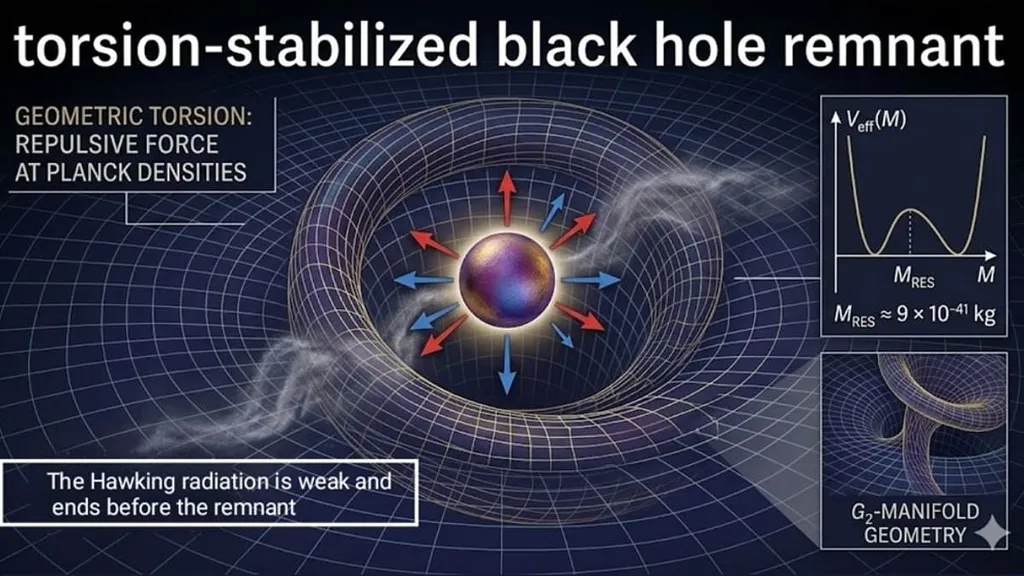
It might sound like something from The Matrix, but scientists now say that our universe has seven dimensions.
In addition to the four dimensions we normally experience - height, length, depth, and time - physicists argue that there are three extra 'folded' layers of reality.
Far from being science fiction, researchers believe it could solve one of the most stubborn problems in the history of physics.
According to the researchers, this wild theory finally explains what happens to black holes when they die.
Scientists used to think that black holes were cosmic voids from which nothing could ever escape.
But in the 1970s, Stephen Hawking realised that black holes emit radiation, slowly evaporating away as time goes by.
The problem is that this appears to violate one of quantum physics' most important rules, creating something called the information paradox.
A group of researchers now say they have found a solution to this 50-year-old conundrum - but it only works if the universe really has seven dimensions.
Scientists say that the universe actually has seven dimensions, the four we are used to experiencing - length, height, depth, and time - as well as three more 'hidden' layers of reality that tangle together in knots.
The information paradox stems from a rule in quantum physics which states that information cannot be destroyed.
Co-author Richard Pinčák, a senior researcher at the Slovak Academy of Sciences, told Live Science: 'Imagine you throw a book into a fire.
'The book is destroyed, but in principle you could reconstruct every word from the smoke, ash, and heat -- the information is scrambled, not lost.'
However, according to Hawking, black holes should eventually evaporate away into nothingness, taking all the information they once contained with them.
This appears to be a fundamental clash between the 'classical' laws of physics ruling big objects like black holes and the quantum laws that govern things on the smallest scales.
Dr Pinčák's unique solution to this paradox stems from a novel way of understanding the structure of spacetime itself.
According to Einstein's theories, spacetime is like a four-dimensional sheet that can twist, bend, and stretch in the presence of strong gravitational fields.
But according to some modern theories, spacetime actually has seven dimensions, including three that we can't normally see.
This theory helps to solve the puzzle of what happens when black holes evaporate and vanish. They appear to disappear, but this violates one of the rules of quantum physics.
'We experience three dimensions of space and one of time - four dimensions in total,' says Dr Pinčák.
'Our model proposes that the universe actually has seven dimensions: the four we know, plus three tiny extra dimensions curled up so tightly that we cannot directly perceive them.'
This means that spacetime can not only fold, but twist - creating a new physical effect known as torsion.
It turns out that this so-called 'torsion field' is key to understanding what happens to black holes when they appear to vanish.
According to the researchers' theory, as a black hole evaporates away to the smallest scales possible, its seven dimensions essentially tangle into a knot.
When this knot becomes small enough, the folding of these hidden dimensions creates an outward force that prevents the black hole from collapsing entirely.
This leaves behind an astonishingly tiny remnant, some 10 billion times smaller than an electron.
However, this twisted knot of hidden dimensions still holds onto all the information that fell into the black hole like a tiny permanent memorial.
Instead of disappearing, black holes shrink so much that their hidden dimensions knot and twist into a shape that keeps them stable forever. This is called a 'torsion-stabilized black hole remnant'.
This means that the information is never lost because the black hole never really vanishes, resolving the apparent problem of the information paradox.
The exciting part of this theory is that it might also help solve a few of physics' thorniest issues.
The researchers say the three hidden dimensions and the torsion field is enough to produce the pattern of interactions behind the Higgs mechanism, otherwise known as the 'God particle', which gives other particles mass.
The researchers suggest that these black hole remnants could even make up dark matter, the invisible substance that makes up 27 per cent of the universe's mass.
If they are right, scientists should be able to detect particles with extra dimensions known as 'Kaluza-Klein particles'.
However, these are about 14 orders of magnitude heavier than the most massive known elementary particle and seven orders of magnitude beyond the reach of the Large Hadron Collider.
Researchers may be able to find traces of these seven-dimensional structures in the Cosmic Microwave Radiation left over from the Big Bang or in ancient ripples in spacetime called primordial gravitational waves.
Yet the technology required for these experiments still remains far off, leaving this solution to the mystery of black holes as just another tantalising possibility.
BLACK HOLES HAVE A GRAVITATIONAL PULL SO STRONG NOT EVEN LIGHT CAN ESCAPE
Black holes are so dense and their gravitational pull is so strong that no form of radiation can escape them - not even light.
They act as intense sources of gravity which hoover up dust and gas around them. Their intense gravitational pull is thought to be what stars in galaxies orbit around.
How they are formed is still poorly understood. Astronomers believe they may form when a large cloud of gas up to 100,000 times bigger than the sun collapses into a black hole.
Many of these black hole seeds then merge to form much larger supermassive black holes, which are found at the centre of every known massive galaxy.
Alternatively, a supermassive black hole seed could come from a giant star about 100 times the sun's mass that ultimately forms into a black hole after it runs out of fuel and collapses.
When these giant stars die, they also go 'supernova', a huge explosion that expels the matter from the outer layers of the star into deep space.