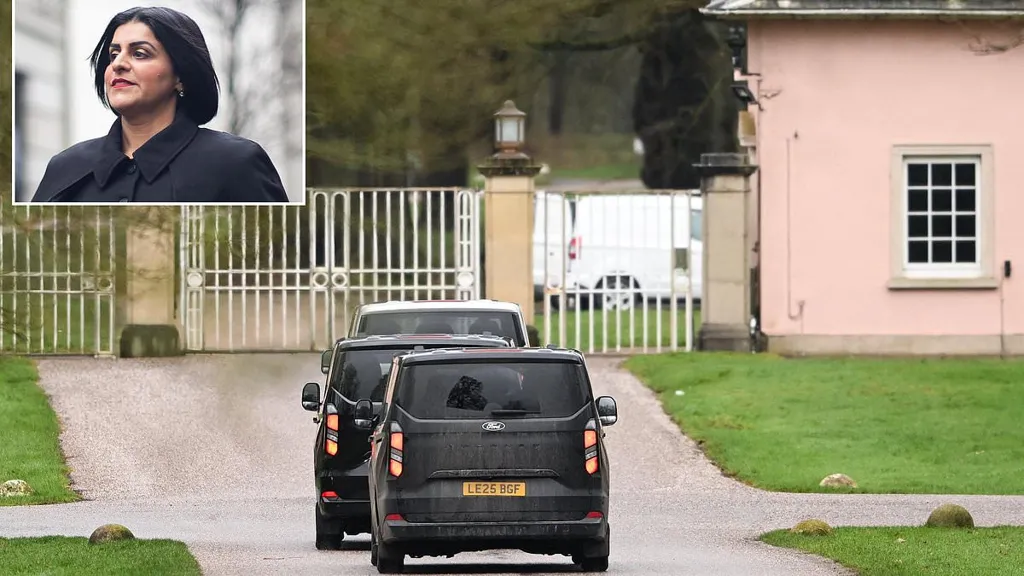
Police briefed the Home Office in advance about their plans to arrest Andrew Mountbatten-Windsor, the Daily Mail can reveal.
A senior officer from Thames Valley Police contacted Home Secretary Shabana Mahmood's office early this morning, before plain-clothes police teams arrived at Wood Farm on the Sandringham Estate at 8am.
It is understood there was a conversation between a police officer and a member of Ms Mahmood's political team, based at her private office at the Home Office's headquarters in Westminster's Marsham Street.
There is no formal protocol for police to notify the Government of any high-profile arrests they intend to make.
Indeed, senior officers and politicians regularly stress that police forces have operational independence from the Home Office and the rest of government.
However, the incendiary nature of plan to arrest Mr Mountbatten-Windsor led Thames Valley to conclude it would be 'good practice' to tip-off the Home Secretary, sources said.
With Andrew's current location being kept secret, multiple sources have confirmed that King Charles and Buckingham Palace was not warned in advance that his younger brother was to be arrested by officers from Thames Valley Police.
The King's brother is the first senior member of the Royal Family to be arrested in modern times.
Police have been assessing claims against Mr Mountbatten-Windsor that emerged in the Epstein files.
These include allegations that while working as a trade envoy for the UK Government he shared sensitive information with convicted paedophile Jeffrey Epstein.
A group of police officers in plain clothes arrive this morning at Wood Farm, on Norfolk's Sandringham Estate, where searches began
Vans approach the Royal Lodge, a property on the estate surrounding Windsor Castle and a former residence of Andrew Mountbatten Windsor, earlier on Thursday
British police officers are now likely to have had access to uncensored copies of the Epstein documents which were published in redacted form by the United States Department of Justice just under three weeks ago.
It had already emerged that police had held informal discussions with the UK government about emails and documents relating to Mr Mountbatten-Windsor and Epstein.
Officers were reported to be keen to study the types of confidential and sensitive information Mr Mountbatten-Windsor had access to while serving as an envoy.
Detectives have detained Mr Mountbatten-Windsor on suspicion of misconduct in public office, an offence which carries a sentence of up to life imprisonment.
The decision to arrest Mr Mountbatten-Windsor at his home - on his 66th birthday - can be seen as an indication of police's level of confidence in evidence uncovered in the investigation so far.
They almost certainly will have asked Crown Prosecution Service lawyers for their opinion before making the arrest, and this morning's unprecedented activity at Sandringham suggests they believe they have an arguable case.
If detectives had been less confident in the evidence they have obtained they may have taken a less conspicuous course of action.
For example, they could have made an appointment with Mr Mountbatten-Windsor - via his lawyer - to attend a police station for interview.
That interview could have been informal or conducted under caution, and arrangements could have been made for Mr Mountbatten-Windsor to enter and leave the police station discreetly.
Thames Valley Police have not taken this route and their decision to arrest the former duke at his home will be interpreted as a confident, perhaps even an aggressive, policing tactic.
The decision to arrest him rather than conduct an interview by appointment also means investigating officers have the opportunity to search MrMountbatten-Windsor's home and seize evidence.
They will be seeking computers and other electronic devices, as well as written paperwork such as bills, receipts and bank records.
Officers have been seen at Wood Farm, Norfolk, and at Royal Lodge, Mr Mountbatten-Windsor's former home near Windsor.
It remains to be seen how long Mr Mountbatten-Windsor will remain in police custody.
The maximum period is 24 hours, except in investigations of serious crimes such as murder or terrorism.
Suspects can be released under different mechanisms.
'Release under investigation' means they are free to go pending further inquiries with no conditions imposed.
Alternatively, police can grant two types of bail.
'Unconditional bail' can be set with a specific date and time on which the suspect must surrender to custody, while 'conditional bail' can add extra requirements such as living at a specific address or regularly reporting to a police station.
Guidance sets out that 'conditions should not be unreasonable, overly restrictive nor punitive'.