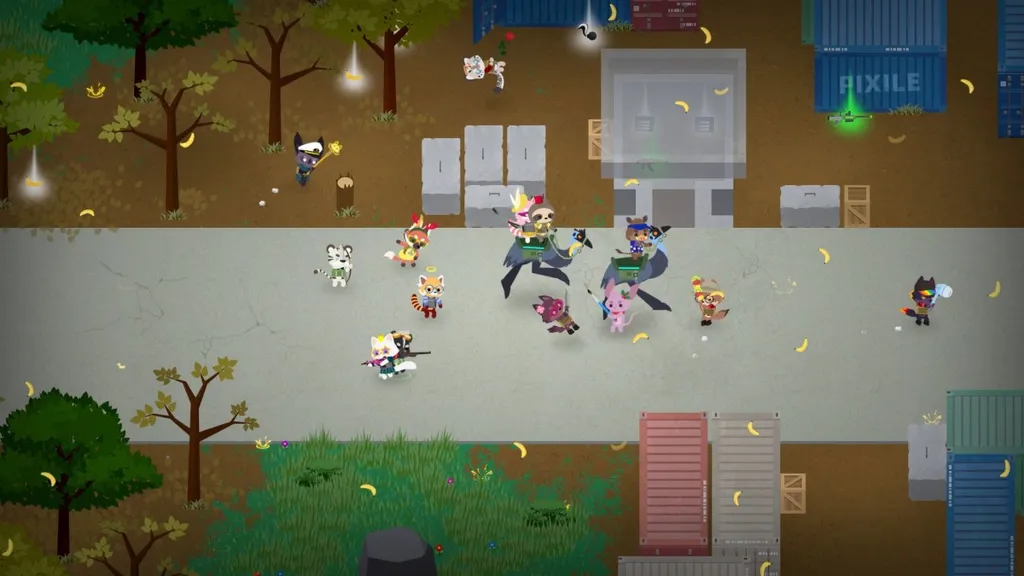
With live-service video games, the landscape has been increasingly defined by aggressive monetization, unrelenting promotions & crossovers, alongside escalating hardware demands, Super Animal Royale occupies a refreshing, distinctive middle ground. From Pixile Studios', it's a top-down battle royale that while remains dark in implication is welcoming in presentation and accessibility; mechanically layered without being intimidating; and social without being extractive. It respects player time, hardware limitations, and attention spans, while still rewarding awareness, mastery, and long-term engagement.
So it's interesting, that rather than chasing the loudest trends in the games-as-a-service ecosystem, Super Animal Royale built an identity around consistency. Matches are fast but tense; systems are readable but deep; and the surrounding social layer, Super Animal World, reframes downtime as a meaningful part of the experience rather than a waiting room. It is a live-service game that despite its furry critters, is intentionally human-scaled.
To find out more, Newsweek spoke with Pixile Studios co-founder Michael One and narrative designer Ruben, about designing a battle royale in this distinct format, building a global live service as a small indie team, and how cuteness and bleakness are not contradictions.
Super Animal Royale stands out immediately as a top-down multiplayer game, which is still relatively rare in this space. What was the core design philosophy behind translating battle royale into that perspective?
From the very beginning, my co-founder Chris and I played a lot of battle royale games ourselves. We were into H1Z1 early on, then PUBG, and we started prototyping to see whether that intensity would translate to a top-down format.
Early on, we ran into a big issue; in a top-down view, players could see everything on their screen, which led to fights happening at the edges. Once we introduced line-of-sight and fog of war, that changed everything. Suddenly you could approach a building and still be surprised by someone inside. That was the moment where the mechanics really clicked.
The game feels notably more approachable than many others in the genre, without losing tension. Was accessibility a guiding goal?
Very much so. We wanted it to be approachable while still capturing everything that a battle royale needs to be. The intensity is still there; there are players who take it very seriously and play competitively.
At the same time, we streamlined systems intentionally. You only have two weapon slots and one utility item. Matches are faster too; you can win a game in around seven minutes instead of committing to something much longer. That pacing felt right for top-down and lowers the barrier to entry without flattening the experience.
One thing that surprised me was how natural player behavior feels, even with bots potentially filling matches. How does that system work?
It depends heavily on time of day. We wait for players to join for a maximum amount of time because we do not want people sitting in a queue too long. Once that timer hits its limit, the remaining slots are filled with bots.
We tune that timing occasionally, but generally two to two-and-a-half minutes is the maximum wait we want. After that, we start the match. Ideally, players barely notice the difference.
Has player behavior meaningfully shaped the direction of the game?
One of the biggest examples is Super Animal World. That expansion came directly from watching players socialize in pre-game lobbies. Some players were even lobby hopping; joining a lobby, chatting, leaving, and repeating without ever playing a match.
That inspired us to create a persistent social space where players could hang out between games. Instead of fighting that behavior, we leaned into it. We gave them fishing, bug catching, quests; things to do while waiting or just taking a break from matches.
Compared to something like PUBG, which still absolutely melts my PC, Super Animal Royale runs remarkably smoothly. I love QA and engineering as parts of game development; how does that relationship work at Pixile?
We are fully remote, which is the first important piece of context. Michael is in Vancouver; Bob and Michael live together and work closely; I am in the Bay Area; our lead artist is in Milan; sound and music are in Toronto; and we have team members in places like Bangkok, Austria, and across the Midwest.
That structure actually helps QA. Internally, we run the company through Discord, which mirrors how we interact with the community. That closeness creates a natural feedback loop between engineering, QA, and players.
So QA is not just internal?
Not at all. The community plays a huge role. We do some traditional contracted QA, especially during major expansions like Super Animal World, but most testing comes from community playtesting.
Because these players know the game deeply, they catch very subtle issues; things like a cosmetic sitting slightly wrong on a specific animal. They know what something is supposed to look like.
We also have analytics through systems like PlayFab, but when it comes to actual quality; game feel, balance, clarity; that is largely informed by qualitative feedback. Some community members genuinely know the game better than we do in certain respects.
Is there anything on the technical side you are especially proud of that players might not notice?
The scale. Chris writes most of the code, and what he has built is a global live-service infrastructure across consoles for a relatively small indie team.
We’re running match servers, social hub servers, and backend systems that all have to communicate smoothly. Maintaining that orchestration; keeping updates stable and synchronized; is not trivial. Relative to our size, it’s a very large operation.
How do you handle server load during peak times or seasonal updates?
We use a hybrid system. We have dedicated physical servers in different regions, each hosting a fixed number of matches. If there is a sudden influx of players, the system automatically spins up cloud instances to scale.
From the player's perspective, it should be invisible. Our job is predicting baseline demand and letting the system absorb spikes seamlessly.
Community-driven content is becoming common in all-ages live-service games. Is that something you want to pursue?
We have not formally implemented that yet. It is interesting but complex to support properly.
What we do have is a very active feedback pipeline. Players suggest animals and cosmetics constantly through Discord. We have channels dedicated to cosmetic ideas, and when something gains traction, it surfaces internally. We listen closely even if there is not a direct creation pipeline.
Your world-building feels deceptively deep. It took me a moment to realize what was happening beneath the surface; cloning, rebirth, this strange science-fiction logic.
That is intentional. We have been working on the lore bible since the beginning. A lot of it is already in the game but there are still secrets we have not revealed.
Some ideas are planned far in advance; others emerge organically. When we introduce a new feature or weapon, we ask how it fits the world and what new ideas it can introduce. I am involved in design conversations to keep mechanics and world-building aligned.
Are there features you know you will never implement?
There are boundaries. The game is all-ages. There will never be blood or gore.
Our core tension is a cute game with a dark underbelly. That balance has to stay intact. The darkness is there if you are paying attention but it is not forced on the player.
Some requests are also simply bigger than we can build right now or far more complex than they sound. That happens often.
We also try to be sensitive. Even something like spiders comes up and we know some players have serious phobias. Those considerations matter.
Battle royale as a genre is inherently bleak. It comes from a story about children sent to kill each other on an island.
What we try to do is make that reality explicit through world-building rather than violence. The cloning concept acknowledges constant death without making it graphic. It gives the game a science-fiction framework that is both playful and sophisticated; bleak and cute at the same time.
This is one of those games I can easily recommend to parents. It is much easier to say, remember Smash TV; imagine that as a battle royale.
That got me thinking; if Super Animal Royale ever became a movie or animated series, who would you want creatively involved?
We actually already have an animated series on YouTube that we produced ourselves. It is closer to South Park in structure; I do most of the voices; Michael does several as well; and we have some other actors involved.
That series helped us establish the tone early on. It is not feature-film budget; obviously; but it is very intentional.
If we are dreaming; Guillermo del Toro. That absurdist; grounded science-fiction sensibility fits surprisingly well.
The world is rooted in real science; things like CRISPR; but it also runs on absurd logic. We would want someone who could balance those layers.
The YouTube series; Super Animal Royale Tonight; actually seeded much of the world-building long before Super Animal World existed. The community would submit gameplay clips; which we framed like a news broadcast or sports highlight show. Players loved seeing themselves become part of the world.
As Super Animal Royale moves beyond Super Animal World; Pixile isn't slowing down; the Bright Future Update arrives March 31 with a Banananite meteor crash that pushes the game into a new retro-future sci‑fi storyline; complete with fresh quests; characters; and seasonal themes. At the same time; the studio is re-centering the battle royale itself; adding new weapons like the X-Ray Cannon and Uzis; high-risk Banan Altars; and new Super Animals born from alien experimentation and space-age engineering.
Just as importantly; v2.1 reflects years of player feedback; smoother matchmaking; featured modes with bonus XP; easier ways to gather with friends; and long-requested quality-of-life upgrades signal that Pixile is paying attention to its community. It's a reminder that even as Super Animal Royale expands its world and mythology; the developer's intent is grounded; building a multiplayer shooter alongside a fleshed-out social hub that serves players a friendly way of connecting and competing.