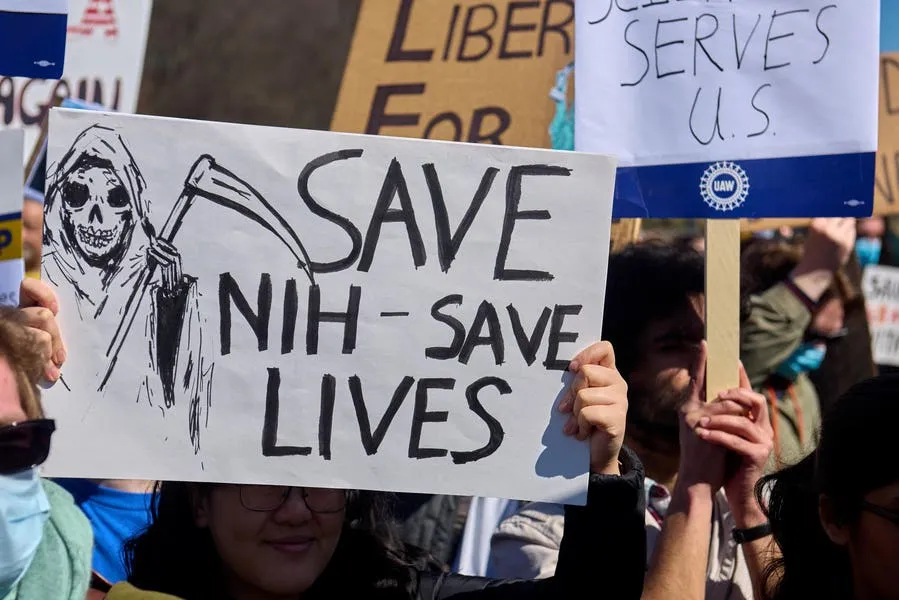
The 24 grantmaking institutes and centers of the U.S. National Institutes of Health are supposed to regularly publish what are called Notices of Funding Opportunities or NOFOs for short. But don't be surprised if you find no FOs for whatever biomedical research you may be doing. In the first 13 months of the second coming of the Trump administration, the number of NOFOs that the NIH has dropped into its website has dropped down to only 84. Compare that to the 787 NOFOs that were posted throughout 2024.
That's left a lot of researchers in a FO-get about it situation. Not only do biomedical researchers need funding to continue their projects combattig diseases, suffering and death. Many of them also need such funding to keep their jobs. Yes, universities and medical centers often leave researchers at the end of planks to find their own funding to pay their own salaries and benefits and the salaries and benefits of their team members. This has already long made researchers careers tough ways to go.
But 2025 made things even worse with the NIH cutting or terminating altogether many grants, funding 22 percent fewer grants than in previous years and installing policies such as a multiyear funding one that will effectively reduce the number of grants awarded going forward. And now 323 grant opportunities are listed as "forecasted," which means they may or may not actually occur.
Congress Rejected Trump Administration's Attempt To Cut NIH Budget By Around 40 Percent
By now, it should be clear as bleach that the Trump administration wants to massively slash NIH funding. The White House during Trump's first go at President from 2017 through 2019 repeatedly proposed substantial cuts to the NIH budget. And the White House tried to cut the NIH fiscal year 2026 budget by around 40 percent. Congress did end up saying, "We can't go for that, no can do," establishing the NIH base budget at $47 billion or so, representing a modest $200 to $400+ million increase from the previous year.
That could be seen as a rejection letter for Trump. After all, the U.S. Constitution established that whole separation of powers thing. There are three branches of government, each supposed to put checks and balances on each other. Congress is supposed to check what the White House does.
The Trump Administration May Still Be Proceeding With Cutting NIH Funding
That's in theory how the U.S. government is supposed to work. Theory smeary, though. The concern among many current and former NIH employees that I talked to is that the Trump administration may be still finding ways to bypass what Congress has indicated. The NIH under Trump has already restricted the ability of its institutes and centers to issue new NOFOs. It's also indicated that it would cut the number of NOFOs by around 50 percent.
This has occurred via multiple mechanisms. One has been forcing each institute and center to reconsider the membership of its advisory council. For years, each institute and center has maintained an advisory council composed mainly of external scientific experts. Every time an institute or center wanted to issue a new NOFO, it could just have the council review and approve the NOFO. That's helped ensure that such FOs are guided by scientific needs rather than politicians and their agendas.
But under the Trump administration part deux, many of the NIH institutes and centers haven't been holding such advisory council meetings. Many of the members of such councils have been told that their memberships are being reconsidered. That's left no one to review and approve many NOFOs.
Meanwhile, the NIH has brought in more political appointees and layers into the NOFO process. Each NOFO now needs to be approved by the NIH director's office and the U.S. Department of Health and Human Services. That essentially allows Trump appointees to veto the issuance of a NOFO for who knows what reason. During a public meeting, National Cancer Institute Deputy Director Doug Lowy mentioned that the NOFO approval process now requires 16 steps and joked that the process has become more complex than a 1929 Rube Goldberg design for a can opener.
NIH Has Blamed Other Things For The Decrease In NOFOs
Other statements from the NIH are nonetheless saying otherwise -- attributing the drop in NOFOs to the record 43-day federal shutdown last fall and efforts to streamline the NOFO process to reduce "administrative burden." It's not clear yet, though, what specifically this streamlining will do, when will it be in place and how specifically it will help researchers and science.
The NIH has also indicated that it is moving towards accepting more investigator-initiated research grant proposals versus issuing NOFOs. The argument is that investigator-initiated research grant proposals will be more innovative and cover a greater variety of areas. The problem, however, with fewer NOFOs, it may be even harder for researchers to tell what the NIH wants, what it really, really wants. With the Trump administration taking steps to lessen the role of scientific peer review in the grant process, will the decision to fund investigator-initiated research grant proposals then rest on what is wanted politically rather than scientifically?
Plus, a greater percentage of a smaller pie could still mean less funding available for investigator-initiated research grant proposals. There's been the aforementioned measures by the Trump adminstration to effectively cut NIH funding. And the White House Office of Management and Budget has continued to impose more and more restrictions and delays on what the NIH can spend.
For example, the OMB last year assumed the power to limit for 30 days an agency's spending to just salaries and other essential expenses. So even though U.S. President Donald Trump signed into law on February 3 the NIH budget approved by Congress, the OMB has been able to insist that the NIH submit a very detailed spend plan before it is able to use the new fiscal year 2026 budget to fund any research grants. NIH has instead had to rely only on previously leftover funds. That’s a bit like being told by your parents that you won’t any new allowance yet and have to rely on what’s already in your pants.
NIH May Not Have Enough Time And Opportunity To Spend Its Congressionally-Allocated Budget
The other problems is that it’s already near the end of March, about halfway through fiscal year 2026. And anything that the NIH has left unspent by the end of September 2026 may just go back to the U.S. Department of the Treasury. Not giving the NIH enough time to fund enough grants would be another way of effectively cutting the NIH budget even though Congress did not allow that.
All of this leaves researchers, their science and the people who benefit from their science, which is basically everyone with a human head and body in a big pickle. It’s a jarring situation and not one that anyone should relish. Don’t be surprised if the lack of FOs from the NIH leaves many people saying another f-word over and over again.