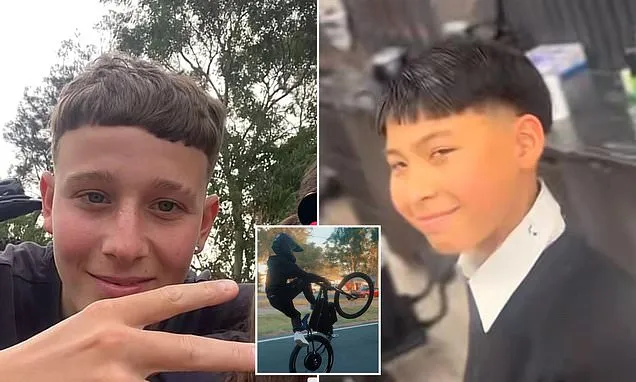
As a mother of four boys, teenagers riding e-bikes had become one of my biggest parenting fears.
But after speaking to friends of William Drake, 16, and Adrian Lai, 15, the two teenagers killed when their dirt bike collided with a bus in Sydney's west this week, that has completely changed.
And I think everyone should be more worried about what happens when police get more authority to seize and destroy these bikes.
William and Adrian were a big part of the growing culture, and while they were on William's fuel-powered bike when they crashed, they often shared their daredevil e-bike tricks online.
They were riding tandem on the night they hit the bus and became wedged underneath. Both boys tragically died at the scene.
The following day, a number of their mates agreed to talk to me about their involvement in the growing illegal e-bike culture.
I expected regret. I expected a wake-up call.
Instead, I was met with defiance. And something far more confronting: fear.
William Drake and Adrian Lai, the two teenagers killed when their dirt bike collided with a bus in Sydney's west this week
William and Adrian were a big part of the e-bike culture
Their school mates opened up to me about the e-bike culture
'What else are we going to do?' one classmate asked me when I questioned whether this tragedy would stop ride-outs.
'How else will we be able to make friends and have somewhere to go?'
He was not worried about being caught, or losing a bike worth thousands of dollars with police about to be granted 'crush' authorisation.
He wasn't concerned about getting hurt, or worse still, losing his life before it even had a chance to really begin.
He was worried about losing his freedom.
Without it, he told me, he had 'nothing left'.
And I could hear that fear. It was real.
Make no mistake, these modified high-speed bikes are dangerous. Many are illegal. And they have no place on public roads.
In New South Wales alone, police have seized hundreds of illegal e-bikes in the past year, with authorities warning of a sharp rise in injuries involving young riders.
National road data also shows teenage boys remain one of the highest-risk groups for road fatalities.
But what struck me most is this: e-bikes are not the real problem.
They are the band-aid covering something much bigger.
Isolation. Loneliness. A desperate need for connection.
Not all kids play sport. Youth clubs are dwindling. And now social media, for many under-16s, is effectively off the table.
These are the children who started high school and became teenagers during Covid, and experienced one of the strictest and longest lockdowns in the world.
They didn't grow up knocking on mates' doors, or meeting at the beach after school.
They grew up online.
Now they have been pushed offline, without being shown what real-world connection looks like.
E-bikes have filled that gap.
They give teenage boys a reason to leave the house. A way to belong. A shared identity without needing to be good at anything else.
And maybe it's helping, because suicide rates in boys under 15 are at their lowest since 2012.
The young teens I spoke to didn't care what the law says, and they are willing to take the risk of being caught for the thing they love most.
That's actually being with their mates, but their logical brains are still developing, and they think it is about the e-bikes.
Which means if we ban them without replacing them, they will not stop.
They will go deeper underground.
Bigger groups. Later-night rides. Faster roads. More risk.
Adrenaline-fuelled rides as they try to avoid police, and that is how it will escalate into more accidents, a gang culture and criminal mindsets.
We have already taken social media away and we are coming for e-bikes, but what are we replacing them with?
Because right now, for many families, there is nothing else.
Parents are stretched. The cost-of-living is biting. There is little time or money to create community alternatives like youth clubs or weekend programs.
So no, I do not blame parents. Many are relieved their kids are not sitting in bedrooms gaming all night.
Not drinking. Not taking drugs. Not being constantly exposed to the dangers online we have all been warned about.
Teens say they have nothing else to do now social media is gone
They are outside. They are social. They are happy.
The rise of e-bikes has mirrored the decline of real-world connection, so where is the plan?
Where are the safe spaces, the programs, the mentors, the fun that allows kids to be kids and gives these boys the same sense of belonging - without the danger?
Because if we keep removing the things they rely on without fixing what sits underneath, this will only get worse.