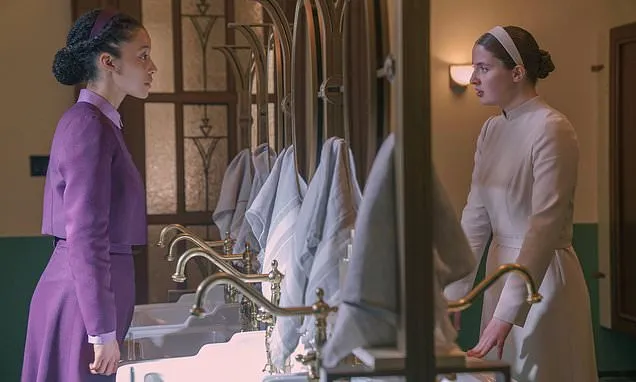
Throughout the six-season run of "The Handmaid's Tale," dread hung over the series like a perpetual rain cloud. It made sense because the U.S. had turned into a totalitarian society called Gilead where women were stripped of their rights. In "The Testaments," debuting Wednesday on Hulu, Gilead is still Gilead - but there are glimmers of hope as a through-line.
Like its predecessor, "The Testaments" is based on a novel by Margaret Atwood of the same name. It takes place five years after the events of "The Handmaid's Tale," and follows privileged girls in Gilead who are on the cusp of adulthood. Viewers are reintroduced to Aunt Lydia (Ann Dowd) from the original, who now runs a school training girls to be proper young ladies who are ready for marriage and most importantly, babies. There is a class where the girls are tested in how they pour tea.
Lydia has become a bit softer since we last saw her. "At the end of 'The Handmaid´s Tale,´ she´s in a deep state of remorse and begging for forgiveness when her life, as she knew it, collapses," said Dowd of her character. "She´s come into this world a gentler human being. She´s still Lydia, but I think she´s had time to let go of the wall that was built around her."
We meet Agnes, played by Chase Infiniti ("One Battle After Another") and her friends Shunammite and Becka played by Rowan Blanchard and Mattea Conforti. Lucy Halliday portrays Daisy, a new student who is instructed to shadow Agnes at school.
"I see them as two cats who´ve been put in a room together and are sniffing each other out," said Halliday. "I think they are aware that there is an inherent similarity overlapping with them both, but they will refuse to admit it because they don´t want to be like the other person."
Because Agnes and Becka have each started to menstruate, it's immediately declared mating season and the girls must marry. This is when cracks begin to show in the Gilead status quo as Becka is uninterested in finding a husband. Agnes is swept up in the romantic idea of it all - until she's introduced to potential mates who are generally older with powerful positions in Gilead's government. She realizes marriage would be a power move for her family and that love isn't required.
Bruce Miller created both "The Handmaid's Tale" and "The Testaments" and says each tells stories about the oppression of women.
"In 'Handmaid´s,' they take a child away from its mother and then say to the mother, 'You´re going to be docile,´" said Miller. By contrast, he said, "'The Testaments' takes a bunch of teenage girls and tells them what they are going to be and also remove their adolescence from their lives."
This new focus on young women in Gilead, who've only known Gilead "is an easier show on the system to watch, I believe," said Dowd. "It doesn´t mean it doesn´t have its intensity. It does. But we´re dealing with a whole group of different characters. We´re focusing on the young women and how they interact with one another, and they can´t help but resist and grow."
"These teenagers´ lives have a certain level of lightness to them," added Miller. "That´s the interesting thing; their lives have all this lightness that Gilead lets them have and then crushes it into some horribleness and breaks that lightness up."
Because of "The Handmaid's Tale," women have been inspired to dress in red cloaks and white bonnets as a symbol of resistance against oppression, most recently at last month's "No Kings" rallies. The cast of "The Testaments" hopes this new chapter also moves people to act.
"There are a lot of topics and a lot of things that happen in 'The Handmaid´s Tale´ that are unfortunately still happening to this day," said Infiniti. "If people can watch our show and if any way they feel emboldened to get off the couch and go out there and fight for their communities, fight for their neighbors unapologetically and with love and respect - I think that that would be the ultimate gift for any of us."
Blanchard, who has been an advocate for women's rights and other causes since she was a teenager, says she can empathize with the teen characters in the story.
"There´s nothing more powerless than being a teenage girl. There´s so much happening in such a short amount of time. So many emotions, you know? So much like self-realization is happening, so much self-actualizing, and these girls are having to form their identities in a very specific way."
When the weight of stepping into Gilead seemed daunting, Halliday said she and her co-stars could turn to Elisabeth Moss - who starred in "The Handmaid's Tale" and is an executive producer of "The Testaments" - for reassurance.
"She´s an encyclopedia of information. She was open with us, and she was there for us if we ever had a question or needed guidance on something. But more than anything, what she gave us was the reassurance that we were doing OK and the space to step into these characters and to step into this world and to kind of trust in ourselves."