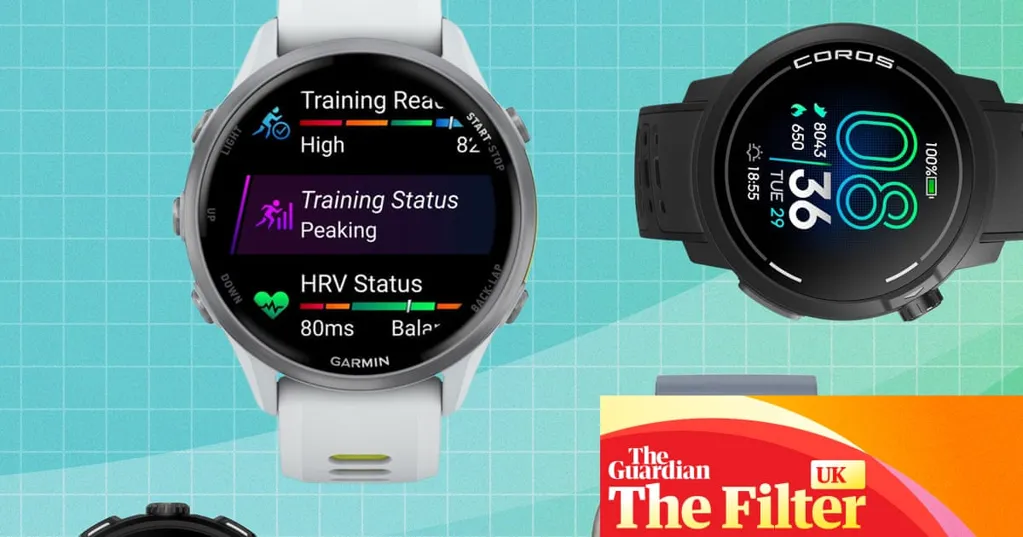
We ran more than 1,000km to test top-rated GPS fitness watches including Apple, Garmin and the best for beginners.
Whether you're hitting the pavements for the first time, running with a club or racing for personal glory, the ability to track your workouts has become an essential part of any training regime. Not only can it help you improve, but you can also use it to avoid injury and share in the social experience. A running watch isn't the only way to do this, but it is a pretty effective option.
But with the market flooded with options, offering an array of features, you might find it difficult to answer all the questions that arise. Do you need offline maps? Do you want to listen to music while you run? Which brand is best, and how much do you really need to spend?
Since a running watch is likely to last for far longer than most other bits of tech, you'll want to make a smart investment - and I'm here to help you do just that.
I ran more than 1,000km to guide you through my tried-and-tested options, so you can pick up the best running watch for you.
I've been reviewing consumer electronics for 18 years, with more than a decade spent as the Guardian's gadget expert. In that time I've seen all manner of tech fads come and go, watched cutting-edge technology become mainstream commodities, used my body as a test bench for hundreds of watches, rings, glasses, goggles and other wearable devices, and covered thousands of kilometres as a keen club runner.
To really determine whether a running watch goes beyond the basics, you have to use it for some time. I ran well over 1,000km, testing each watch on its own and in pairs, wearing the devices for short and long runs across different urban and wooded environments. I wore them for club runs and on solo efforts, for training, workouts and races, plus during the day and night, to fully evaluate their capability to track metrics and analyse data.
I've poked and prodded them, updated them, tested their maps and navigation, and monitored their stamina. I've compared readings from wrist-based optical heart-rate sensors to more accurate chest straps, compared pace and cadence readings, splits and total distances, routes and traces. And since GPS accuracy is so important and varies between watches, I put the top contenders through two different urban stress test routes to see which devices were reliable and which lost the plot. The first saw me weave between the tallest buildings in the City of London, while the other was around the notorious Canary Wharf loop of the London marathon, which tends to send racers' watches wild.
Just starting out? Use your phone for free
If your running journey is just beginning, then it's likely you already have a device to track your workouts. Your smartphone will be able to track your route, distance and pace; you just need the right app to do it.
If you're an iPhone user, Apple's built-in Fitness app can track runs and other workouts, too. Android phones usually arrive with a workout-tracking app installed; which one will depend on the brand of your phone. Samsung's Health, Google's Fit or Fitbit, for example, can all track the basics.
One of the most popular free, cross-platform apps is Strava. It not only tracks your workouts but also enables you to share them with friends and family through its integrated social features for support and encouragement.
Do you already own a smartwatch?
Similar to phone-based tracking, practically any smartwatch can be used for tracking runs. Even older versions of the Apple Watch, Google Pixel Watch and the Samsung Galaxy Watch will work great, with built-in GPS and heart-rate monitors, and many of them track far more than the basics.
The downside is relatively short battery life, but they should be fine for runs under marathon distances. All models should come pre-loaded with fitness-tracking apps that can record your runs, but Strava also has free apps for the Apple Watch and Google's Wear OS.
- Garmin Forerunner 570 - a really great running watch that's just a little too expensive for what it offers, in particular, the lack of offline maps. A great option at a discounted price, though.
- Suunto Race - software updates see the predecessor to the great Race 2 gain most of the new features of recent models. It's a smart buy at a good discount.
- Garmin Forerunner 165 - Garmin's entry-level OLED running watch is great, but it costs a bit too much to be a budget pick and lacks dual-band GPS. Look for a deal.
- Garmin Forerunner 265 - the older-generation mid-range Garmin was one of the best with dual-band GPS, an OLED screen and multiple sizes, but was quite expensive at launch without maps and has since been phased out.
- Garmin Forerunner 965 - Garmin's previous top-of-the-line Forerunner remains extremely capable, missing only a few of the Forerunner 970's features. A good buy at a steep discount.
Go to the effort of buying a dedicated running watch and you want the device on your wrist to at least work as hard as you are, pounding the pavements. So while practically any watch with a GPS will get the job done to some extent, it's the features below that I considered alongside when selecting models for this test:
- Screen - it has to be bright, crisp and clear enough to view and understand at a glance during the run.
- Fit and profile - it has to sit on the wrist comfortably and securely, neither moving about during vigorous exercise nor being too tight as you become warm due to activity.
- Strap replacement - straps become sweaty, smelly and wear out; so being able to replace them easily is essential either with like-for-like options or different ones for different occasions.
- Ease of use on the run - do the buttons work? Can you lock the touchscreen? Are haptics strong enough? Can you hear beeps while pushing for that next PB?
- Heart-rate accuracy - accurate heart-rate tracking is essential for using zones during training as well as evaluating effort levels over time.
- GPS accuracy - how long does it take to get a lock? How well does it hold onto signals in difficult conditions? This is vital!
- Battery life - will it last long enough between charges?
- Water resistance & durability - should withstand rain/snow/mud etc., anything we cope with!
- Companion app & data export - good cross-platform apps essential; reliable syncing/stats/maps; ability send/export data elsewhere.
- Training & analysis - how good is data analysis? Is it representative/adaptive?
- Software support - should be secure/updated regularly despite low cybercriminal interest.