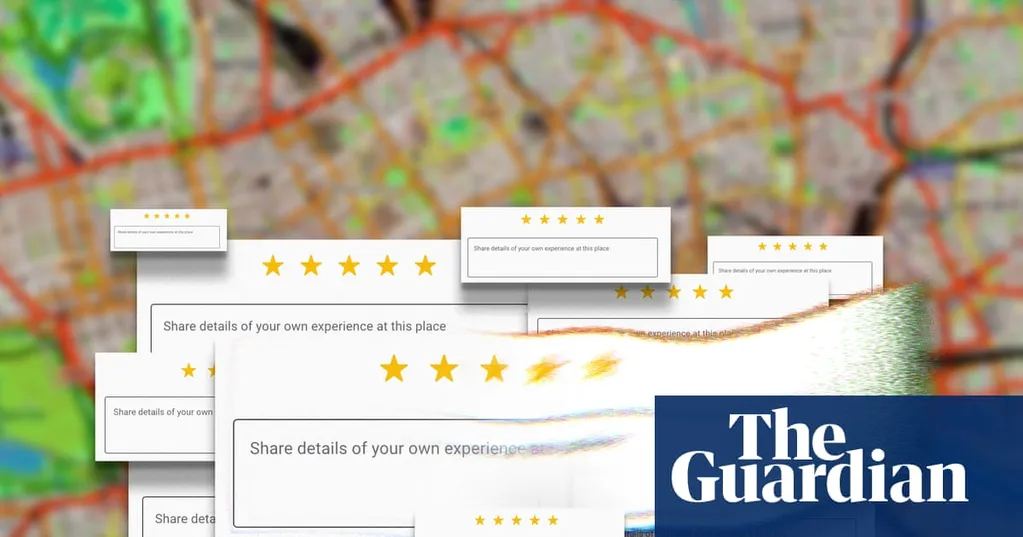
The holiday flat near(ish) the Roman ruins of Pompeii was "disgusting", and smelled of "a mix of dampness and sewage", according to one reviewer on Google Maps. I never visited, but I gave it five stars.
I did the same for an DoubleTree by Hilton hotel across the Thames river, Ibis budget hotel in east London, that is part of the Accor group, a central Travelodge and the nearby Hyatt Place - some of the best-known hotel brands in the world. Scattered in there were requests for reviews for hostels and B&Bs in Genova, Naples, Maastricht, Krakow and Brussels. For a few days I had a new job: writing fake reviews on Google Maps in exchange for cryptocurrency.
All of the hotel brands who responded to a request for comment said they had nothing to do with the reviews - and indeed said they had never seen anything like it. So what is going on? The answer appears to give a small insight into the huge and growing industry of online scams that is undermining trust in the customer reviews that are a vital part of e-commerce and costing consumers billions of pounds a year in misdirected spending.
But hotel reviews may not be the main purpose of the scam: in fact, the scammers' main target was likely to be me, and all the other people tempted into writing the reviews.
"It's a pleasure to meet you," was the first message from "Sharon Roberts", a now-deleted account on Telegram, a messaging app, that was almost certainly a pseudonym. It was not the first message from out of the blue: my number is on list somewhere of potential marks, so two or three offers of work come through a month. This time I decided to see whether the promises of up to £800 per day were true.
After responding, nine days of prodding, coaching and motivational messages followed to try to persuade me to sign up for the job. Is this legal? In English that appeared unlikely to come from a native speaker, Sharon's confusing answer was: "We collaborate with SMS operators through post job opening on Telegram and SMS."
But Sharon was just a recruiter. High productivity scammers have embraced the division of labour, apportioning each part of the swindle to a specialist. Sharon handed me on to a "receptionist" who called herself Victoria Castillo - again, there was no evidence that the name belonged to the person behind the account. Victoria coached me through the process of setting up a crypto wallet on an American cryptocurrency exchange, and accepting payments in USDC, a stablecoin that is pegged to the US dollar. (Under UK law recipients of cryptocurrency payments must declare their source. "You can ignore this one," was Victoria's advice when I asked about the notification.)
Victoria's profile pictures showed a blond woman in front of an unidentifiable city skyline, or in a pristine white ski suit by a snowy piste. She said she was based in New York but born in the UK. Reverse image searches suggested the person's face matched with pictures on several pornographic websites.
The internet has enabled fraud to become a truly global industry. Investigators around the world have found an increasing number of this type of scam being operated in countries with weak rule of law, such as Cambodia, Myanmar, or Russia. In some cases the scammers themselves are victims of trafficking and enslavement in prison-like scam centres. When we later asked Victoria if she was in any danger the response was "Ha? I am always safe". Her profile gave no indication of where she was actually based.
Serpil Hall, a fraud consultant who has spent 20 years battling scammers, said that she has seen a big increase in the volume of online scams in the last six or seven years - helped by new technologies that make it easier for scammers to mimic official businesses.
"When it comes to scams they are getting very crafty," she said. "Especially with AI, generative AI and now agentic AI" - bots that can operate independently and take actions in the real world, potentially against victims.
My new employers did not appear to be using the most sophisticated tools, but they made up for it in scale. Victoria directed me to a separate channel on Telegram, with the name and approximate branding of Quad Marketing Agency, a large, New York-listed company.
A Quad spokesperson said: "Quad had no actionable information on this channel and is not affiliated with it in any way. We are reviewing this matter and will take warranted and appropriate action regarding this unauthorized use of the Quad name and accompanying imitation of our logo."
The channel purporting to be Quad, easily accessible to anyone on Telegram, has 16,800 subscribers, while another near-identical channel has 14,700 subscribers - giving a glimpse into the industrial scale of the operation.
A spokesperson for Telegram said it has a "robust anti-spam system" that prevents many scams before they can start.
"While scams are unfortunately present on every social network," the spokesperson said, "Telegram routinely removes such scams from its platform as part of its normal moderation processes."
The channels post a steady stream of "work" from 8am to 7pm UK time: up to 14 reviews, paid at first at $5 per review. These are interspersed with "business tasks", where the worker sends cryptocurrency, and the employers send back the same amount with a healthy commission added on top. Since 12 March the channel had published nearly 6,000 posts asking for fake reviews.
Accor and Travelodge both said that that it had nothing to do with the fake reviews and would seek to ensure none were published. A Travelodge said: "We treat the integrity of customer reviews extremely seriously and as our customer review policy states, we do not create, commission, or publish fake reviews under any circumstances." Hilton and Hyatt Place were approached for comment.
Another, slightly different offer of fake review work - also organised via Telegram - used the branding of HotelsCombined, part of the Booking.com group, to ask for reviews of hotels as far afield as Bucharest, Bali, and Thailand via a website custom-built by the scammers.
A Booking.com spokesperson said that only customers with confirmed stays were able to post reviews - suggesting they were unlikely to be published. The spokesperson said "those measures, combined with specialised teams and automated systems, mean that we have a robust procedure in place to detect and prevent reviews that do not meet our content guidelines."
There were several possible ways the scammers could have been using marks like me.
Firstly, internet reviews have made it easier than ever for criminals to sell dodgy goods and services. The UK's Competition and Markets Authority (CMA) in 2023 found that fake review text on products causes annual harm of between £50m to £312m to UK consumers (and that is not including services such as hotels). The CMA - which separately on Friday launched a new investigation into five firms over fake and misleading online reviews - said that between 11% and 15% of all reviews for products it examined, including Bluetooth headphones, irons, kettles, desk chairs, water bottles, yoga mats, and vacuums, were fake.
That is money essentially pocketed by scammers - which makes the labour of fake reviewers like me potentially valuable. It is unlikely any of the larger hotel chains paid for fake reviews, but the service is readily available via internet searches, and could be tempting for a smaller operator.
Then there are the transactions themselves. I received $5 per fake review in USDC. Chainalysis, a firm that tracks blockchain transactions often with law enforcement, said the wallets that made the payments and others linked to it follow a very consistent pattern revealing the industrial scale of the scams. Wallets are topped up from elsewhere before sending out tens of thousands of small payments presumably to recruits like me. The wallets tended to pay out between $300,000 and $600,000 in USDC before transferring the money on.
Under laws introduced in the UK last April, web platforms such as Google who carry reviews must have clear policies on the prevention and removal of fake and incentivised reviews, flag suspicious activity, and ensure as best they can that published reviews are genuine and not misleading.
Google this year agreed to do more to identify and remove fake reviews, after pressure from the CMA. And - reassuringly - my surge of fake reviews triggered an automatic response. At least some appear to have been blocked by Google's systems.
Google said that it takes swift action against bad actors by removing policy-violating content, suspending accounts, and even pursuing litigation. The company said it has removed more than 240m fake reviews since 2024, the vast majority of which were removed before they were seen, and restricted 900,000 accounts for violating policies.
Hall said that fake reviewers have turned to "human bots" because "the companies are getting in front of it and putting in place measures" to detect fraudulent activity. But she added it was likely the scammers were "double dipping" - using my labour, but also using payments for money laundering, before scamming me at the end.
Cryptocurrencies play a crucial role. Digital assets by design store all transactions in the publicly available blockchain. But taking a pot of tainted money and splitting it up and recombining it many times, a practice known as "tumbling", can help to obscure its origin - a valuable service for criminal groups.
After using my labour, the scammers' attention eventually turned to extracting cash from me - a smaller-scale version of the "pig butchering" scams in which criminals fatten up targets by gaining trust, before running off with large amounts of money. Victoria said the only way to continue would be carry out a "business task", which consisted of paying $50 and receiving $60 back.
A table regularly published on the channel helpfully laid out what I could expect if I kept on: ever-increasing payments would win ever-increasing awards, peaking at $16,000 for an initial outlay of $10,000.
Jacqueline Burns Koven,Chainalysishead of cyber threat intelligence,"This appears likely similar employment scams-basically,a scam where people sign up do 'tasks' build up balance then have pay remove balance or 'upgrade' account.While scammer may make few initial payouts instil confidence victims,end goal run away funds."
Victoria sent daily motivational reminders to try to get me on board, but the Guardian's expense account does not run to sending thousands to possible fraudsters, so I reached the end of the line with the job. When I revealed that I was a journalist and asked who she really was she complained I was invading her privacy; before responses stopped. She did not reply detailed request comment.
The review job had dried up, and I only made $30 from several hours of work spread out over weeks. But in the meantime a couple of different messages had popped up on Telegram: young women offering more work.