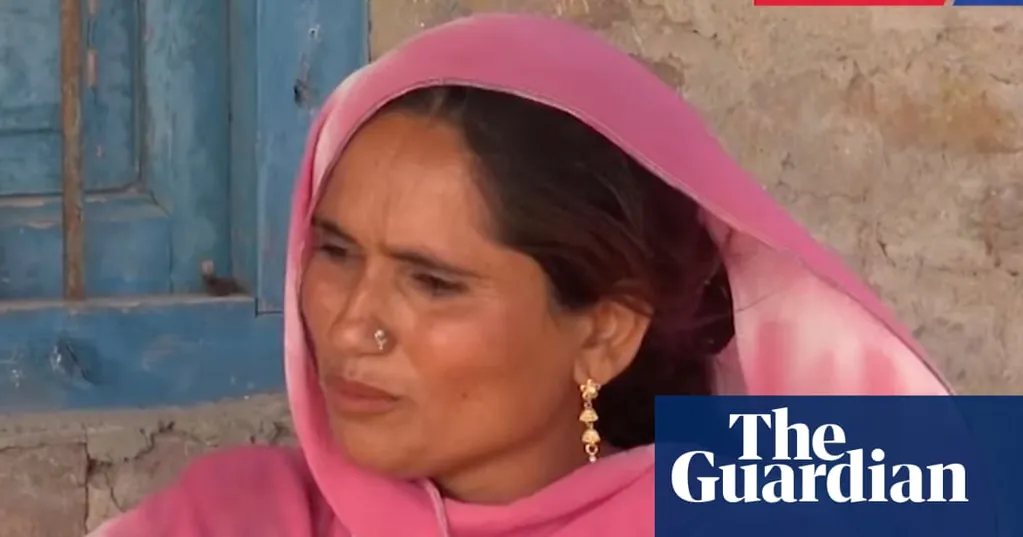
When Naushaba Roonjho became the first girl anyone in her district knew to have passed Pakistan's national secondary school exam, the news was not celebrated. At home, in her village of Sheikh Soomar in southern Sindh, her father told her: "This is enough, you don't need to study more. You should stay at home now."
It was 2010 and Roonjho was 17; within weeks she was married, to Muhammad Uris, a labourer. Although, like all the girls in Thatta district, she had left school after primary, Roonjho had kept up her studies independently.
"People mocked me," Roonjho says. "They said girls don't need education and get spoiled if they study."
In the early years of her marriage, she dedicated herself to raising her children, stretching her husband's income to feed them all, and doing household chores. The couple lived with her parents, but when Roonjho saw an advert for a national rural development programme that was looking to train community workers, she applied.
Going door to door as a health worker was seen as shameful. Some accused her of dishonouring her family.
By 2019, the conflict reached a breaking point. Her family told her to stop working or leave the house. Roonjho and Uris chose to leave, and with their savings the couple built a single-room home of their own. The separation hardened her resolve rather than weakening it and she had the full support of her husband.
"My parents stopped talking to me for two years. They didn't accept that I wanted to study or become something in life."
But working on vaccination drives and health hygiene initiatives around her district, Roonjho saw the need in her community.
"People don't wash their hands after using the bathroom or before eating. There are no midwives, and many women don't know the danger signs during childbirth."
In Pakistan, the maternal mortality rate is 155 deaths per 100,000 live births, a drop from 178 a decade earlier but still far above the UN's goal of 70 by 2030.
"Some families closed the door on me," she says. "During polio vaccination they said don't give this to the children and considered the vaccination fake."
Her husband faced daily taunts. “People mocked me more than they mocked her,” says Uris. “They said ‘Don’t you feel ashamed? Your wife is going out working with men.’”
He pushed back every time. “I told them, ‘Whether you respect us or not, we will continue doing good. I’ll always stay with her.’ Both of us are educated. We passed the matric [secondary-school exam],” he says. “Our thinking is different from the villagers.”
The couple started working on improving girls' education in the village, Roonjho going door to door.
“There were no girls in the school,” he says, talking about the Sheikh Soomar government school, a school that - on paper - exists for boys and girls, but had no functioning space for girls.
“She went to each house,talked and convinced the parents,five or six girls started going.” Eventually, seven enrolled, including their own two daughters.
“For us, that is a very big number,” says Uris. “Because before her, not even one girl was in school.”
The Sindh Rural Support Organisation (SRSO) is a development body established to help build local leadership. Through their model, villages form local support organisations (LSOs), community-run groups that coordinate local development and mobilise women at the grassroots. “I was part of that,” Roonjho says. “I became the president of the LSO. I worked in family planning, polio vaccination and health initiatives.”
Zulfiqar Kalhoro, the CEO of SRSO, says women such as Roonjho are central to rural change. “We bring women together to form community organisations,” he says. “The leadership comes from within the village.”
For him, Roonjho stood out early. “She never asked for anything for herself; she worked for other women. That’s real leadership.” According to Kalhoro, the impact is visible across rural Sindh. “Today, most families are educating their daughters, and women leaders like Roonjho make that possible.”
Raasti, 19, is a polio vaccinator who has been working with Roonjho and views her as a mentor. “I look up to her as a strong woman,” she says. “Seeing her work for education and health makes me feel good and feel like change is possible. She works with dedication and honesty. I admire that she goes beyond her means to achieve her goals.”
As her next step, Roonjho enrolled in a disaster-preparedness programme on the Indus River. “We were taught what to do when there are floods, how to keep property documents safe, how to protect ourselves,” she says.
This work helped her develop the confidence to speak in meetings and negotiate with officials, experiences that now define her next move. Roonjho, now 33, has her sights on elections in 2027, running for political office in the local authority. And she will have her village behind her, says Manzoor Ali, a 60-year-old elder. He says the transformation of Sheikh Soomar is the clearest change to the community he has ever witnessed. “She has done so much for this village without even having a seat in politics,” he says. “If she gets a seat, she will do even more."
“People here were being simple-minded,” he says. “They thought girls would get spoiled or leave the family.” But watching Roonjho go house to house, he says, the change has been remarkable. “Now I don’t think there is a single house with a daughter who isn’t sending her to school,” he says.
“If more women go out, learn, and take part in decisions, everything in this village will improve, and I would be very happy to see that.”
In Pakistan, the lowest tier of government is the union council (UC), which oversees basic services at neighbourhood level. “The UC chairman doesn’t do anything,” says Roonjho.“For years,we have asked for clean water,electricity and roads.Nothing happens.”
“I will stand for UC chairman,” she says.“I want to solve these problems.I want to be the voice for poor people.”
She has already begun visiting households,laying the groundwork for her political campaign.
“My biggest wish is that my daughters study and live with respect,” she says.
“I wasn’t allowed to study,” she says. “But I will make sure no girl in this village grows up hearing those same words.”