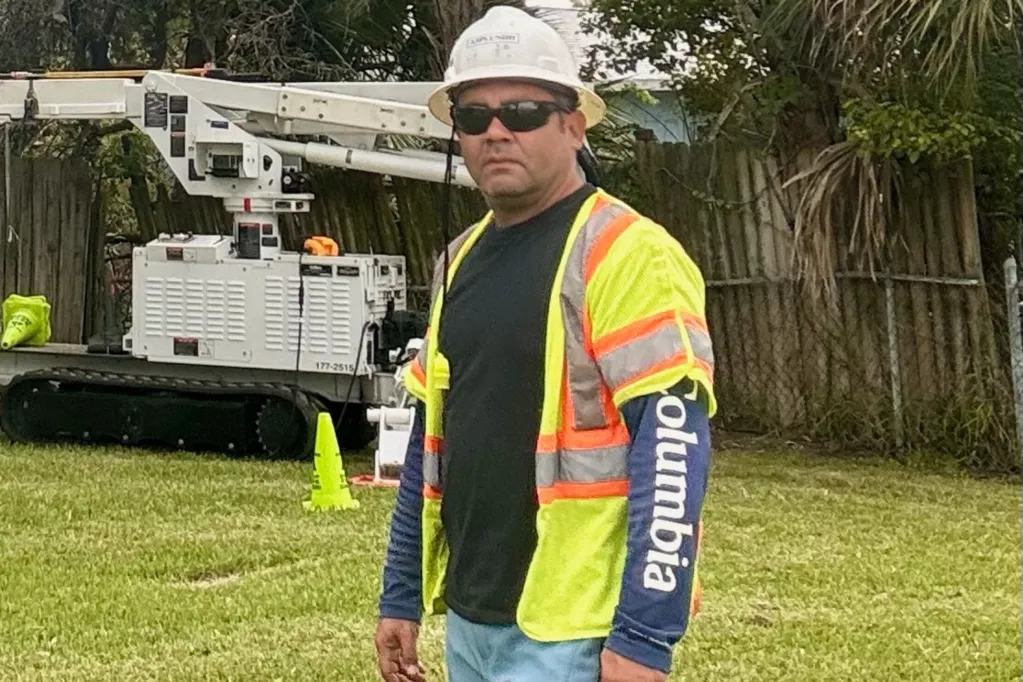
A Venezuelan man who spent three weeks in ICE custody before being released has told Newsweek that federal agents asked him what music he wanted to hear while being transported to a detention facility.
Manuel Perez Sanchez, a power line worker and father of three, said he was arrested on January 11 in Woodbury, Minnesota, while on his way to buy groceries.
"They pointed guns at me through the windshield, shouted 'Let me see your hands,' and pulled me out of my van," Perez Sanchez told Newsweek in an exclusive statement.
The man said that ICE agents allegedly told him, "these documents weren't legal ... you have no status and no right to be in the United States," even after he showed them his identification and work authorization.
"They used a lot of physical force to arrest me, even though I didn't resist, didn't try to run away, didn't hit them, or disrespect them. They put the handcuffs on very tightly, with anger or hatred. They mocked the situation in my country," Perez Sanchez said.
"They asked me what music I wanted to listen to in their van while they were taking me to Fort Snelling, and I told them, 'AC/DC Thunderstruck.' That song gives me energy when I'm working among the trees, and it makes me forget my worries; I needed that at that moment," he said.
Perez Sanchez, who entered the U.S. in 2018 on a B2 tourist visa and later applied for asylum due to instability in Venezuela, said his arrest disrupted a pending immigration court case. His original hearing in Orlando, Florida, was postponed from July 2020 to January 2026 due to COVID-19. He is employed as a foreman in nationwide power line clearing operations. Newsweek has reviewed a copy of his work permit.
A spokesperson for the Department of Homeland Security (DHS) told Newsweek: "Assertions that Manuel Alfredo Perez-Sanchez, an illegal alien from Venezuela, has valid legal status to remain in the U.S. are FALSE. Perez-Sanchez entered the U.S. on a B2 tourist visa that required him to depart the U.S. by May 21, 2019. To be clear: work authorization is not legal status. On January 11, 2026, ICE arrested this illegal alien. An immigration judge ordered him eligible for bond. The fact remains that he is illegally in our country."
"My documents were withheld, specifically my Florida driver's license and my Employment Authorization Document," Perez Sanchez said. "I have sent several emails to ICE offices in St. Paul, El Paso, Miami, and Jackson, and I haven't received a definitive answer regarding the return of my documents. Because of this, I was forced to request a replacement EAD and pay a fee of $470."
The Trump administration has increased immigration arrests, including of people with valid work permits, as it barrels forward with an aggressive deportation push.
Describing his transport and detention, Perez Sanchez said, "We were on the plane for three hours; one detainee was gagged and put in a straitjacket because he asked to use the bathroom."
"Allegations of improper use of force are FALSE. The use of restraints on detainees is a standard ICE protocol. It is an essential measure to ensure the safety and well-being of both detainees and the officers/agents accompanying them. Our practices align with those followed by other relevant authorities and is fully in line with established legal standards," a spokesperson for DHS said.
He said he was first held at the Fort Snelling, Minnesota, processing center, then flown to East Montana Processing Center in El Paso, Texas, before being transferred to the Otero Processing Center.
Perez Sanchez described East Montana as chaotic and overcrowded. He said detainees were mixed regardless of criminal record, confined in large tents with minimal hygiene, and given limited access to phone calls. "It was a survival camp. I didn't receive my blood pressure medication for a week, and I saw a nurse only twice," he said.
He characterized Otero as better organized but still restrictive. Detainees were provided with medication, meals, and limited recreational activities. He said detainees were subject to strict schedules, frequent bed checks, and possible solitary confinement for minor infractions.
A DHS spokesperson said, "These claims of subprime conditions at ICE facilities are FALSE. All detainees are provided with proper meals, water, medical treatment, and have opportunities to communicate with their family members and lawyers. All detainees receive full due process.
"ICE has higher detention standards than most U.S. prisons that hold actual U.S. citizens. Illegal aliens are provided with three meals a day. Meals are certified by dieticians.
"It is a longstanding practice to provide comprehensive medical care from the moment an alien enters ICE custody. This includes medical, dental, and mental health services as available, and access to medical appointments and 24-hour emergency care. This is the best healthcare than many aliens have received in their entire lives."
Perez Sanchez said he has no criminal record in the United States, not even a traffic violation, and has consistently filed and paid his taxes. He has invested his savings in the country, including purchasing a home in St. Augustine, Florida, in 2024. He is married to a kindergarten teacher and is the father of three children, ages 6, 8, and 14.
Perez Sanchez said his family was deeply affected by his detention.
The family is raising money on a GoFundMe post to cover legal fees and expenses incurred during his detention.
Perez Sanchez was released on January 30, 2026, after a bond hearing in which a judge granted a $5,000 bond. He remains under intensive supervision and has a limited ability to work or travel.
He said that upon his release on bond from Otero Immigration Court, ICE fitted him with an ankle monitor and ordered him to remain within a 60-mile radius of his home, after being transported to ISAP offices in El Paso, Texas.
The man said that when he visited the ISAP office in Jacksonville to register his ankle monitor, officials determined he did not qualify for the Intensive Supervision Program because he was already out on bond under the authority of the Orlando Immigration Court.
He also said that ICE had told him his pending asylum case would be expedited, but because he missed his Master Hearing due to his arrest, the Orlando judge rescheduled it for December 17, 2026, nearly a year later, while hearings for his wife and daughter were set for 2028, creating delays, expenses, and personal stress.
"I love this country, I respect its values and its laws, but I am disappointed that they haven't listened to me or given me the right to speak and explain my situation," Perez Sanchez said.