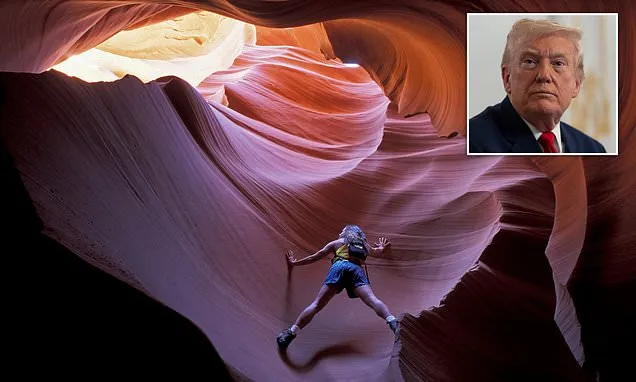
Visitor numbers at Navajo Nation Parks have declined sharply this year as international tourists, particularly Canadians, avoid visiting the US due to its politically 'hostile' environment.
Some guides for the parks, which stretch across the southwest in Arizona, New Mexico and Utah, have reported seeing half as many visitors joining their tours over the summer, which is the peak tourist season.
Around 320,000 people visited Monument Valley, one of the most popular Navajo Nation destinations, between the beginning of the year and August, which is the end of the peak season and the last month with available data.
In 2024, the valley had close to 525,000 visitors, the New York Times reports. That represents a drop of around 200,000 people this year, or about 40 percent.
Lake Powell Navajo Tribal Park, which is home to the influencer-loved Antelope Canyon, had a record 1.2million visitors in 2024. Between January and August this year, that number was down 13.5 percent.
The parks have been hit particularly hard by a broader trend of reduced international tourism in the US, which has seen a five per cent decline in foreign arrivals between January and August compared to the same period last year.
That represents 2.3million fewer visitors spending their cash and propping up tourism-reliant local economies around the country.
Canadians boycotting US tariffs and protesting President Trump's contemplation of annexing their country have led the reduction in tourism.
October was the tenth consecutive month of decline in the number of Canadian visitors to the US.
Compared to last year, air travel from the country dropped almost 24 per cent, and car travel fell more than 30 per cent, according to Canada's statistics office.
That has had a profound financial impact on the Navajo Nation.
Allison Yamamoto-Sparks, the visitor services manager for Utah's San Juan County, which includes the northern part of the nation, told NYT that in the county, spending by Canadians was down 37 percent through June.
International tourists tend to spend far more in the nation than American visitors, which means their absence can spell doom for small businesses that rely on big purchases during the peak tourist season.
Shaunya Manus, a marketing specialist for the tribal tourism department, said: 'They can come in and buy a $2,000 rug like it's nothing.'
'If the international market dissipates, it’s going to hit us really hard because a lot of people need those sales to make their income.'
The lower number of visitors poses a serious threat to the livelihood of many people in the Navajo Nation, where tourism is a major economic engine that creates thousands of jobs.
There has been a decrease of around 200,000 visitors to Monument Valley this year, or about 40 percent.
Last year, Antelope Canyon had a record 1.2million visitors, but locals do not expect that number to reach those heights again for the foreseeable future.
The parks offer a means to make a living where there is little alternative. Helen Myerson, a Monument Valley tour guide, said: 'A lot of jobs are scarce around here.'
The median household income in the Navajo Nation is about $30,000, which is around $50,000 less than the national median household income of $83,730 in 2024.
Hospitality business owners in the area who have been scraping by are anxious about next year as well.
Canadians are expected to continue avoiding the US, and those planning their trips for 2026 seem less likely than ever to head to Navajo Nation Parks.
Steve Simpson, who owns Twin Rocks Trading Post and Cafe in Bluff, said: 'My fear is not so much this year, which we have managed to muddle through. My fear is what happens next year, when people are booking their travel now and saying, "Well, we're just not going to go to America."'
Long-term, there is some hope on the horizon. The Navajo Nation Tourism Department was granted three times its regular budget for fiscal year 2026.
That will allow the department to hire more people to assist its current staff of just six employees.
It will also allow the department to hire Placer.ai, an Israeli tech company that tracks cellphone location data to understand visitor trends and habits.
Canadians are expected to continue avoiding the US, and those planning their trips for 2026 seem less likely than ever to head to Navajo Nation Parks.
Long-term, there is some hope on the horizon. The Navajo Nation Tourism Department was granted three times its regular budget for fiscal year 2026.
Bobby Martin, the Navajo Tourism Department's manager, said that data will help with figuring out what locations to target for marketing and advertising and that it will help create more robust budget pitches.
There are also two new hotels opening in the Navajo Nation, which should help to draw in tourists who currently stay in border towns and spend much of their money outside the nation's local economy.
A 75-room hotel in Shiprock, New Mexico, is expected to open next summer, and another hotel in Shonto, Arizona, has already been built and is just waiting to open once a dispute over a lease agreement is solved.
The tourism department is also working on a short-term rental platform that will allow locals to rent their homes to visitors, which would create new revenue streams for tribal members and help keep tourist money inside the nation.