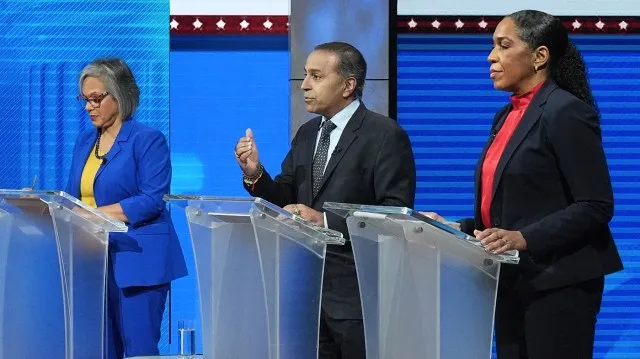
Democrats are fighting over a rare Senate opening in Illinois, with Tuesday's party primary likely to decide the deep-blue state's next senator.
At the top of the 10-candidate field, Reps. Raja Krishnamoorthi and Robin Kelly and Lt. Gov. Juliana Stratton are blitzing ads, exchanging jabs and drawing support from national figures as they barrel toward the March 17 showdown. And Gov. JB Pritzker (D), who's backing Stratton, looms large.
The winner will be all but assured to succeed Sen. Dick Durbin (D-Ill.), whose decision to retire after five terms set off a high-stakes scramble in Prairie State politics.
"It's a close race because every candidate is bringing all of the available tools to address what Democratic primary voters want. All of them have liberal policies, Trump-accountability policies ... all acceptable to voters," said Illinois Democratic strategist Tom Bowen. "So that's why this race will probably be pretty close up until the end."
Krishnamoorthi, a five-term lawmaker from the suburban Chicago 8th Congressional District, emerged as the early front-runner with a significant fundraising edge and support from more than two dozen fellow members of Congress for the seat.
But Stratton, who served in the Illinois House before joining Pritzker's administration, has seen signals of momentum in some polls as the race ramps up. She's boosted by backing from the billionaire governor and the likes of Sen. Elizabeth Warren (D-Mass.).
And Kelly, who has represented the South Side-area 2nd Congressional District for more than a decade, boasts support from the Congressional Black Caucus (CBC) and Democratic kingmaker Rep. Jim Clyburn (S.C.). Her lower-profile bid has been seen as a potential spoiler in the race, expected to splinter some of Stratton's support, particularly from Black voters.
Bowen characterized the primary as "a clash" between Stratton and Krishnamoorthi, while Kelly has "offered herself as the alternative." But he stressed that the race has seemed to lack "a real difference" between the three leaders on policy, progressive values or approach to President Trump.
"I kind of interpret that as, I'm not sure Democratic primary voters exactly have in mind, you know, one archetype to address what's wrong with this country and to address the problem that is Trump," said Bowen, who is unaffiliated in the race.
With early voting underway ahead of the Tuesday primary, the three candidates got heated over immigration and fundraising in a Monday forum with WTTW News.
Stratton came out swinging against Krishnamoorthi over his vote for a House resolution on antisemitism that included thanks for law enforcement, including Immigration and Customs Enforcement (ICE), and criticized him for taking in funds from Palantir, an ICE contractor.
Krishnamoorthi hit back by saying he didn't need to be "lectured" on holding ICE accountable, stressing his immigrant background and his work in Congress, and he said he had donated the Palantir money to immigrant rights groups.
In turn, he accused Stratton of a "policy of hypocrisy," calling out that the Democratic Lieutenant Governors Association (DLGA) under her leadership accepted a donation from a group that oversaw an ICE detention center. She said she's called for the group to return the money.
Kelly knocked both her colleagues for their sparring, labeling it "the teapot calling the kettle black."
"Since they're not that ideologically different, neither of them is going to be talking in any sort of conciliatory way about cooperating more with the president, or reaching across the aisle. That's not the mood of the moment," said Brian Gaines, a professor of state politics at the University of Illinois Urbana-Champaign.
Krishnamoorthi holds a fundraising advantage, and ad spending supporting his campaign accounts for roughly $37 million so far, more than double the $14.8 million spent for Stratton and dwarfing the $1.3 million for Kelly, according to AdImpact.
Meanwhile, Pritzker has pumped in funds to boost Stratton's bid through the Illinois Future PAC, with a $5 million jolt in recent weeks.
The CBC, which is backing Kelly, criticized Pritzker earlier this month for putting his thumb on the scales.
"A sitting governor shouldn't be heavy-handing the race," CBC Chair Yvette Clarke (D-N.Y.) said in a statement reported by Punchbowl News."
Though Kelly has been at odds with the governor in the past, she told The Associated Press that she didn't solicit the CBC's message against Pritzker.
Kelly has also gotten a boost from supporters of Krishnamoorthi as the race intensifies: Politico reported this month that the Indian American Impact Fund, which backs the congressman, launched an ad that also boosted Kelly as it sought to knock Stratton.
In a statement to The Hill, Stratton's campaign accused Krishnamoorthi and his allies of "resorting to cheap political plays in an attempt to split the vote" and "dilute Black political power."
A spokesperson for Kelly's campaign told The Hill that Kelly is "running her own race" and "isn't interested in the noise" as Election Day approaches.
In a race without strong ideological separations, Gaines noted that "identity voting, and people thinking about race and ethnicity and the candidates," could play a meaningful role.
If either Stratton or Kelly wins the Senate seat, the senator-elect could help set a new record for the number of Black women serving in the Senate, where two Black women serve currently and just five total have served to date.
Krishnamoorthi, on the other hand, could become only the second Indian American in the Senate, after former Sen. Kamala Harris (D-Calif.).
The race is also a test of influence for Pritzker, the two-term governor and a major Democratic fundraiser. After flipping the governor's mansion in 2018, Pritzker is up for reelection to a third term this fall, but he's fueled chatter about a possible run for president in 2028.
"If Stratton wins, I think then he'll be taking the credit ... [and] he'll play it off if Stratton doesn't win," Gaines said of the governor.
There's been little independent polling in the race, but surveys from groups aligned with Krishnamoorthi and Stratton suggest a close contest between the two.
In one of the few unaffiliated polls, a January Emerson College Polling/WGN-TV survey found that a significant 46-point plurality of voters were still undecided weeks ahead of early voting. Krishnamoorthi led the field with 31 percent support in the poll, more than 20 percentage points ahead of Stratton, his next-closest competitor.
An early March poll commissioned by a pro-Krishnamoorthi group put him up 11 points over Stratton, with 15 percent of respondents undecided, as shared by Politico. But other results signal a potential surge for Stratton: A survey commissioned by the DLGA the same week showed Stratton leading the congressman by 2 points, with 25 percent of respondents undecided.
In a state that's voted blue in every Senate race since 2014, Tuesday's primary carries the weight of a general election. Though six Republicans are running in their own primary, the winner of the Democratic nod is likely to sail to victory in the general election to win the safe blue seat.
"It will be a victory. I don't think there's any suspense with the general election. It's not a year when a Republican is going to pull a rabbit out of a hat," Gaines said.
Experts expect the Democratic nominee will spend the months between the primary and the general election starting the transition to fill Durbin's outsized role in party politics.
Meanwhile, the political shuffle around Durbin's exit sparked key primaries down the ballot, and Illinois voters will weigh in Tuesday in the primaries to replace both Krishnamoorthi and Kelly, and for Pritzker's new lieutenant governor pick to replace Stratton.