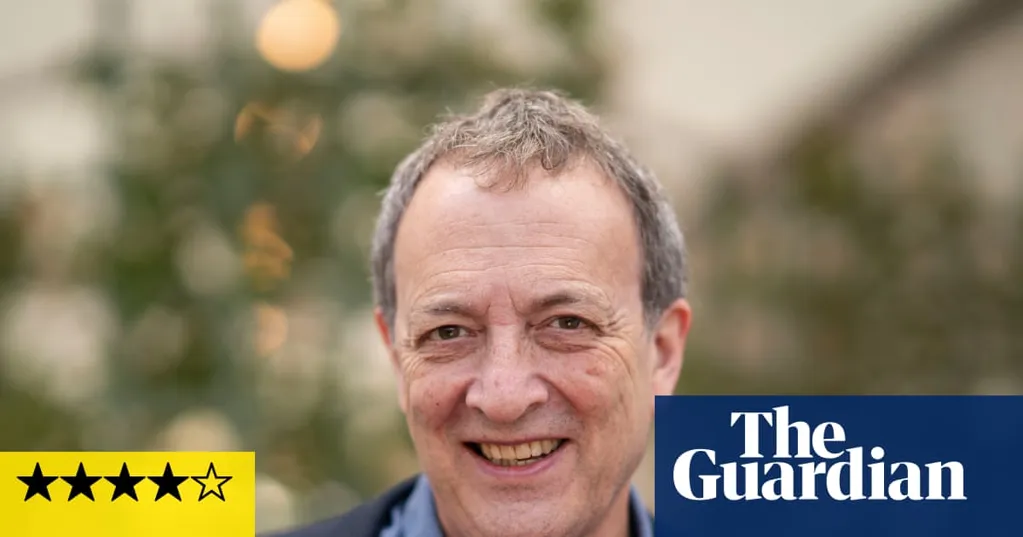
Misha Glenny's debut as host of the long-running Radio 4 series tackled JS Mill's On Liberty - a bold move given the BBC's current legal battles.
"As we come to the text, we'll try to tease out the difference between utilitarianism and libertarianism ..."
That sort of thought has become normal after cornflakes on BBC Radio 4 Thursday mornings. The shock this time was the voice: not a nasal mature Cumbrian but a smoother, deeper, younger north Oxford tone. This was Misha Glenny's debut, having replaced Melvyn Bragg as host of the university of the airwaves, In Our Time.
Next week's edition is a deep dive into the Mariana Trench in the Pacific, the world's deepest oceanic depression, formed by the forced layering of tectonic plates. That subject might have been a good place for Glenny to begin, as he's said that it was a 2008 edition on tectonic geology in the Bragg era that fired his fascination with the format and a desire to fill the seat if it became free.
But the BBC might have feared the metaphorical implications - with Glenny navigating the Bragg Trench, Radio 4's deepest chasm, following the polymath's retirement last year after his 27-year stint.
So there was logic in beginning instead with John Stuart Mill's 1859 philosophical treatise, On Liberty. As a journalist and broadcaster, Glenny has reported on the rises and falls of authoritarian regimes, especially in eastern Europe. The lines between freedom and tyranny are a topical subject in the Putin and Trump ascendancies, with the US president also now de facto commander-in-chief of Venezuela and eyeing the governance of Greenland, Canada and Cuba.
Listeners, though, may have sensed buttock-clenching on the management floors of Broadcasting House when the conversation steered close to actual liberties taken by politicians. Glenny did not want to begin his In Our Time career by bringing the BBC a second $10bn lawsuit from the 45th/47th president.
The show's second incumbency began with a chaotic trail on the Today programme at 8.45am, in which Nick Robinson asked Glenny how the first show had gone. That seemed to throw his interviewee, whose mumbled response implied that he couldn't say yet as it hadn't gone out. (Radio 4 confirmed that the episode was pre-recorded.)
The new host's first academic triangle was Helen McCabe (University of Nottingham), Mark Philp (Warwick) and Piers Norris Turner (Ohio), the inclusion of an American suggesting a greater desire to reach out to the series' big international audience.
Beyond the identity of the presenter, nothing much had changed - the safest and probably most sensible approach with a broadcasting franchise transition. It was a thoughtful 42 minutes, especially revealing on the increasing belief that Mill's wife, Harriet Taylor Mill, was a substantial co-author. A possible omission was real-life application and parallels. Although there were occasional references to a notional "despot" or "government" and "bigoted" thought, no names or places were mentioned. It is impossible to know if the focus would have been the same before a litigious occupant of the White House.
With younger academics often up against a senior questioner, In Our Time has always resembled a varsity seminar. Bragg's persona veered between testy professor and enthusiastic student, depending on the proximity of the topic to his own knowledge.
On his first outing, Glenny sometimes sounded like a junior don taking over the class of a celebrated Emeritus, but this showed a proper humility about the magnitude of the challenge.
Bragg developed various catchphrases - from "could you unpack that for us?" to an occasional, "yes, I'm not actually thick" when the unpacking of ideas became too Ikea. Glenny was scrupulously polite, coming closest to disagreement with a chuckling "that's a different issue!".
Next week: tectonic plates. And, as whoever is now running the BBC will be well aware, the In Our Time succession comes at a time when the supportive layers beneath the corporation are bucking and perhaps buckling. A new director general and head of news are needed after the resignations of Tim Davie and Deborah Turness over the Panorama editing that triggered Trump's litigation. The keystone TV series, Strictly Come Dancing, has no hosts at the moment and the signature radio franchise has just got a new one.
It's certain that In Our Time will be mentioned during the current negotiations with the government over a new BBC charter. The Glenny incumbency certainly can't be accused of dumbing down - the biggest risk during BBC funding renewal - but he needs to access greater registers of approval and disapproval before he can claim bragging rights.