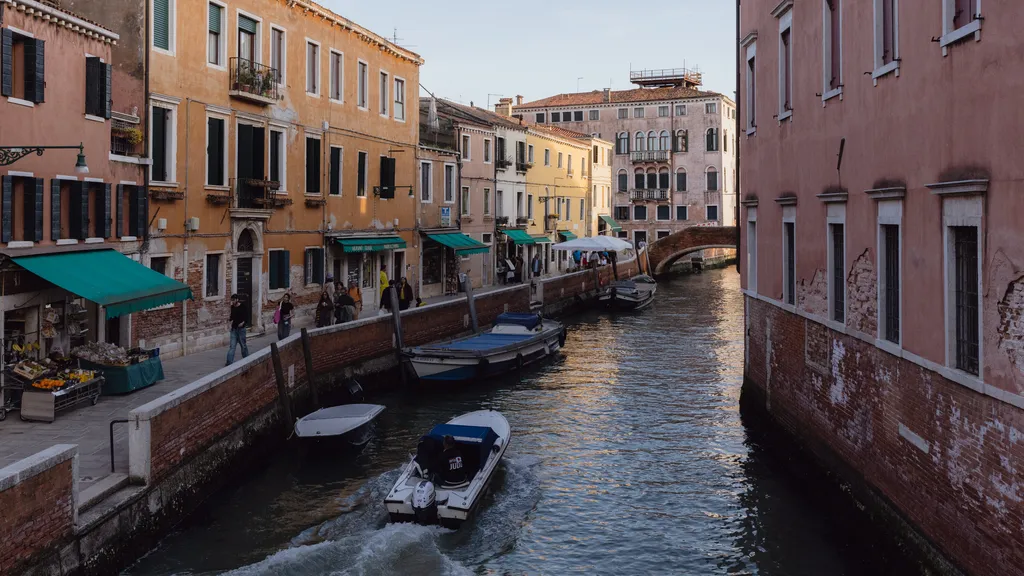
Relaxing in an atmospheric bar, contemplating the scene in front of you over an early evening aperitivo. What could be a better way to appreciate the qualities of a great European city?
Venice, built on millions of wooden piles in the middle of a lagoon, and dating back 1,800 years, is surely the most distinctive. Today, despite the depredations of rising sea levels, depopulation and overtourism, the island city also manages to retain a highly distinctive bar culture.
This is the capital of the region reputed to have invented the now universally popular cocktail known as the spritz. The city's traditional snack-and-wine bars, the bacari, are as much a part of its sense of place as the pubs in Dublin and the cafes in Paris.
"I always think of it as the most improbable of cities," said Robin Saikia, the idiosyncratic British author of "Drink & Think Venice," a local's guide to some of its must-experience bars, cafes and aperitivi.
Saikia has lived full-time in Venice for more than 20 years, and is the co-founder of a small gallery in the Dorsoduro district of the city specializing in contemporary watercolors and glass. He said he first visited "La Serenissima," as the city is also known, as a schoolboy in the late 1960s and has spent time here almost every year since.
"I've been an adopted Venetian since childhood. I've seen the city change. But it hasn't changed as badly as my Venetian friends would have us believe," Saikia said in an interview, referring to the extensively reported issues caused by millions of tourists visiting the city annually. Nowadays fewer than 50,000 people live in the historic center of Venice, but Saikia's book makes it vividly clear that they know how to live.
In its introduction, Saikia wrote that he hoped the book would encourage travelers to meditate on "the less obvious connections one might make between time and place, past and present."
A photographer and I were in Venice three weeks before the opening of the Biennale to take up that Proustian invocation. With Saikia as our guide, we spent an early evening sampling a handful of the author's favorite bars and signature drinks.
We started in an upscale venue on the Grand Canal, not far from St. Mark's Square, then escaped the crowds by crossing westward over the Accademia Bridge into the side canals of the Dorsoduro district to try some more affordable haunts.
Here are five we visited, in strict crawl order.
Bar Longhi, the Gritti Palace
Address: 2467 Campo Santa Maria del Giglio, 30124 Venice
Drink: Doge Gritti, €31 ($36)
The terrace bar of one of the most opulent historic five-star hotels in Venice. We're sitting on white leather seats overlooking the Grand Canal, watching the gondolas float by, nibbling a better class of black olive, with a lovely view of the famous two domes of Santa Maria della Salute. But why pick a bar where a cocktail costs $36? Aren't we being ripped off?
"It's worth a million dollars, with this location, with this view. It's a memory you'll cherish for the rest of your life," Saikia said. "This memory will bring you back to the city. Just think of all the $40 you've spent elsewhere and felt totally ripped off."
He has a point. The interior of Bar Longhi is palatial, decorated with original 18th-century genre scenes by Pietro Longhi. And this golden-hued drink is decadently delicious.
The Doge Gritti cocktail is a tribute to Andrea Gritti, the colorful and canny leader whose diplomatic skills helped the Venetian Republic avoid further conflicts with the French, Spanish and Turks in the early 16th century. The palazzo we are sitting in was once his home. According to Saikia, this concoction is a proprietary mix of gin, Maraschino cherry liqueur, Carpano Antica Formula vermouth and orange bitters. That subtle balance of sweetness and sourness makes it dangerously more-ish, but perhaps not at these prices.
Onward.
Osteria Al Squero
Address: 943 Sestiere Dorsoduro, 30123 Venice
Drink: Spritz Select, €3.50 ($4)
We cross the Grand Canal into Dorsoduro, the relatively quiet southwestern district that includes the Accademia Gallery and the Peggy Guggenheim Collection.
Squero (or Boatyard) is a traditional back-canal bacaro where no-nonsense drinks are served with Venice's trademark cicchetti (snacks) on paper plates. This popular bar overlooks one of the oldest working gondola repair yards in Venice.
We join the line waiting to order. Saikia suggests a Spritz Select, a quintessentially local variant of the spritz, which is said to have been invented in the Veneto region in the early 19th century during the Austrian occupation. Aperol or Campari is the typical liqueur; usually partnered with Prosecco, ice and soda. This particular version uses Select, a liqueur blended from 30 botanicals that has been made in Venice since the 1920s.
"It's the 'media via,'" Saikia said, explaining his penchant for a spritz with Select. "Aperol is too sweet. Campari is too bitter. At least for my taste."
We fall into conversation with Asher Golden in the line. Golden is a Toronto-based restaurant consultant on an A.I.-researched cicchetti tour of the neighborhood. He, too, is inspired to order a Spritz Select. They come in plastic cups, with a slice of orange and a green olive, and cost €3.50 euros ($4).
"I've never had a Spritz Select before and it's a revelation," Golden said. "It's a grown-up Aperol spritz with character. The olive garnish is unnecessary, but anyone who likes a Negroni would love this lighter option."
Al Chioschetto
Address: 1406 Dorsoduro, 30123 Venice
Drink: Birra Moretti, €3 ($3.50)
The Little Kiosk, as it's named, sits on the Fondamenta Zattare al Ponte Lungo, overlooking the deeper and wider Giudecca Canal that runs along Venice's southern flank. This informal, al fresco bar epitomizes what Henry James called Venice's "waterside life." An easygoing crowd of about 150 people, mostly young, student-like and Italian, are enjoying the spring sunshine and an affordable drink on the edge of the waterway.
Two girls are handing out drinks from a serving hatch. Saikia had hoped to order a bottle of Castello premium lager, which would have allowed him to perorate on the Austro-Hungarian tradition of brewing beer in the Venetian Dolomites. But Al Chioschetto does not have any Castello. We content ourselves with plastic cups of Moretti draft lager, costing €3 each.
Tea Monselesan, a graduate of the nearby Accademia di Belle Arti di Venezia, is out for an early evening drink with friends. She is enlightening on the distinctiveness of Al Chioschetto and of Venice's bar culture.
"From the springtime onward, the Chioschetto is very popular," Monselesan said, speaking with a plastic cup of what she called "white spritz" (Prosecco, ice and a slice of lemon) in her left hand. "It's very chilled. You feel you're on a beach."
"You can't escape drink in Venice," Monselesan said. "In Rome and Milan, you have to plan. Venice is much smaller. You can't help bumping into people, stopping and going to a bar."
"It's a ritual," she added, heading off with her friends to find a free spot on the crowded, stony beach.
Blu Bar
Address: 1634 Dorsoduro, 30123 Venice
Drink: Pallina of Spritz Campari, €2 ($2.40)
Saika’s “local.” A modest bar in a tranquil corner on the Fondamenta San Basegio, on the western side of Dorsoduro. The church of San Sebastiano, filled with paintings and frescos by the 16th-century artist Paolo Veronese, is just across the water.
“Drink & Think Venice" informs us that Luciano, as the genial Chinese proprietor is known to regulars, has presided over this establishment for the last 15 years. “He’s a much-loved member of the community,” Saikia said, adding that this was a bar where locals go: “Working gondoliers. Pensioners.” They pop in for a drink or a snack, or try their luck with one of Blu Bar’s slot machines, according to Saikia.
Saikia suggests drinking a pallina of Spritz Campari. In his book, he characterizes a pallina (marble or little ball) as a “simple, down-in-one pick-me-up,” combining just wine and a liqueur mixer, served in small wine glasses.
Enjoying our pallini outside, standing between San Sebastiano and two burly young Venetians in shorts scoffing slices of reheated pizza off a shared paper plate, we become aware that we have made yet another one of those improbable connections -- or at least juxtapositions' between Venice's past and present.
One of the pizza-eating men has a large tattoo on his leg featuring what appears to be a West Highland terrier. “You’d expect something a bit more ferocious,” Saikia said, knocking off his pallina.
Il Mercante
Address: 2564 Fondamenta Frari, 30125 Venice
Drink: Silk cocktail, €15 ($17.50)
Northward to the San Polo district, with its most famous monument,the enormous medieval basilica of Santa Maria Gloriosa dei Frari, deep in the historic center of Venice.
There are several bars dotted around the campo.Il Mercanteis notthemostcrowded,butitscertainlyservesthemostcreativedrinks.Describingitselfasa“modern-stylecocktailbar”thatuses“innovativeflavors,”IlMercanteoccupiesthepremisesofamuch-loved19th-centurycoffeehouse.Manyfeaturesoftheoriginalinteriorhavebeenpreserved,butthedrinksmenuhashad21st-centurymakeover.
We both order a drink calledtheSilk.Accordingto themenu,itconsistsofseaweeddistillate,greenrooibostea,cherry,cardamom,kaffirlimeleavesandverjus.Saikiaseemstothinksomeseawaterisalsoadded,butthatisnotmentionedontherecipe.
When the cocktails arrive,strips of Japanesedriedseaweedareattachedtotherims oftheglasseswithtinywoodenclothespegs.Wetakeasip.Thereiscertainlysomethingoutlandishlymaritimeaboutthiscocktail’ssweet,spicykick.
Dusk is falling.Aperitivo hourisending.
"No one can say Venice is dying," Saikia said. "I like this bar because it's forward-looking. It's a classic case of modern Venice reinventing itself by going back to its origins," he added referring to how this contemporary cocktail evokes the sights, scents and tastes of Venice centuries ago when the city was key destination for Eastern traders on the Silk Road; and Frari was frequented by worshipers—not tourists.
"It's a mirror of the future," Saikia said.