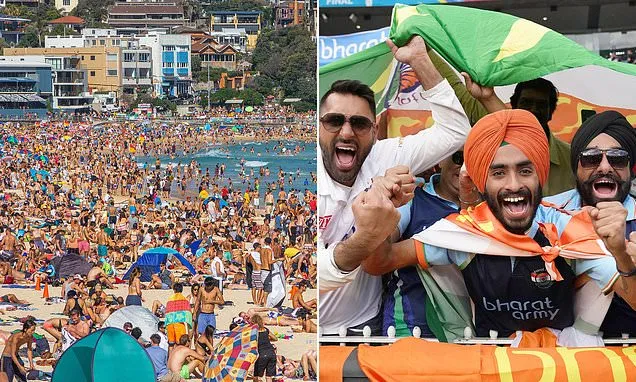
For the first time, English people are no longer Australia's top source of migrants - while nearly a third of the population was born overseas.
New Australian Bureau of Statistics (ABS) data has revealed people born in India now make up the largest number of Australian residents born in a different country.
The statistics also show that 8.83 million people, out of the population of 27.6 million, were born overseas - or 32 per cent.
Of those 8.83 million migrants, nearly a million (971,020) were born in India, slightly more (970,950) than the number born in England.
The last time there were so many overseas-born people living in Australia as a percentage of the population was in 1891, which was due to gold rush-era migration.
Australia's population has been growing steadily since World War II and grew by 3.8 million during the past decade.
English migration to Australia peaked in 2013, with more than a million people migrating. It has been falling slowly since.
Chinese-born people are the third largest group of non-Australian-born residents with 732,000 people, which is its peak.
New Zealand migrants increased from 618,000 in 2024 to 638,000 in 2025 to come in fourth, followed by people from the Philippines (412,539) who rounded out the top five.
The figure from the Philippines has doubled in the past decade while there's an increasing number of Vietnamese, South African, Nepalese, Sri Lankan and Malaysian people making up the migrant numbers.
The ABS figures also found that the average age for Australia's overseas-born population was 43, which is down from 46 in 2005.
The median age of the Australian-born population is 35, up from 33 in 2005.
The new data also showed that Australia is now ranked eighth in the world for the number of migrants in its population.
Australia's 2025-26 permanent migration program allows 185,000 migrants into the country through the 'skilled worker' stream.
In September last year the Albanese government's migration policy was blasted after an Australian National University report revealed that only 12 per cent of placements available in the migration program were being given to skilled workers from overseas.
The report found the majority of visas were going to the family members of skilled workers.
Immigration Minister Tony Burke has said there would be no change to the permanent migration intake this financial year.
Burke also defended immigration despite reports and political commentary which have highlighted allegations that the Labor government has used migration policies to 'buy votes' ahead of elections.
'Modern Australia and multicultural Australia are the same thing,' Burke told reporters on April 15.
'When people say they love Australia -- and I do, and almost everybody on this continent does -- modern Australia is what they're loving, and we are a multicultural nation.'
MacroBusiness chief economist Leith van Onselen said last May that the high concentration of Chinese and Indian voters was likely to keep giving the Labor party a solid, long-term voting bloc, helping it to secure safe seats in Sydney and Melbourne.
'We'll start getting voting blocs form where they might actually form an Indian political party that lobbies for interests that are favourable to Indians, whether it's more parental visas ... they'll create voting blocs and lobby groups that lobby for their interests but not necessarily in the greater interests of Australia,'
Opposition leader Angus Taylor recently said that 'immigration numbers are too high'.
Australia's population is projected to reach 31.5 million by 2035.