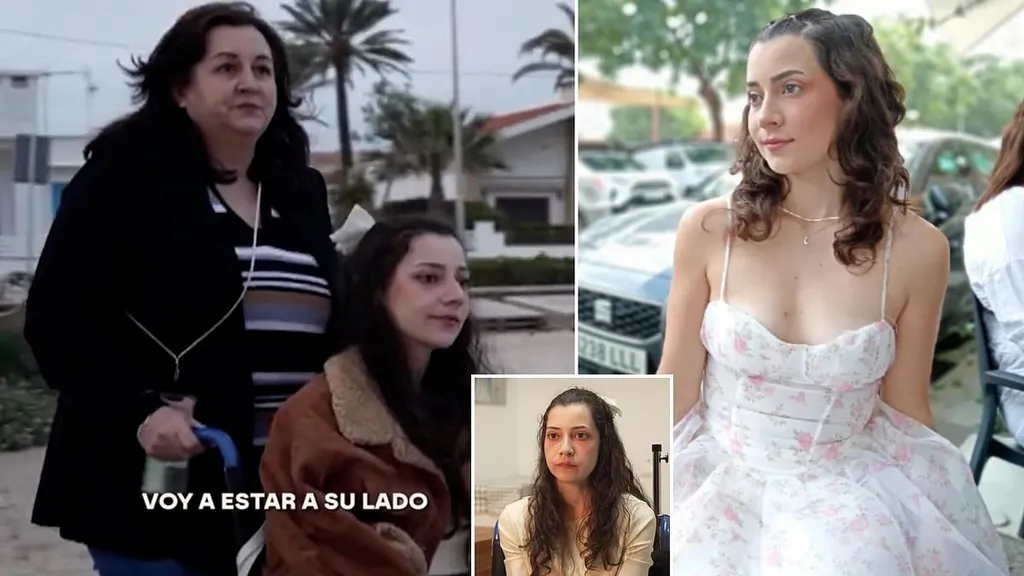
In the end, Noelia Castillo donned her prettiest dress, wore her makeup exactly how she liked it and chose a room with no one in it but a doctor. She wanted to look beautiful when she died.
The pain that had followed her for years, through mental health issues, sexual violence and a paraplegic body, would be over in minutes.
On Thursday evening, in a Barcelona hospital, the 25-year-old was given three drugs intravenously and, within 20 minutes, her heart stopped.
'I want to go now and stop suffering, period. None of my family is in favor of euthanasia. But what about the pain I've suffered during all these years?' she said in her final interview.
'I've told them how I want it to be. I want to die looking beautiful. I've always thought I want to die looking good. I'll wear my prettiest dress and put on makeup; it will be something simple.'
Noelia's death, carried out under Spain's euthanasia law, followed a bitter legal battle that reached the country's highest courts and drew international attention.
But long before courtrooms and appeals, there was a childhood and adolescence shaped by trauma.
In the interview, she recalled warm childhood summers spent at her grandmother's house, where she fondly remembered going to fairs and having dinner outdoors.
By her early twenties, Noelia had attempted to take her own life more than once, through drug overdoses and self-harm.
'It was a very happy time,' she said.
However, this joy quickly faded when her parents divorced and lost their home after facing financial struggles.
She described the joint custody agreement as 'unstable,' recalling how she and her sister would 'wait until three or four in the morning' at bars while their father drank.
'After that, it was all bumps in the road, darkness, emptiness ,' she stated.
Noelia subsequently entered the care system after her parents lost custody due to addiction, mental health struggles and homelessness.
She and her sister were placed under the guardianship of the Catalan government, moving through juvenile detention centres from the age of 13.
By her early twenties, she had attempted to take her own life more than once, through drug overdoses and self-harm.
'I had two suicide attempts with pills,' she recounted in the interview.
'Then my mother put me in a psychiatric ward. In the first one I self harmed. Then I drank a bottle of toxic cleaning solution. They had to wash out my stomach.
'In the second psychiatric ward I self harmed two or three times and I tried to kill myself twice,' she said.
The young woman was diagnosed with borderline personality disorder and obsessive-compulsive disorder with paranoia and suicidal thoughts.
During that time, she was also sexually assaulted by a partner of four years after taking sleeping pills and by two other men at an entertainment venue.
And in October 2022, aged 21, Noelia was gang raped by three men in a nightclub, in what she said was a turning point.
Days later, on October 4, after using cocaine, she climbed to the fifth floor of a building and jumped.
She survived, but the fall left her with a severe spinal cord injury, leaving her paralysed from the waist down.
She lived with constant neuropathic pain and incontinence, confined to a wheelchair and requiring catheters every six hours. Noelia was given a 74% disability rating.
'I don't feel like doing anything: not going out, not eating. Sleeping is very difficult for me, and I have back and leg pain,' she said in the interview with Antena 3 days before her death.
'My father saw me fall and couldn't do anything,' she later said referring to her suicide attempt. 'But after everything he's done, I don't feel sorry for him anymore.'
By April 2024, after a year and a half of living partly paralysed, she formally requested euthanasia through Catalonia's Guarantee and Evaluation Commission.
Three months later, in July, her request was approved, but what followed was a legal fight that would stretch on for more than a year and a half.
Her father, Geronimo Castillo, supported by the ultraconservative Catholic group Christian Lawyers, sought to block the procedure.
He argued that her mental health affected her ability to make a free and conscious decision and said there were indications she had changed her mind.
The father further claimed her condition didn't meet the criteria for 'unbearable physical or psychological suffering'.
In a desperate bid to keep her alive, it was revealed he had even recorded videos of her walking to prove her capability.
Videos released by Spanish outlet OK Diario on Thursday showed Noelia's father filming his daughter learning to walk again after her paralysis.
'When you've been walking all day, you get exhausted,' Noelia says in the footage as she uses a walker to slowly move across a room.
Noelia's father is heard encouraging her as she climbs up and down a flight of stairs with the help of crutches.
Noelia was due to die in August 2025, but courts initially suspended the euthanasia after her father's efforts. Appeals followed, moving up through the Spanish legal system.
In March 2025, a judge ruled that her father was not authorised to decide for her and, in September, the High Court of Justice of Catalonia upheld that ruling.
Castillo had argued that his daughter suffers from a personality disorder which affects her judgement, pointing to 'the obligation of the state to protect the lives of people, especially the most vulnerable, as is the case with a young person with mental health problems'.
'I want to finish with dignity once and for all,' Noelia told the court at the time.
She claimed to have been 'coerced' by religious groups and said people had filled a room in the care centre where she was living with 'small pictures, crosses and religious symbols'.
In January 2026, the Supreme Court refused to admit a further appeal, effectively backing her right to proceed.
However, another appeal was launched by lawyers in February, citing 'the violation of the right to effective legal oversight' and the right to life, but the Constitutional Court said there was a 'clear absence of any violation of a fundamental right'.
Days later, the case was taken to the European Court of Human Rights, but on March 24, the Strasbourg court rejected the request to halt the procedure, clearing the last legal obstacle.
Noelia, who had followed every step of the battle, made one last appearance on Spanish television.
'I've finally done it. Let's see if I can finally rest because I can't take this family anymore, the pain, everything that torments me from what I've been through,' she said.
Her relationship with her father had deteriorated during the fight. 'He hasn't respected my decision and he never will,'
she said.
'He wanted to put the house he bought in my name so he could continue collecting child support.
'After this, he doesn't want to put the house in my name, or pay for the funeral, or attend the euthanasia, or the burial, and he says he doesn’t want to know anything about me. That in his eyes, I’m already dead.'
Appearing with her in the interview, Noelia's mother, Yolanda, hit out at the lawmakers dictating her daughter's fate.
'I’ve been praying and thinking maybe she will change her mind at the last minute... but if she doesn’t want to live, what can I do?' she said.
'And it isn’t like I have a magic wand to stop this because at the end of the day some judge made a decision on the life of my child.'
'These decisions are being made by people who did not even birth her.'
However, she said she would 'always be' by her daughter's side although she doesn't agree with her decision.
Spain's euthanasia law introduced in 2021 allows adults of sound mind suffering from a 'serious and incurable illness' or a 'chronic and disabling' condition to request assistance to die subject to strict safeguards.
The costs are covered by the public healthcare system.
According to government data 426 requests for assisted dying were granted in 2024—the most recent year available.
By the time the final ruling came every legal avenue to stop Noelia had been exhausted.
In the interview Noelia said she's 'always felt alone' and 'never felt understood or empathised with'
'Before requesting euthanasia my life was dark. My end was dark. I had no goals or objectives,'she added.
Teary eyed protesters gathered on Thursday outside the Sant Pere de Ribes assisted living facility where Noelia would be euthanised.
One heartbreaking moment shows Noelia's best friend being denied the chance to see her one last time.
In an emotional interview with OK Diario, her friend Carla Gutierrez said: 'I wanted to see her [Noelia] to see if she changes her mind, or at least to say goodbye.'
Jose Maria Fernandez acting for Christian Lawyers said at the doors of the hospital: 'The legal system has failed. The euthanasia legislation is being applied as an applied suicide law.'
'The procedural system has failed and there's been a failure in this country's health system.'
'This is a young girl who has had a lot of problems and obviously a very difficult life and we all regret this. But the only thing the health system has been able to provide her with has been death.'
'We think Noelia should have received treatment a long time ago for her mental health problems.'
He added: 'We hope this case will serve at the very least to prevent it from happening again so there are no more Noelia's.'
Meanwhile politicians in parliament lambasted the decision branding it an 'execution'.
'A law designed to alleviate suffering terminally ill elderly people final stages lives now going used execute 25-year-old girl,'s
sd
sd
sd
sd
sd
sd
sd
sd
sd
sd
sd
sd
sd
sd
sd
sd
sd
sd
sd
sd
sd
sd
sd
sd
sd
sd
sd
sd
sd
sd
sd
sd
sd
s