Forbes contributors publish independent expert analyses and insights.
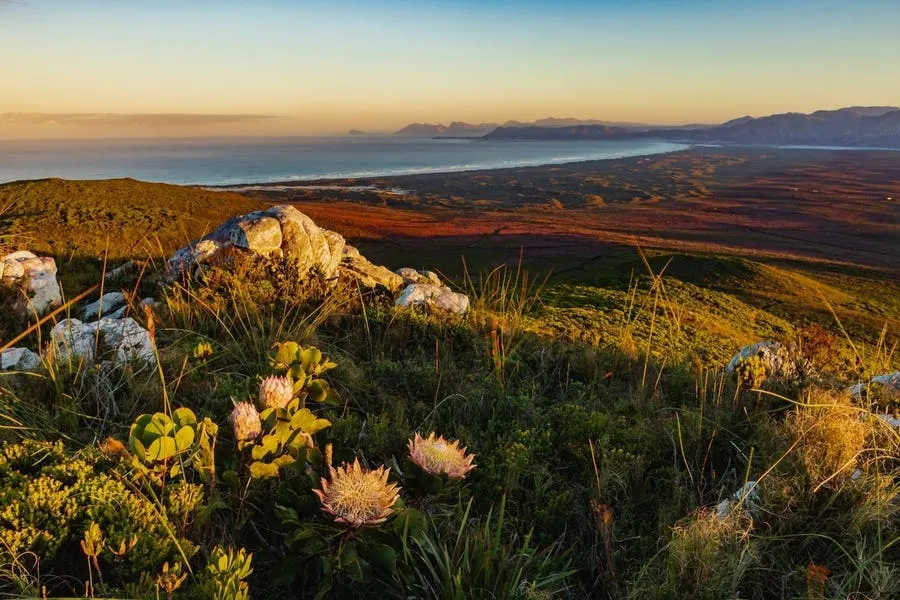
At the southern tip of Africa, near where the Atlantic and Indian Oceans meet, beyond the wine routes and safari circuits, there's a landscape that has reshaped scientists' thoughts on biodiversity. Low, wind-shaped shrubs ripple across limestone hills. Wildflowers bloom, not despite fire, but because of it. Soils are nutrient deficient, and yet produce a botanical diversity that rivals that of entire continents. This is fynbos, the defining vegetation of the Cape Floristic Region.
Covering 19 million acres and given World Heritage status in 2004, the Cape Floristic Region, or Cape Floral Kingdom, is located entirely within the borders of South Africa. This is the smallest of the world's six floral kingdoms; yet it contains nearly 9,000 plant species, 70% of which occur nowhere else. This is one of the world's great centers of terrestrial biodiversity, representing less than 0.5% of the area of Africa, but home to nearly 20% of the continent's flora. On the 8,650 acre Grootbos Private Nature Reserve, an award-winning, luxury eco-reserve, this vegetation is protected, preserved, studied, celebrated, and quietly positioned as a model for how conservation and high‑end tourism can be mutually beneficial.
Grootbos, Afrikaans for "large forest", sits at the ecological crossroads of rolling hills, undulating valleys, pockets of Afromontane forest, and stretches of rugged coastline. While the name Grootbos comes from the ancient, indigenous, endangered Milkwood forests found on the reserve, the real star of the show is the fynbos, a low‑growing, fire‑adapted vegetation that has evolved, over tens of millions of years, into one of the most botanically complex ecosystems on the planet.
What Makes Fynbos Extraordinary
While elsewhere, landscapes were being reshaped by glaciers during the Ice Age, the southern tip of Africa remained ice-free, allowing the fynbos to evolve uninterrupted. South African fynbos is thought to be between 2 and 4 million years old, though some of its plant families, such as the proteas, date back tens of millions of years, as far back as the dinosaurs.
Fynbos, Dutch for "fine bush", is not a single plant type, but rather a wide range of plant species, dominated by four major families: Proteaceae, Ericaceae (heaths), Restionaceae (reed‑like plants), and Geophytes. All of these plants have evolved and adapted to survive with minimal nutrients, regular drought, and periodic fires; forming an ecosystem of small, hardy plants adapted to poor soils and tough conditions.
Fire, often viewed as a destructive force, is central to fynbos survival. Many fynbos species require heat or smoke to trigger seed germination. Some proteas, for example, are known to store seeds in woody cones that only open after a burn, ensuring that seedlings emerge into nutrient‑rich ash and reduced competition.
Proteas: Flagships of the Fynbos
No plant better symbolizes fynbos than the protea. Named after the shape‑shifting Greek god Proteus, the protea family includes nearly 120 species, the majority of which are found in Southern Africa. Grootbos is home to several species of protea, including the King Protea (Protea cynaroides), South Africa's national flower, whose massive bloom is not in fact a single bloom, but instead a composite structure containing hundreds of tiny flowers.
Proteas are evolutionary opportunists, with thick, leathery leaves to reduce water loss and fire‑resistant traits that allow rapid post‑burn recovery; yet many species remain threatened. Grootbos serves as a genetic reservoir for proteas and numerous other plants, helping safeguard species.
Heaths, Reeds and Underground Survivors
While the flashy proteas tend to demand your attention, the most plentiful plants in the fynbos are actually the Ericaceae, delicate ground‑hugging plants with flowers shaped like miniature urns, bells or tubes. Then there are the Restionaceae, dense, reed‑like plants that are highly efficient in these often harsh and dry climates. Lastly are the Geophytes, like the irises, lilies and orchids, that erupt in sudden, spectacular but short-lived displays after fire or seasonal rain.
Despite its evolutionary sophistication, fynbos is facing one of the most rapid rates of extinction in the world due to habitat loss, land degradation, invasive alien plants and climate change; this is where Grootbos Private Nature Reserve comes into its own.
Conservation And Community
Grootbos Private Nature Reserve is a leader in sustainable tourism. Unlike many places that retrofit sustainability onto luxury, Grootbos was built around conservation from its inception. Thousands of acres of land are formally protected here; the reserve has documented multiple species previously unknown to science proving that botanical discovery is not a closed chapter but rather an ongoing process.
Key conservation measures include the removal of alien and invasive plant species; vegetation restoration; fire management. Ongoing wildlife monitoring; botanical research; entomology projects all provide crucial data used to inform conservation decisions; a biodiversity plan aims to connect isolated pockets of protected land. As Grootbos Nature Reserve Director Michael Lutzeyer explains: "We are working on a green corridor initiative which would link Grootbos with other committed properties to form a 'green corridor' totaling over 136000 acres. This initiative stands to benefit the whole region and various tourist destinations along this corridor".
The Florilegium
One of the highlights of Grootbos's conservation ethos is the purpose-built Florilegium, an ambitious gallery documenting the reserve's extraordinary plant diversity through detailed botanical illustrations. Modeled on historic European florilegia, botanical artists from around the world were commissioned to paint local fynbos species in precise detail, often working alongside botanists to ensure taxonomic accuracy.
In an age of digital photography, the 250 unique botanical artworks in the gallery underscore the enduring scientific value of illustration: allowing the depiction of multiple life stages, diagnostic features and a record of plant pollinators to coexist all in a single artwork. Each illustration represents hours and hours of field observation, studio work and peer review; creating a permanent record of species that may one day face extinction in the wild. The Florilegium which took four years to complete serves both as a scientific record and as an educational resource - a celebration of science and beauty.
Grootbos: The Lodges
Accommodation at Grootbos is spread across Garden Lodge, Forest Lodge, and two private villas. All sitting quietly amongst the trees, with large windows and decks to frame the views; the rooms are generously proportioned; with an emphasis on space; quiet; connection to nature.
Guided botanical walks in the reserve focus on the extraordinary plant diversity of the Cape Floral Kingdom. Longer hikes; horse rides; 4x4 botanical drives traverse forest; open fynbos; rugged ridgelines offering insight into ecology; geology; land management. Birdwatching rewards with brilliant flashes of color; while a coastal safari blends land and sea; pairing stunning shorelines with the opportunity to encounter whales and other marine life just offshore.
The Cape Floristic Region may be small on a map; but its importance is global. At Grootbos; this ancient floral kingdom is not frozen behind glass. It is alive; flowering; burning; regenerating; and quietly reminding us that the future may depend on how well we understand what's right beneath our feet.